 Strategic Resource Intelligence
Advertising Disclosure: Americas Gold and Silver is an advertising client of SilverWars. SilverWars LLC has received total cash compensation of US$[30,000] from Americas Gold and Silver under an advertising, sponsored content, and distribution agreement covering [January 2026 – December 2026] that includes this post. This post was prepared by SilverWars using public market sources, Americas Gold and Silver public disclosure, and SilverWars’ own market analysis. It is for informational and educational purposes only. It is not investment advice, not a recommendation to buy or sell any security, and not an offer or solicitation.
A new weapons program is also a materials program. Before a prototype can become fielded hardware, its electronics, electrical connections and ammunition components have to be built from materials that meet the selected construction and qualification requirements.
On September 29, General Dynamics Mission Systems announced its selection to develop and demonstrate the Army’s Versatile Networked Obstacle Munitions system, or VNOM. GDMS is one of three selected contractors. It says it funded development through a demonstrated prototype before the award. The effort will evaluate the system for possible further development, production and fielding. [1]
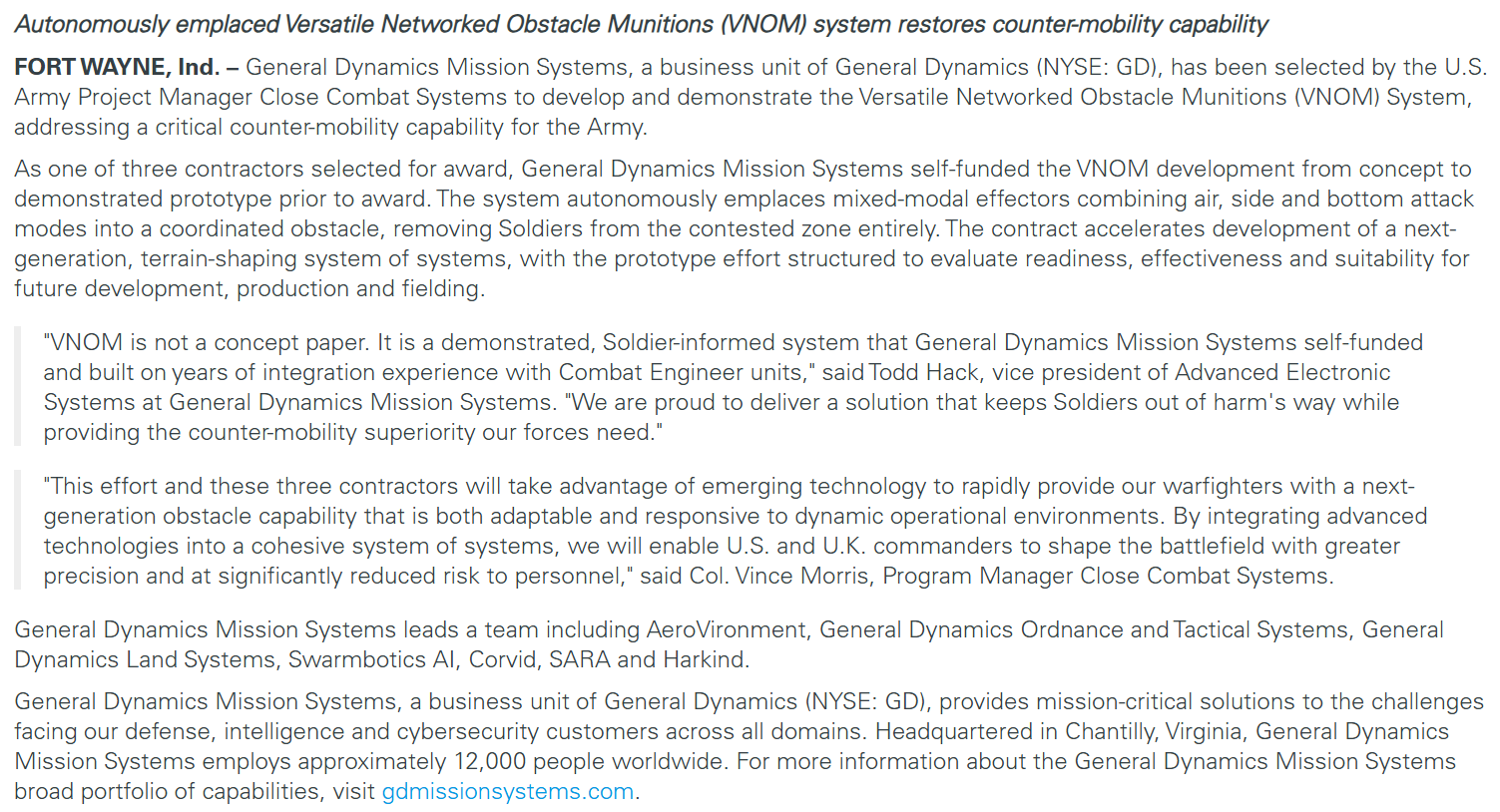
The company describes autonomous emplacement of effectors combining air, side and bottom attack modes into a coordinated obstacle. Its team includes AeroVironment, General Dynamics Ordnance and Tactical Systems, General Dynamics Land Systems, Swarmbotics AI, Corvid, SARA and Harkind. [1]
For SilverWars, those functions make component construction and mineral supply central to the investigation. VNOM’s component-level bill of materials is not public. The records below establish actual material constructions across military specifications and the defense supply base.
Start with the contractor’s silver requirements
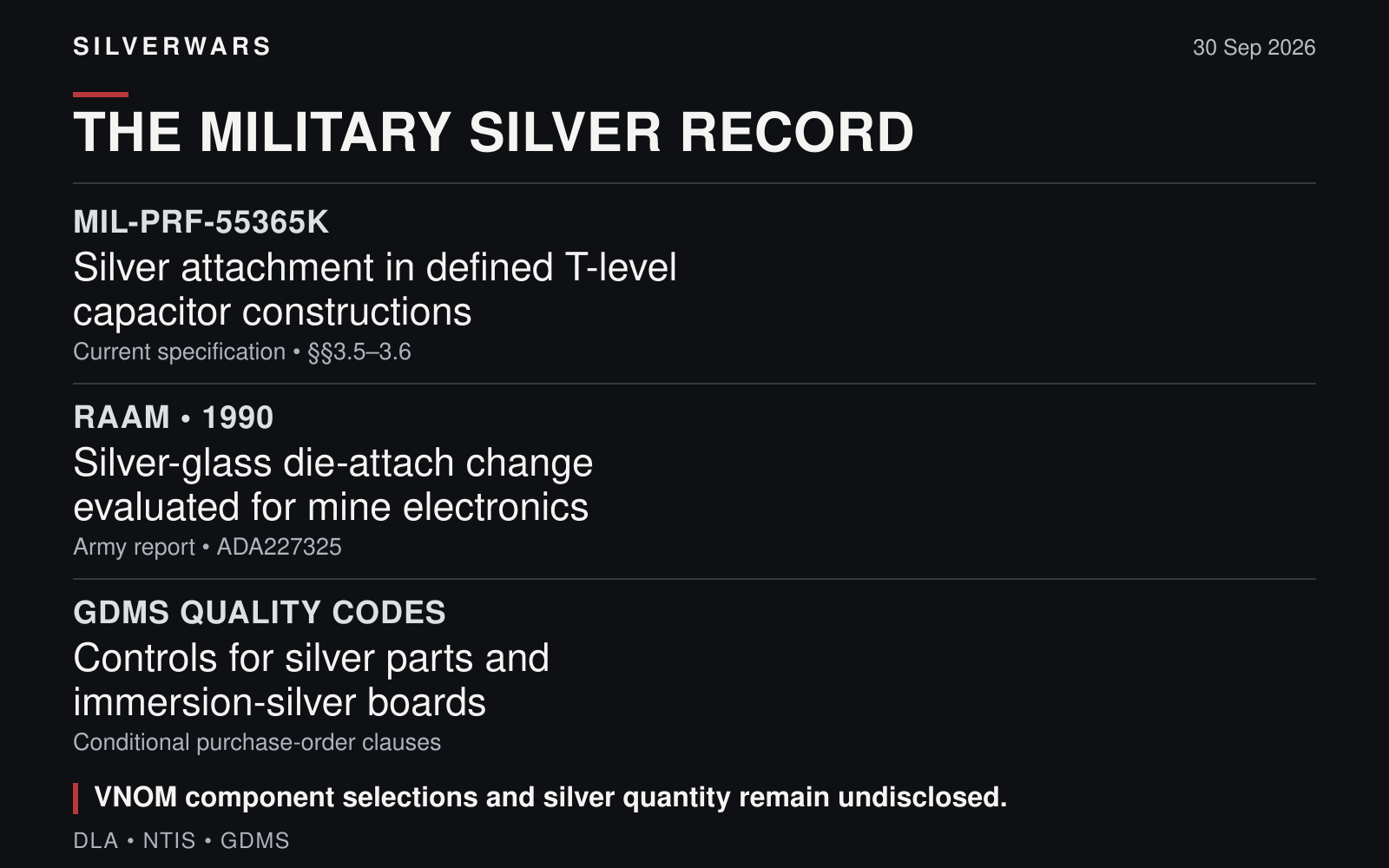
GDMS publishes supplier controls that expressly cover silver-bearing hardware. QA080 governs the packaging of silver and silver-plated parts, including protection against tarnishing. QA164 and QA165 address protection of printed boards with an immersion-silver surface finish. When invoked on a purchase order, these clauses become requirements for the supplied parts and boards. [2]
That is a direct connection to the contractor’s procurement system. Silver appears as a material requiring specific handling in finished components and board surfaces. Following these material categories takes the investigation into the hardware that suppliers actually deliver.
Silver and tantalum meet inside the capacitor
MIL-PRF-55365K provides a more exact construction record. The specification governs tantalum chip capacitors, with a T-level category intended for high-reliability applications including space and missiles. [3]
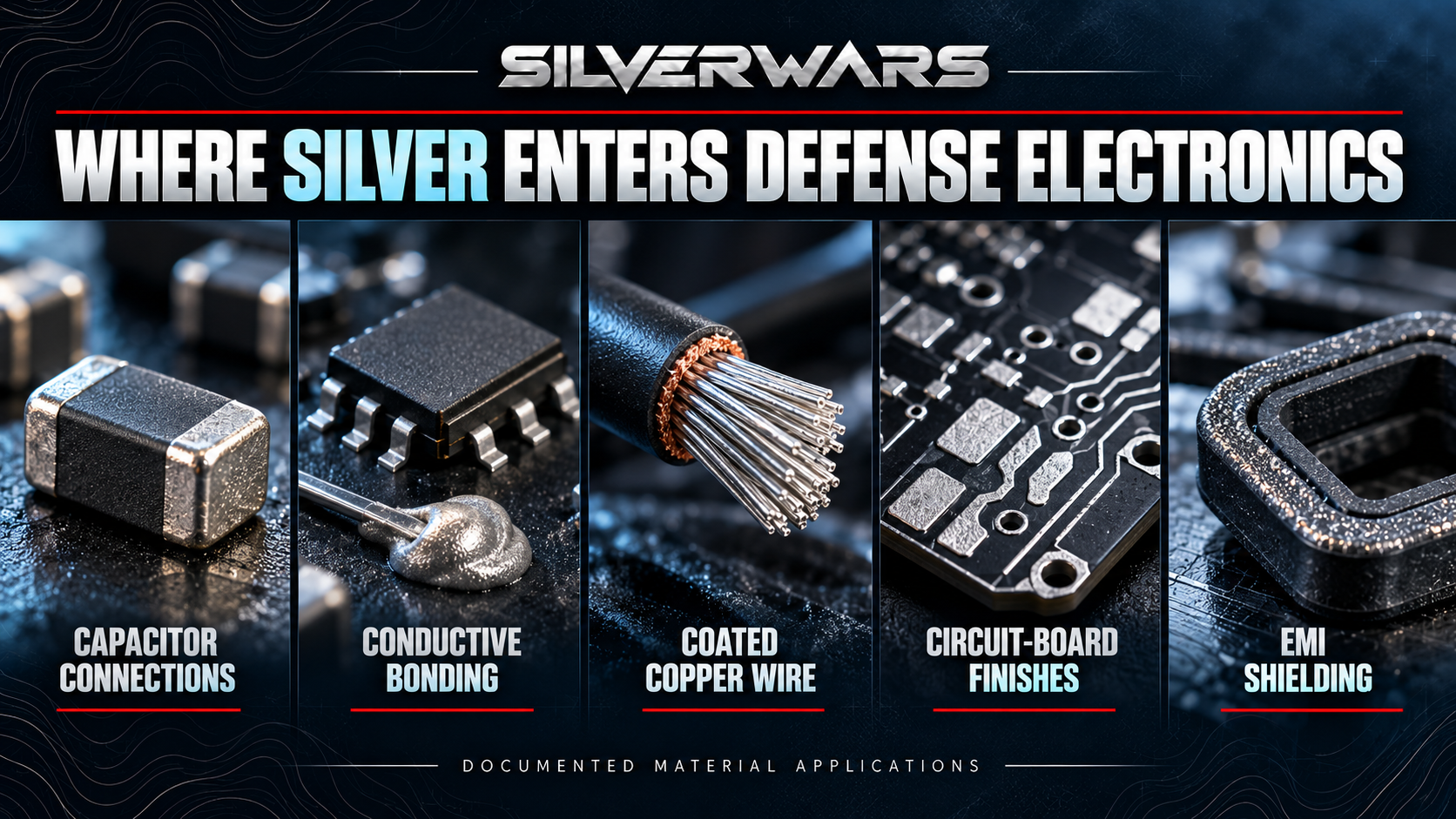
For the specified T-level constructions, sections 3.5 and 3.6 require a silver-epoxy attachment joining the cathode connection to a silver-coated tantalum element. Radiographic inspection and destructive physical analysis examine that attachment. Silver occupies an internal electrical connection in a component whose underlying element is tantalum. [3]
This is why counting only the bulk metal in a weapon can miss an important part of its materials requirement. A small attachment can occupy a critical position in an approved component. Our analysis is that changing a specified attachment material can become a component qualification issue, even when the quantity of metal is small.
Conductive bonding, wire and shielding
Silver also appears in commercially documented electronic assembly materials. Meridian’s EPO-TEK H20E is a silver-filled conductive epoxy used for semiconductor attachment and hybrid microelectronics. Its manufacturer lists electrical connection, thermal transfer, and aerospace and defense among its functions and markets. The material provides a documented route for silver into electronic packages. [4]
Wire provides a second construction route and brings copper into the picture. DLA’s active record for the DoD-adopted SAE-AS22759/9 standard identifies fluoropolymer-insulated electrical wire with silver-coated copper conductors. The silver coating and copper conductor are defined together in the wire construction. [5]
Shielding provides a third. Parker’s CHO-SEAL 1285 connector gasket uses silver-plated aluminum filler in silicone. The manufacturer documents its electromagnetic-interference shielding and grounding functions and describes it as a military-grade gasket. Here, silver, aluminum and a polymer form a functional part around an electronic connection. [6]
These are concrete material forms: an adhesive inside a package, a coating on a conductor, and plated filler in a gasket. They give us specific components and suppliers to follow as new military hardware moves toward production.
The Army mine-electronics precedent
The Army’s 1990 RAAM Integrated Circuit Source Change Analysis examined silver-glass die attachment in integrated circuits for the M718/M741 Remote Antiarmor Mine. Die attachment secures the semiconductor chip inside its package. The official National Technical Reports Library record, ADA227325, identifies the proposed component change and the government test analysis. It places a specific silver-bearing construction under Army evaluation for a named munition. [7]
That historical record complements the current specifications and manufacturer documentation. The material trail runs through the packaged electronics that make the larger system work.
The metals behind the component
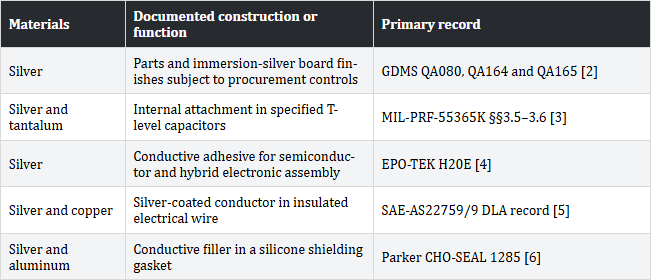
The useful materials map begins with these constructions. It connects each metal to a component and a function, rather than treating every mineral associated with defense as an equal candidate.
Antimony connects ammunition to contracted supply
Antimony adds a different construction and procurement record. The Army identifies antimony sulfide as an ingredient in ammunition primers and is supporting domestic processing of that material. The required chemical form matters: antimony metal ingots and antimony sulfide serve different supply requirements. [8, 9]
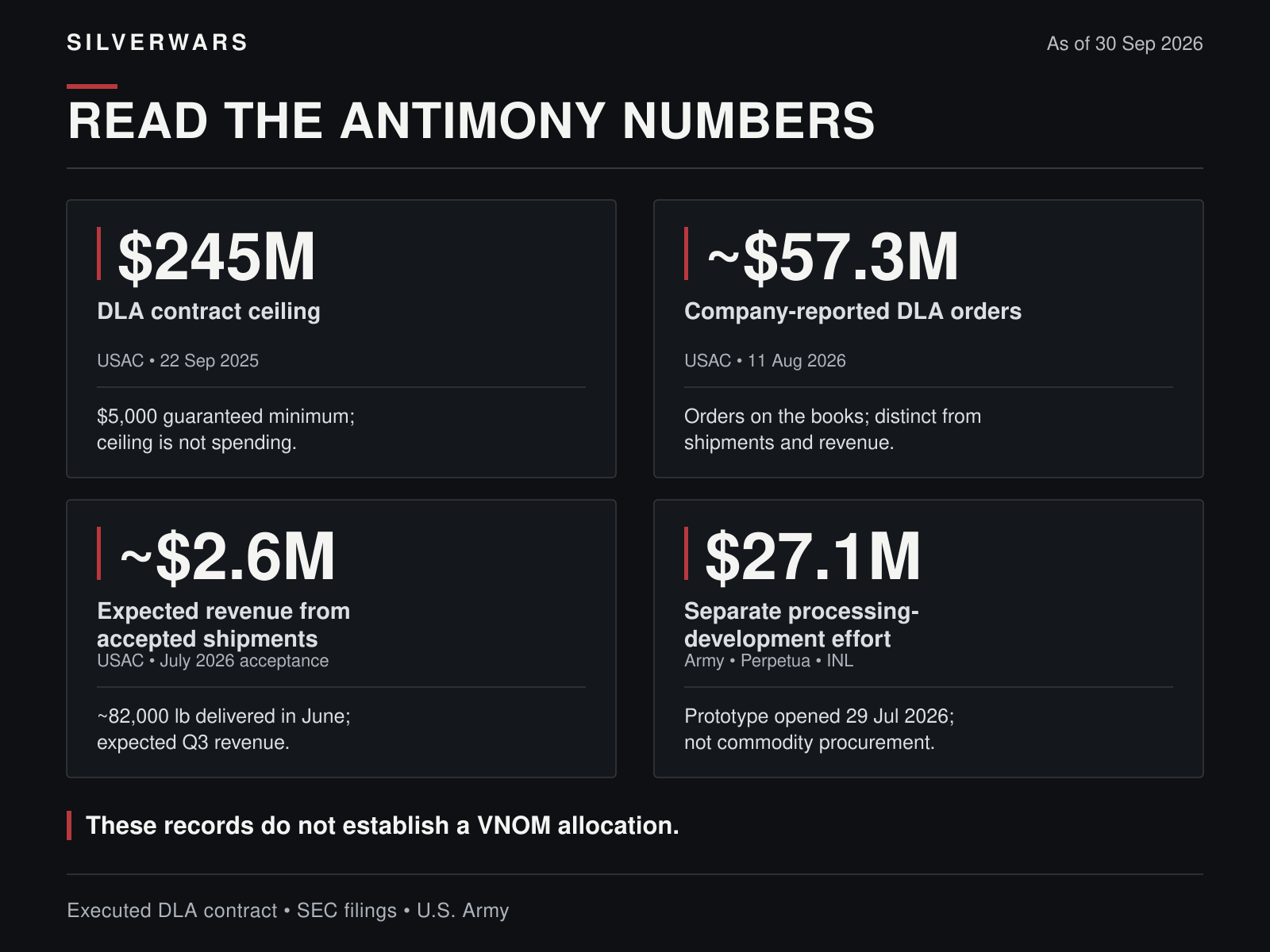
DLA’s executed September 22, 2025 agreement with United States Antimony covers antimony metal ingots for the National Defense Stockpile. The five-year contract has a $245 million ceiling and a $5,000 guaranteed minimum. The ceiling sets the available contract capacity; purchases occur through orders. [9]
On August 11, 2026, US Antimony reported approximately $57.3 million in DLA orders on its books. It also reported roughly 82,000 pounds delivered in June and accepted in July, associated with approximately $2.6 million in expected third-quarter revenue. Those disclosures show orders progressing into accepted material deliveries. [10]
The processing side is visible too. The Army, Perpetua Resources and Idaho National Laboratory opened a prototype antimony-sulfide processing facility on July 29, 2026. The Army’s account and Perpetua’s quarterly filing place it within a $27.1 million process-development effort. That investment supports the ability to produce the material form needed for ammunition applications. [8, 11]
Galena connects a silver mine to antimony processing
Americas Gold and Silver and United States Antimony announced a definitive joint venture on February 10, 2026, to build an antimony-processing facility at Idaho’s Galena Complex. Americas holds 51 percent and US Antimony 49 percent. The planned feed is antimony-bearing silver concentrate from Galena. [12]
This is a concrete connection between a silver mining operation and a planned processing route for another defense-relevant metal. The announcement contemplated US Antimony purchasing production under supply agreements to be completed. US Antimony’s subsequent filing reported no significant operational activity at the venture as of June 30. Those dated disclosures describe a project moving through development, rather than an operating source of deliveries. [12, 13]
The commercial significance is the route from a mine’s output to a usable material form. A silver operation can contribute to a wider metals supply chain when its concentrates contain recoverable antimony and the processing and delivery arrangements can be established.
Follow the hardware into the supply chain
We raised this mineral-supply question in our earlier Anduril coverage. VNOM brings it back to the construction of the hardware itself: qualified capacitor attachments, conductive adhesives, coated wire, board finishes and shielding materials, alongside ammunition ingredients and their processing routes. [14]
 SilverWars
The antimony agreements and Galena venture are broader supply-chain records; they do not establish a VNOM allocation. Measuring VNOM’s silver demand will require selected parts and production quantities.
The case for following silver is already concrete. Military specifications and supplier records place it in defined electronic constructions. Copper, tantalum and aluminum appear alongside it in those same constructions. Antimony shows how an ammunition material can drive stockpile orders and processing investment. A defense buildout therefore has to be examined through approved components, usable material forms and agreements that deliver them.


Sources and document locations
[1] GDMS VNOM announcement, September 29, 2026
Full company release reproduced by ASDNews and attributed to GDMS. Development and demonstration selection; subsequent production conditional.
[2] GDMS supplier Quality Codes, updated April 15, 2026
QA080, QA164 and QA165; conditional purchase-order requirements.
[3] MIL-PRF-55365K, November 11, 2024
Scope section 1.1; T-level silver attachment sections 3.5–3.6, printed pages 5–6. The 25 percent attachment criterion is not silver weight percentage.
[4] Meridian EPO-TEK H20E conductive epoxy product documentation
Silver-filled adhesive; semiconductor attachment and hybrid microelectronics; electrical connection and thermal-transfer functions; aerospace and defense market. Manufacturer application evidence.
[5] DLA ASSIST record for DoD-adopted SAE-AS22759/9 electrical wire
Active record identifies fluoropolymer insulation and silver-coated copper conductor construction; adopted December 8, 2004.
[6] Parker Chomerics CHO-SEAL 1285 connector-gasket case study
Silver-plated aluminum filler in silicone; EMI shielding and grounding; manufacturer describes the gasket as military grade.
[7] NTIS ADA227325, RAAM Integrated Circuit Source Change Analysis, 1990
Army report by John Printz; official catalog describes evaluation of a proposed silver-glass die-attach construction in M718/M741 RAAM integrated circuits.
[8] Army, Perpetua and INL domestic antimony-sulfide processing facility, August 6, 2026
Facility opened July 29; prototype and demonstrations; $27.1 million process-development effort.
[9] Executed DLA–USAC contract SP8000-25-D-0007, September 22, 2025
SEC Exhibit 10.1; contract pages 1 and 3 and statement of work. $245 million ceiling, $5,000 minimum; National Defense Stockpile ingots.
[10] US Antimony second-quarter results release, August 11, 2026
SEC-hosted company disclosure; management commentary and delivery highlights. Company-reported orders and accepted shipments are separate figures.
[11] Perpetua Resources second-quarter 2026 Form 10-Q
Note 8; estimated $27.1 million process-development agreement, distinct from material procurement.
[12] Americas Gold and Silver–USAC definitive Galena JV announcement, February 10, 2026
51/49 ownership, silver-concentrate feed and proposed purchases subject to supply agreements.
[13] US Antimony second-quarter 2026 Form 10-Q
Note 13; Galena JV had not commenced significant operational activities as of June 30, 2026.
[14] SilverWars Anduril critical-minerals supply-chain coverage
Internal related coverage; not a primary source for VNOM or procurement claims.