 Strategic Resource Intelligence
A meridian is a line of longitude. The word can also mean a peak or a point of culmination. Meridian Air Charter was also the name of the Forester family’s charter business (for those in the know). MITRE's public announcement gives no explanation for the project's name. But a study intended to set the direction of American warfare needs a clear reference point: the public interest.
For military space systems, that means examining what gets built, who benefits, and what must be replaced to keep the capability working. Industry knowledge belongs in that examination. So do competing designs and independent scientific judgment.
SilverWars' ENNEAD concept puts renewal on the table: investigate whether useful spacecraft can be serviced and upgraded instead of routinely replaced. JASON offers a relevant precedent for independent examination of military space infrastructure. Before committing to another cycle of manufacture, launch and disposal, Meridian should ask a basic question: why replace what could remain useful?
Independence begins before a contract is awarded
MITRE announced Meridian on October 2, naming Elon Musk, Palmer Luckey and Newt Gingrich as co-directors. The study will examine future warfare technologies and operational concepts. According to the commissioning office, MITRE's National Security Engineering Center manages the project, and MITRE will author an unclassified report of no more than 30 pages, with classified annexes, after 120 days.
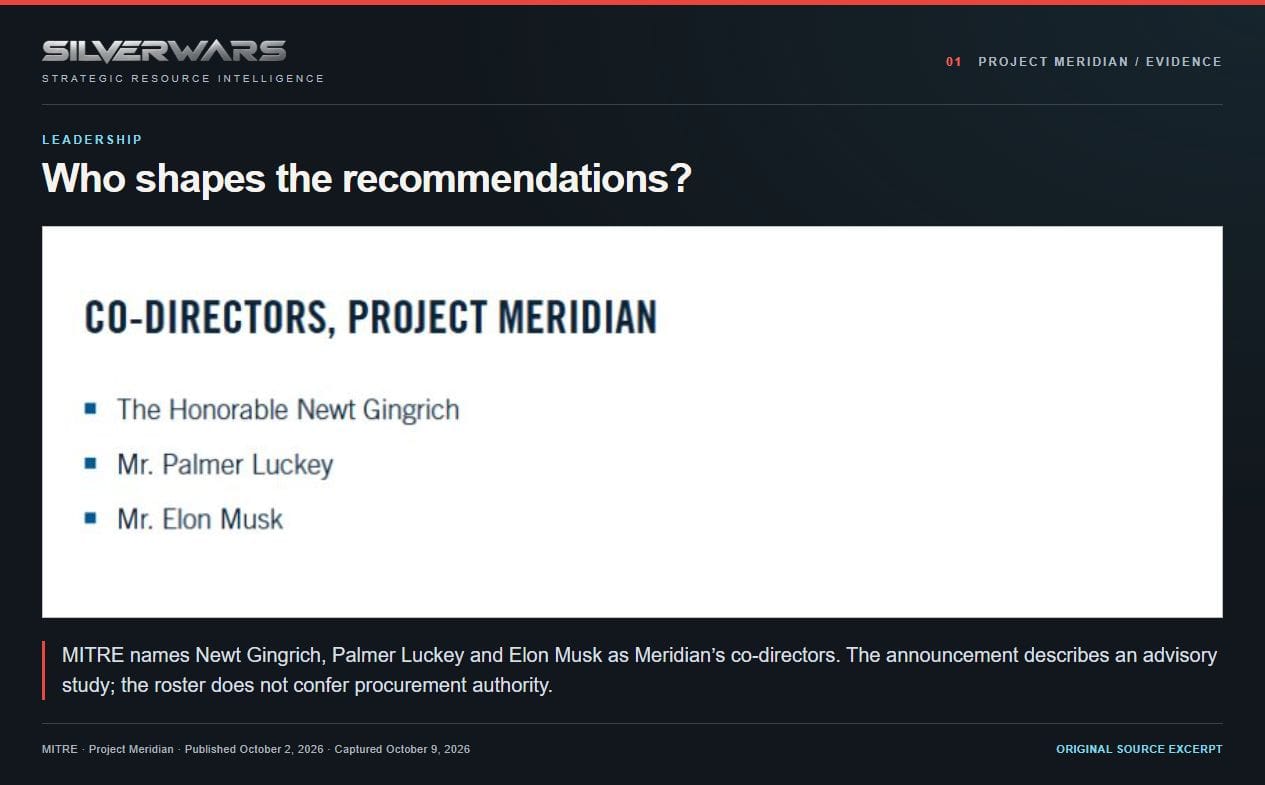
This is an advisory study. Its participants have an opportunity to influence capability priorities; the announcement does not give them procurement authority. That distinction matters, but decisions about assumptions, alternatives and acceptable costs can favor a business model long before a bid is written.
SpaceX markets Starshield for government observation, secure communications and hosted payloads. Its quarterly SEC report, filed August 4, records its February 2 acquisition of xAI. In July 2025, the Pentagon announced advanced AI awards to four companies, including xAI, each with a $200 million ceiling. A ceiling is potential capacity, not money already spent. Musk’s commercial interests overlap with orbital infrastructure and military AI.
The same scrutiny applies to Luckey. Anduril’s Army enterprise contract carries a maximum potential value of $20 billion, explicitly not an obligated amount. The Army also says the vehicle will not substitute for competition on future programs. Existing government business establishes interests worth examining, not evidence that Meridian produced those awards.
Safeguards have been described. Inside Defense reported on October 5 that participants are MITRE consultants subject to contractual conflict-of-interest and nondisclosure requirements, while MITRE retains responsibility for analysis and recommendations. The test is how those arrangements protect judgment in practice. Publish relevant interests, permitted participation, recusals and enforcement arrangements to the extent lawful. Preserve useful expertise while making it possible to challenge its conclusions.
The distinction should remain visible after the study ends. A recommendation can become a requirement, a budget request and eventually an acquisition decision. At each stage, identify who approved the choice and what evidence was added. That record would show whether a participant’s commercial proposition survived independent review or advanced without meaningful challenge.
Leadership requires judgment and candor
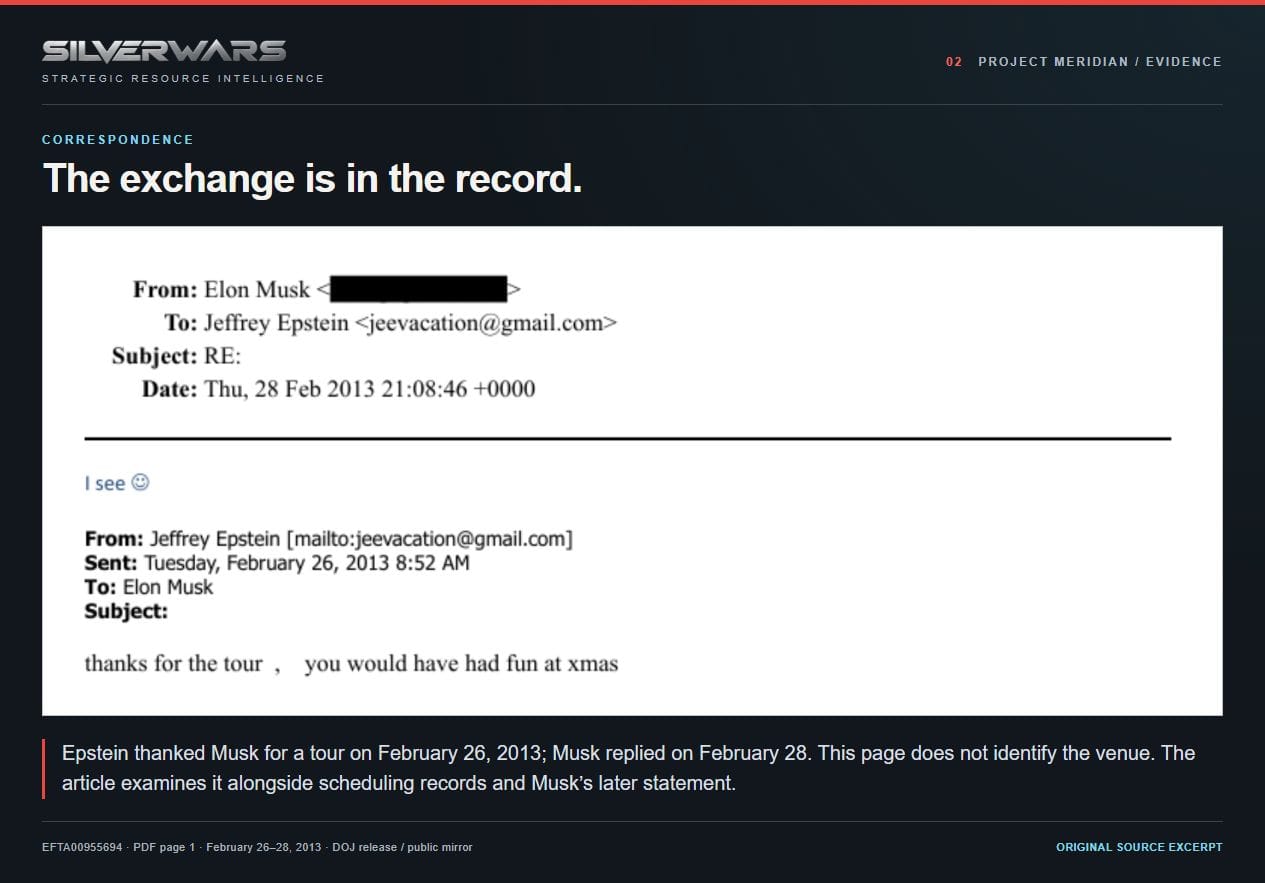
Meridian’s sponsors should explain how they assessed the judgment and candor of its co-directors. Musk’s documented contacts with Jeffrey Epstein make that a concrete vetting question. TIME’s account of the released records connects February 2013 scheduling for a SpaceX visit with an email thanking Musk for a tour. Musk replied two days later. In his July 2020 statement, Musk said that, to the best of their knowledge, Epstein had never toured SpaceX. The discrepancy warrants an explanation; it does not establish that Musk personally led the tour or knowingly lied.
A November 2012 exchange records Musk asking about the “wildest party” on Epstein’s island. The exchange occurred four years after Epstein’s 2008 conviction. Musk says he declined repeated invitations to the island and Epstein’s aircraft. The correspondence establishes social interest, not a completed island visit or involvement in Epstein’s crimes.
Edge supplies a separate institutional connection. Its event account places four sessions of its July 2009 synthetic-genomics (Humans 2.0) Master Class at SpaceX. Brockman asked Epstein to back that event. Edge’s 2009 tax return separately records $53,000 from Enhanced Education, the registered trade name of the J. Epstein Virgin Islands Foundation. The reviewed records do not earmark that contribution to the event or show that Musk knew about the funding request.
Technical achievement does not settle questions about judgment. MITRE and the commissioning office should explain the standards used to assess leadership, how relevant disclosures were evaluated and how discrepancies were resolved. These historical contacts do not establish compromised Meridian decisions. They support a demand for accountable vetting alongside the financial-conflict controls.
The financial interests extend beyond the founders
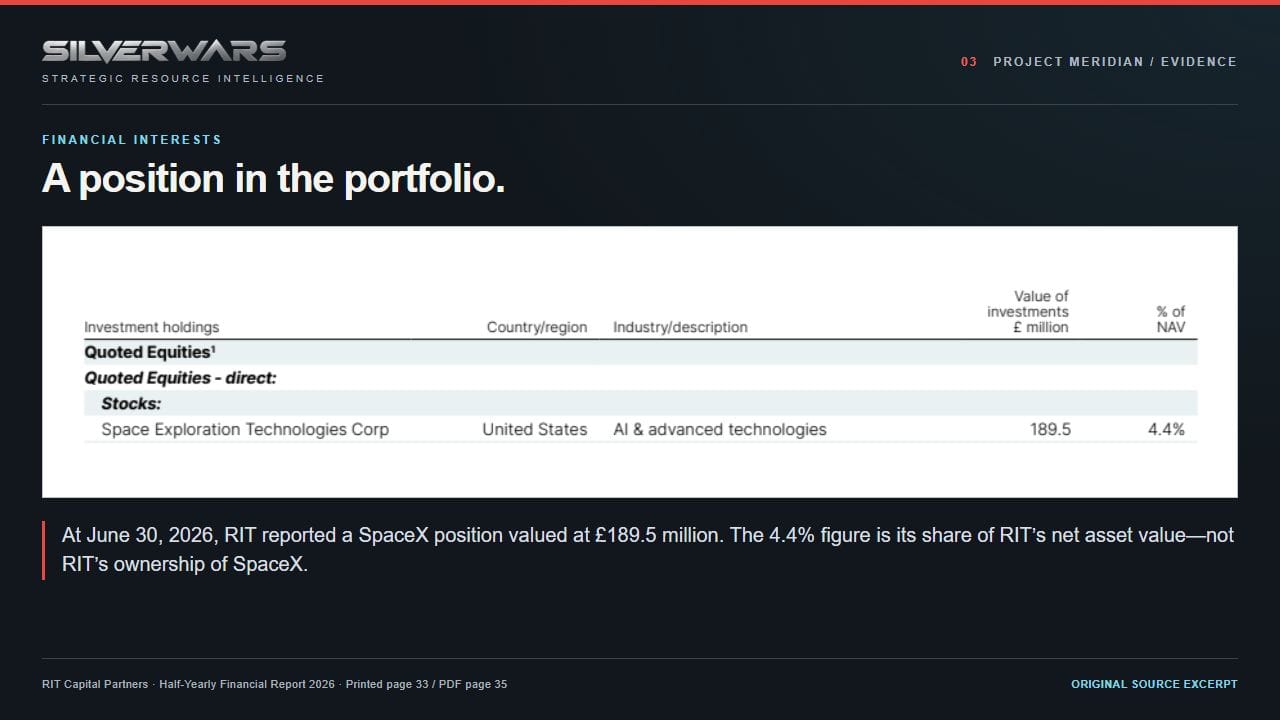
The investor connections should be stated precisely. RIT Capital Partners identifies the late Jacob Rothschild as its founder and the family as its largest shareholder. At June 30, 2026, its interim report listed a SpaceX position valued at £189.5 million, or 4.4 percent of RIT’s net asset value. That measures the investment’s weight in RIT, not RIT’s ownership of SpaceX. Its April presentation also identifies indirect exposure to Anduril.
A separate manufacturing connection involves Volex, led by CEO Nat Rothschild. A Tesla-hosted certification dated January 21, 2025 names Volex Interconnect Systems in Suzhou as an authorized manufacturer of specified Tesla-branded electric-vehicle connectors. It does not establish a SpaceX supply relationship or authority over Meridian.
RIT’s portfolio positions show why the financial interests relevant to an independent review can extend beyond a company’s founders. The Volex record concerns automotive manufacturing and should be kept separate from that defense-investment exposure. These records establish no authority over Meridian. An investment proposition should earn a recommendation only when its military benefit justifies the cost and resource burden.
Replacement carries a material cost
SilverWars has examined the material demands of orbital expansion. The strongest argument starts with components. An ESA-funded Leonardo study compared solid-silver, silver-plated and silver-sputtered solar-cell interconnects. All three contain silver. Their manufacturing, handling and thermal-cycle tradeoffs show why reducing metal content requires qualification, not merely choosing a smaller number. The study does not establish which construction Starshield uses.
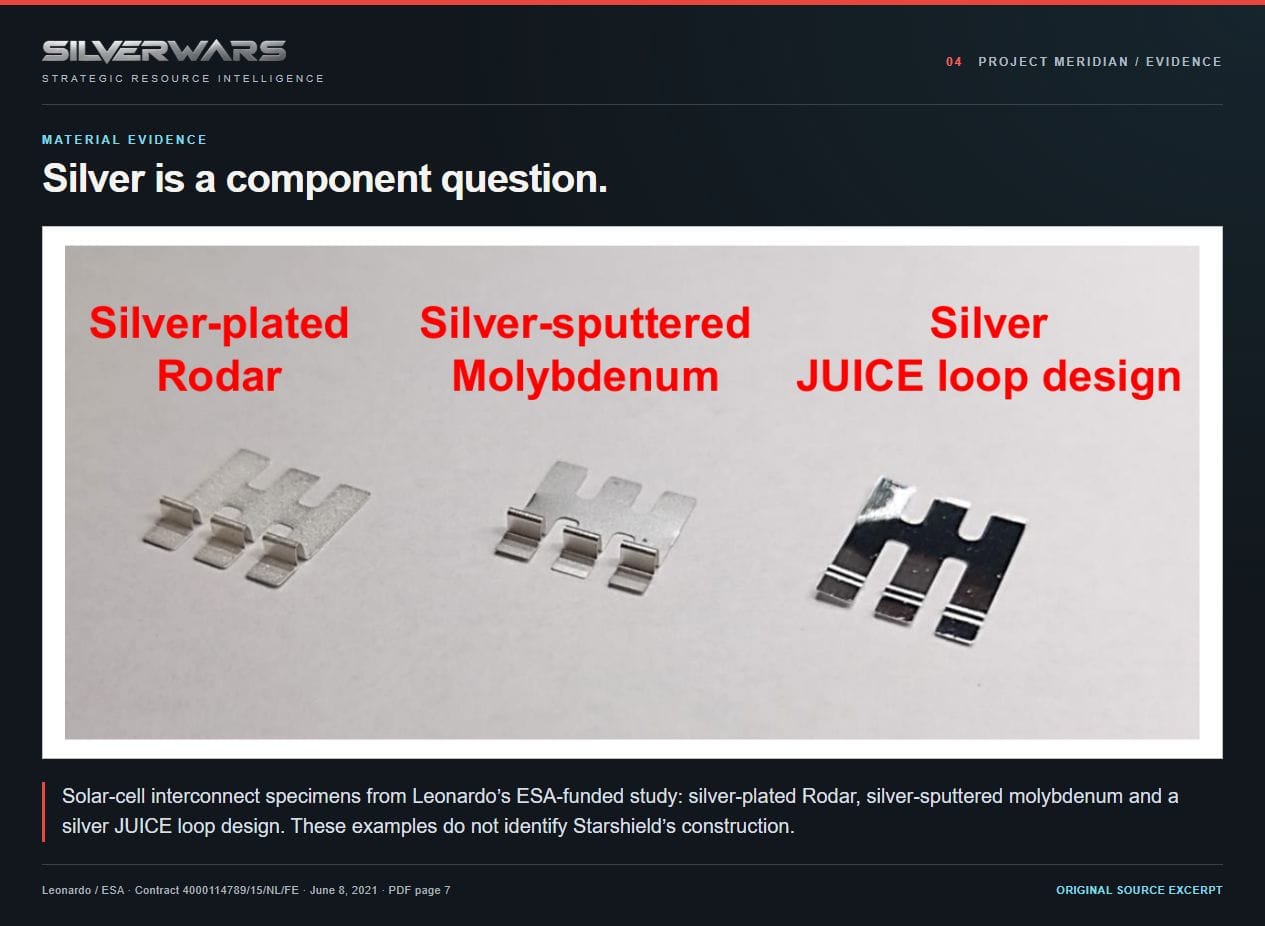
Sheldahl’s materials handbook specifies silver coatings on certain thermal-control films. Calculating their contribution to a spacecraft requires the selected product, installed area and coating thickness. Reflecting sunlight for thermal control is different from shielding electronics against ionizing radiation.
NOAA researchers detected silver among elements associated with spacecraft reentry in stratospheric particles. That is evidence of atmospheric dispersal, not a measurement of Starshield’s silver inventory, annual losses or resulting environmental damage. Material dispersed during reentry is nevertheless different from factory scrap collected for recovery.
Meridian should require a traceable bill of materials by spacecraft generation and subsystem. Count manufacturing losses and recovered scrap, ground equipment, service life and replacement rates. Separate metal embodied in hardware from gross purchases and demand for newly mined material. Then test whether qualified components can reach the production line in the required quantities and time. A financing plan cannot answer that supply question.
The accounting should also show what remains useful at the end of the comparison period. A kilogram retained in working equipment, a kilogram in a retired module awaiting recovery and a kilogram dispersed during disposal are different outcomes. Measure recoverable material against demonstrated recovery processes. Do not count a theoretical future recycling capability as metal already returned to the supply chain.
ENNEAD makes renewal a design question
ENNEAD is SilverWars’ open-source concept for purpose-built, serviceable spacecraft supported by nine orbital depots. Its starting scenario has 225 active satellites and 18 reserves, or 243 clients. An illustrative sequence brings a reserve into service before a client returns for attention. The design asks whether refueling, accessible components and planned upgrades could preserve useful hardware and the materials already invested in it.
The page publishes assumptions, calculations and runnable source so readers can examine the proposal. Its coverage result concerns geometric visibility; the mass comparison is a partial accounting of payload sent into orbit. Neither establishes equivalent Starlink capacity or a measured saving in silver. Those are questions for the engineering study.
Retaining useful hardware should be an explicit objective in Meridian’s comparison. Test renewal against replacing spacecraft and carrying more propellant from launch, without sacrificing mission performance. Establish which parts of a client can remain useful, which need changing, and whether the service infrastructure earns its place in the system.
Give JASON a specific comparison to investigate
There is a direct historical precedent. The published abstract of Space Infrastructure for 2020, JSR-99-125 describes JASON’s 1999 summer study of approaches to building, launching, powering and servicing Earth-orbiting satellites for military missions. The September 2000 report addressed reducing capital and operating costs while improving flexibility and performance.
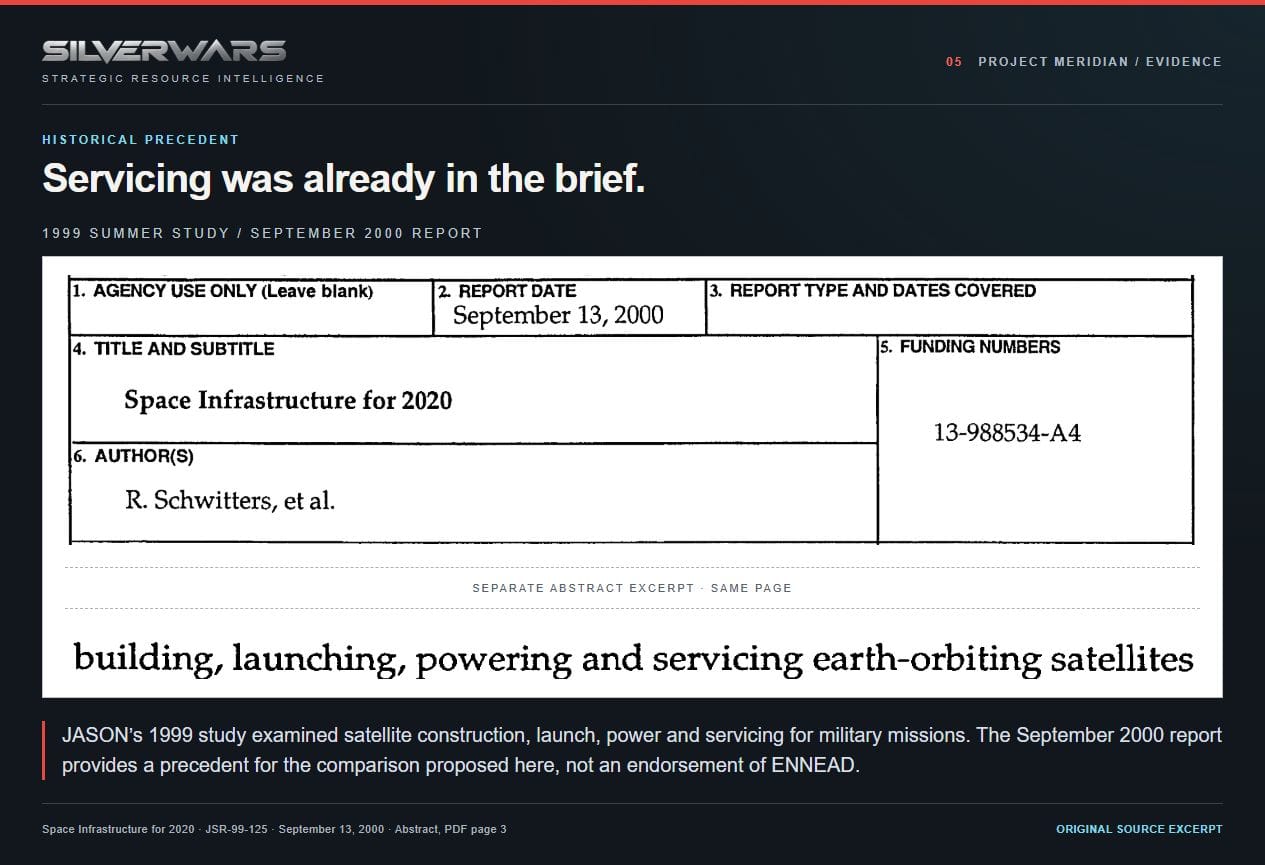
The government has already commissioned this class of investigation. Meridian should renew it using today’s spacecraft, launch capabilities and servicing proposals. The question is when each approach can meet the mission, and what the country must commit to keep it operating.
MITRE describes JASON as an independent group it manages. Meridian’s announcement does not task it. Commission a separate technical comparison, subject to suitable expertise and capacity, with authority to examine incumbent approaches and ENNEAD on equal terms. Because MITRE is associated with both efforts, specify a distinct mandate, conflict screening and a route for publishing unclassified disagreement.
The reviewers should control the assumptions they test, obtain the necessary engineering data, and distinguish measured performance from projections. Ask them to identify when replacement wins, when servicing wins, and which uncertainties prevent a decision. Apply the same standard to commercial proposals and SilverWars’ own concept.
Compare missions and test the interfaces
A smaller constellation is not automatically an equivalent one. Low orbit can offer latency and sensing advantages. Higher orbits and hybrid designs bring different coverage, capacity and survivability tradeoffs. CBO’s constellation analysis illustrates how assumptions change a 30-year production-and-launch comparison. It excludes operations, ground infrastructure and research and development; it is neither a complete lifecycle estimate nor a Starshield silver audit.
Set matched requirements before comparing the alternatives: coverage, latency, throughput, resolution where relevant, availability and performance under attack. Use the same operating period and account for upgrades. Publish sensitivity tests for hardware life, launch price, service frequency and failure rates.
The comparison must count the whole service system: depots, reserves, docking equipment, tankers, propellant, replacement modules and safe disposal. It must test missed rendezvous, failed transfers, extended servicing and the loss of a depot. Can another facility serve the affected clients without consuming the expected savings in maneuvers and downtime? How much reserve capacity must be launched to keep the promised service available?
Hardware also ages in ways refueling cannot reverse. Retaining an old bus may constrain power, processing or payload performance. Replacement can deliver better technology and lower operating burdens; modular servicing can offer a different route to improvement. Test both. The useful measure is the material and cost required to sustain a specified capability over time, including every support asset that makes renewal possible.
MITRE’s 1958 origins in SAGE, the Semi-Automatic Ground Environment, provide another useful reference. The Defense Science Board’s SAGE II proposal carries forward the integration problem: link sensors and weapons while incorporating capabilities such as AI, directed energy and proliferated low-Earth-orbit constellations. Its emphasis on adaptability, interoperability and affordability supplies criteria for comparison. It does not establish Meridian’s adoption of a Starshield-centered architecture.
Existing procurement already pursues some openness. Space Systems Command’s May announcement describes the SpaceX backbone working alongside SDA’s transport layer. Its August awards to five companies fund standardized interconnection and prototype demonstrations. Those efforts deserve recognition, followed by tests of whether different suppliers can exchange data and retain practical access.
Apply the same demand to servicing. Can another supplier dock, refuel or replace a module? Who controls the specifications, software and permission to connect? A replaceable component is of limited value if changing its supplier makes the rest of the system unusable. Technical interfaces and contractual access should be assessed together.
Make the independent judgment visible
The Pentagon and MITRE should publish evaluation criteria, unclassified conflict controls and the alternatives examined or excluded, with reasons. Explain who can revise assumptions and who retains final authority when participants disagree. Record recusals where financial interests overlap with study decisions, and explain how restricted information is protected without preventing meaningful technical challenge.
The final assessment should show its material balance, lifecycle costs, performance evidence and unresolved uncertainties. Preserve dissent where the evidence supports more than one conclusion. If a design changes after review, record what changed and why. That gives the public a way to distinguish an independently tested recommendation from a persuasive presentation.
ENNEAD makes renewal an explicit alternative. JASON could test it alongside replacement and longer-life designs, with the independence to reject any of them. If recurring replacement delivers the best military capability, show the comparison that establishes why. If useful hardware can remain in service with a lower material burden, explain what would make that possible. Before replacement becomes a strategic assumption, independent scientists should test whether it is a technical necessity.