 Strategic Resource Intelligence
In remarks published on September 18, NASA Administrator Jared Isaacman described rebuilding the agency’s experimental-aircraft fleet and working with industry on new airframes and propulsion.
The fiscal 2027 budget request gives that ambition a more concrete shape. Its high-speed research covers reusable, airbreathing flight—using oxygen from the atmosphere—for commercial travel and space access. The request describes research into high-temperature materials, propulsion and vehicle reuse. At hypersonic speeds, hot air flowing around the vehicle transfers heat into its surface. The materials problem reaches beyond surviving heat: hardware has to remain useful through repeated exposure, at a cost that leaves reuse worth doing.
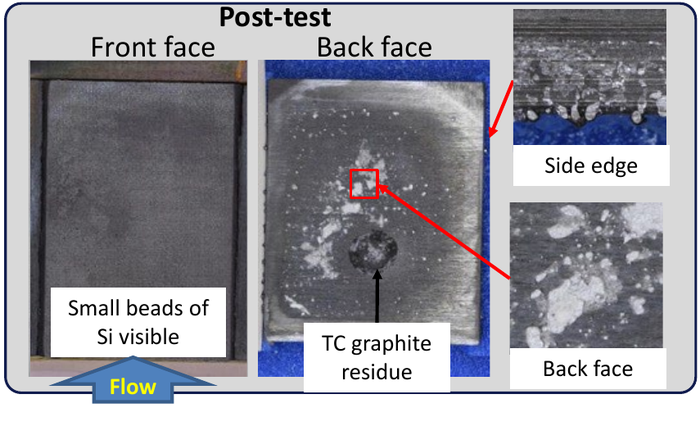
One finding in NASA Langley’s 2023 materials research makes that distinction visible. Composite specimens survived their laboratory heat tests while free silicon inside the material melted, moved and solidified elsewhere. One 180-second run reached a maximum surface temperature of 2,975°F. Free silicon was present within the composite, distinct from the silicon chemically combined with carbon in the ceramic itself. Surviving an exposure had left another question: what condition was the material in afterward?
Two ways to live with the heat
An aircraft’s thermal protection and its load-bearing structure can do different jobs. In one approach, a low-density ceramic layer limits heat flowing into the structure underneath, while its exposed surface radiates heat away. The insulation helps the underlying airframe stay cooler. Langley’s 2023 hot-structures presentation, on slides 3–5, sets this beside a hot structure: a part that carries its loads while operating at high temperature.
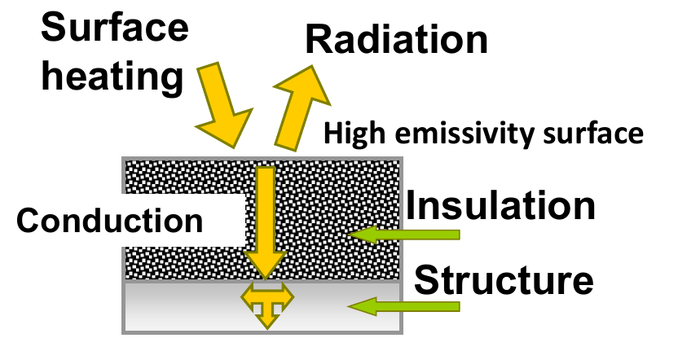
Insulation needs to preserve its protective function, while a hot structure also needs useful strength and stiffness at high temperature. Several thermal-protection approaches may be needed within a vehicle, rather than a single material covering every surface.
Silicon is one of the critical minerals behind that structural approach. The United States’ final 2025 critical-minerals list names silicon among minerals whose interrupted supply poses economic or strategic risks. In the structural composite, silicon is chemically combined with carbon as silicon carbide. Silicon-carbide fibers reinforce a surrounding matrix of the same ceramic. For its SiC/SiC technologies, NASA Glenn reports lower density and higher temperature capability than metallic superalloys, alongside better toughness and damage tolerance than an unreinforced ceramic. Those properties answer a specific flight problem: a structure has to carry load while hot, resist damage and limit the weight an aircraft must carry.
The same material still expands as it heats. If the surrounding construction restrains that movement, stresses develop. Langley’s researchers identify two challenges for its potential use in reusable airframes: managing thermal expansion in a stiff material and manufacturing complex parts to tight tolerances.
A familiar material can become a new manufacturing problem
NASA Ames’ work on insulation for the Orion capsule offers a related manufacturing example. One of its ceramic-fiber materials is Alumina Enhanced Thermal Barrier, or AETB. Its constituents include silica, alumina and aluminoborosilicate fibers. Here silicon is present in oxide-based fibers that help form low-density insulation, a different material form and function from the silicon-carbide structural composite.
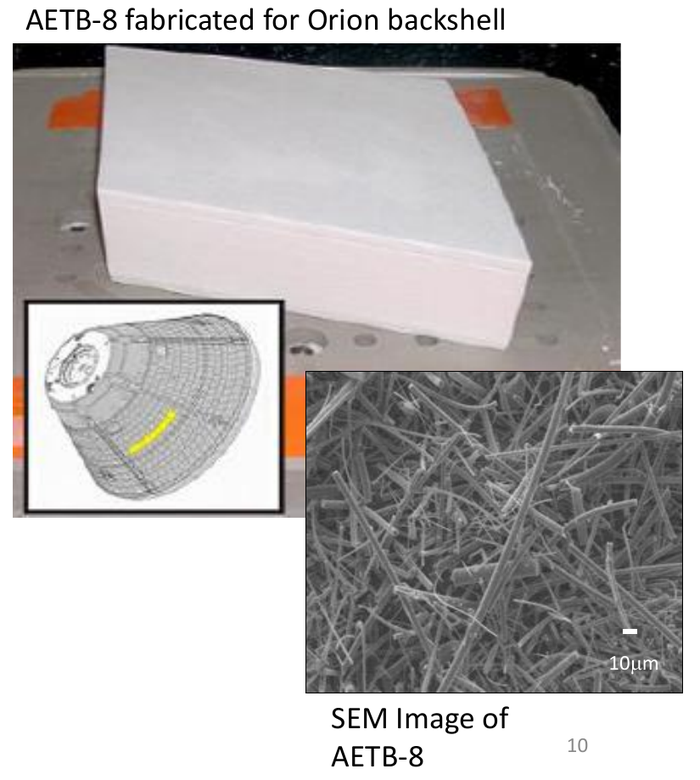
Ames’ January 2024 development presentation shows an AETB tile made for the backshell, or rear outer surface, of the Orion capsule beside a microscope image of its fibers. It also describes a problem that begins before flight. Historically, AETB production drew on raw materials bought during the Shuttle era. The modern raw materials behaved differently during processing: using the historical procedures had produced tiles that failed to meet the AETB-8 specification.
The replacement feedstock existed. The old process did not reproduce the required finished material with it. In that 2024 development work, Ames was studying processing and measuring the resulting tiles: their density, response to pulling forces in tensile tests, and thermal conductivity. Those measurements connect the manufactured tile with its weight, mechanical response and ability to limit heat flow.
What another flight is worth
A lower-priced fiber becomes useful when the process turns it into a consistent tile with the required thermal and mechanical behavior. Its purchase price alone leaves out the work needed to achieve that consistency. The presentation also describes work on lower-cost, widely produced alternative fibers and different processing approaches, without reporting an achieved saving.
The full-cycle cost described by Ames includes raw materials, manufacturing, integration and refurbishment. A part may cost more to make and still earn its place if it remains useful through enough flights with manageable intervention. Conversely, repeated repair or replacement can consume the advantage of bringing the vehicle home. The public research establishes those competing pressures, without supplying a commercial aircraft’s cost per flight.
In the laboratory tests on slide 15 of the Langley presentation, free silicon moved within specimens that all survived. The post-test examinations included photography, surface scanning and X-ray imaging, with detailed analysis still underway when the results were presented in 2023. The result does not establish how that change affected remaining strength or life. If a change compromises the protection or strength required for another use, repair or replacement adds work and cost before the hardware can return to service.
Langley’s research follows that service-life question through repeated exposure, inspection, repair and life prediction. It also spans small specimens, parts and larger structures. Ground facilities cannot reproduce every relevant load and environment together, which gives flight experiments a role in resolving what earlier tests leave uncertain.
Reusable flight therefore reaches back into the materials factory. Silicon-bearing fibers help form insulation that limits heat flow into a cooler structure; silicon carbide offers a lower-density route to carrying load at high temperature than metallic superalloys. Keeping those functions available for another flight requires a repeatable manufacturing process and hardware whose condition is understood after use. Silicon serves its purpose in the finished ceramic part that protects or carries the vehicle; the economic benefit of using that part again depends on its service life and full-cycle cost.