 Strategic Resource Intelligence


In 1934, a Baltimore & Ohio Railroad bondholder presented a coupon for $22.50 in interest and demanded $38.10. Both figures had a basis. The first was printed on the coupon. The second was what the bondholder said he was owed under the bond’s promise to pay in dollars containing as much gold as they had in 1930. Between the promise and the payment, Congress had changed the rules. The dispute went to the Supreme Court. The bondholder got $22.50. Read the opinion in Norman v. Baltimore & Ohio Railroad Co.
That dispute arose on the way off gold. Anyone proposing to take America back owes us an answer to the same question. When the definition of a dollar changes, which promise do we keep to the people who borrowed and lent the old one?
What the return to gold settled in 1879
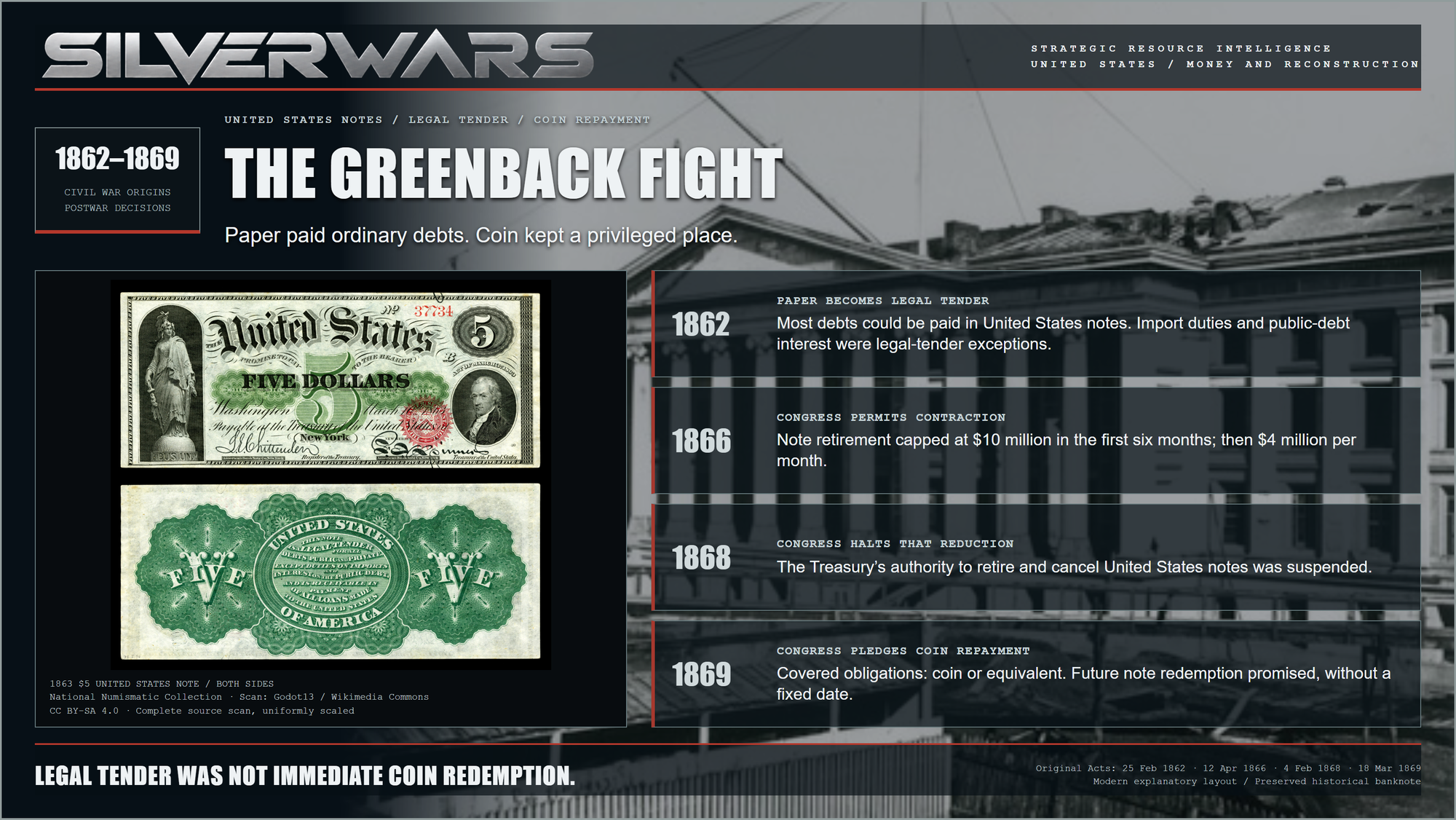
During the Civil War, a merchant could use a federal paper dollar, the greenback, to settle most debts. The merchant who owed import duties had to find coin. The investor collecting interest on federal bonds was entitled to coin. Congress chose which creditor had to take paper and which could insist on metal. In 1869 it pledged coin repayment on federal obligations, subject to the terms under which they had been issued. The Treasury resumed redeeming greenbacks in 1879. The country restored convertibility without a general debt jubilee. Doom Line · The Greenback Fight · 1869 public credit law · Treasury’s 1879 report
Now look at that achievement from the other side of the loan. In 1893, Nebraska Senator William V. Allen asked his colleagues to imagine a farmer taking out a mortgage when a bushel of wheat earned a dollar. If wheat fell to fifty cents, the farmer would have to deliver twice the crop for every dollar of debt. The lender could point to the mortgage and truthfully say that the amount owed had never changed. The farmer could point to the barn and show how much more wheat it took to pay. Read Allen’s Senate speech
That arithmetic gives William Jennings Bryan’s 1896 Cross of Gold speech its political meaning. A farm family could favor silver because it wanted its harvest to cover the mortgage. Four years later, the Gold Standard Act defined the dollar in gold and made the Treasury responsible for maintaining parity among forms of U.S. money. Congress settled what a dollar was. The farm family still had to earn it. Doom Line · The Cross of Gold · Doom Line · The Gold-Defined Dollar
What a modern proposal leaves open
The Gold Standard Restoration Act introduced in the House in 2023 gave the Treasury up to two years to fix the dollar to gold at the closing market price on the day it chose. The bill specified who would redeem the notes and who would guarantee payment. It offered households no corresponding adjustment on existing debts. Read H.R. 2435, especially section 3
Choosing a market price on day one answers the first day’s question. Suppose defending that price later requires tighter credit and a worker’s hourly wage falls from $30 to $25. A fixed $1,500 mortgage payment goes from 50 hours of gross pay to 60. That hypothetical wage cut puts a price on the risk the borrower carries. Multiply it across households and the risk reaches creditors too. Families cut spending, businesses lose revenue, and some loans go unpaid. Ben Bernanke on debt deflation
A partial debt jubilee would write down existing debts to give borrowers relief. In that household, a payment reduced to $1,250 would restore the original 50-hour burden. Congress would then have to say who absorbs the reduction. If a pension fund owns the loan through a mortgage security, its beneficiaries have a stake. If the Treasury compensates investors, the public picks up the bill. Those competing claims are why I consider a broad jubilee politically unlikely. Agreeing on a gold price is one decision. Getting creditors, borrowers and taxpayers to agree on who takes a loss is another.
Before endorsing a return to gold, I’d ask its sponsors to publish the missing page. At their proposed gold price, what happens to existing borrowers if wages fall? Which debts would they write down, by how much, and at whose expense? If the answer is that every dollar must be repaid in full, say plainly that the family in this example will owe ten more hours of work each month. That cost belongs in the proposal alongside the promise of sound money.
SilverWars built the Doom Line so readers can follow a monetary decision back to the record. Open “The Greenback Fight” and look at the five-dollar note alongside the law that governed it. Then follow the fight over repayment through Bryan’s speech and the 1900 Act. These are three of the archive’s 99 entries, spanning 1717 to 2025. Explore the SilverWars Doom Line