 Strategic Resource Intelligence

PAID PROMOTION | Disseminated on behalf of Gunnison Copper Corp. Gunnison Copper Corp. has paid SilverWars LLC total cash compensation of US$[90,000] under a [August 2026-August 2027] investor-relations agreement that includes creating and distributing this post. SilverWars receives no securities compensation and does not hold or trade Gunnison securities. [Full compensation details].
On October 27, Zipline announced a fleet-wide flight-control update that it says makes deliveries quieter and uses less energy. The company reports 21% lower energy use per flight. Its aircraft already carry blood to Rwandan health facilities, while a newer system in the United States lowers packages to individual delivery locations with the aircraft overhead. The update addresses a practical operating problem across that growing service: conserving energy while reaching the places customers need it to serve.
Zipline's P2 aircraft is already doing that work in the United States. Its April launch of an early-access service in the Houston area followed operations across more than 20 Dallas-Fort Worth municipalities. Rwanda's next step is different: a signed expansion agreement announced in February includes P2 urban service in Kigali alongside a third long-range distribution center in Karongi. The Kigali component was announced as an expansion, not an operating-service milestone. For a delivery operator, the investment question is whether the complete service can meet promised delivery windows at an acceptable cost, including the loading, charging and turnaround between flights.
Two aircraft, two ways to reach the customer
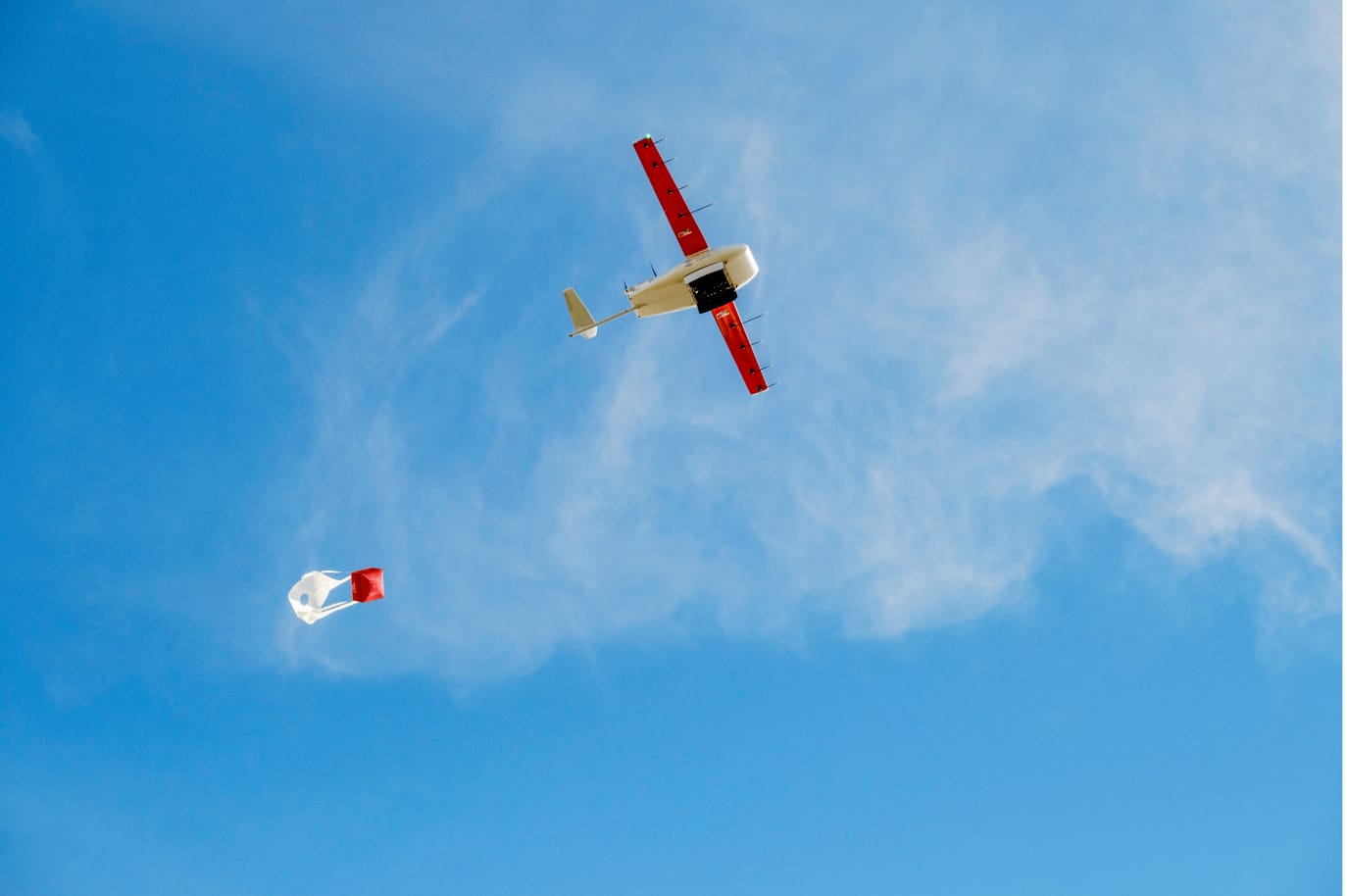
Rwanda already has experience with drone delivery as part of its healthcare system. Its Biomedical Centre describes Zipline's role in moving blood and blood products to remote or difficult-to-reach areas. Zipline's established Platform 1 uses a parachute to release the package, allowing the aircraft to keep flying. That approach suits a designated receiving area. The package reaches the ground without bringing the aircraft down with it.
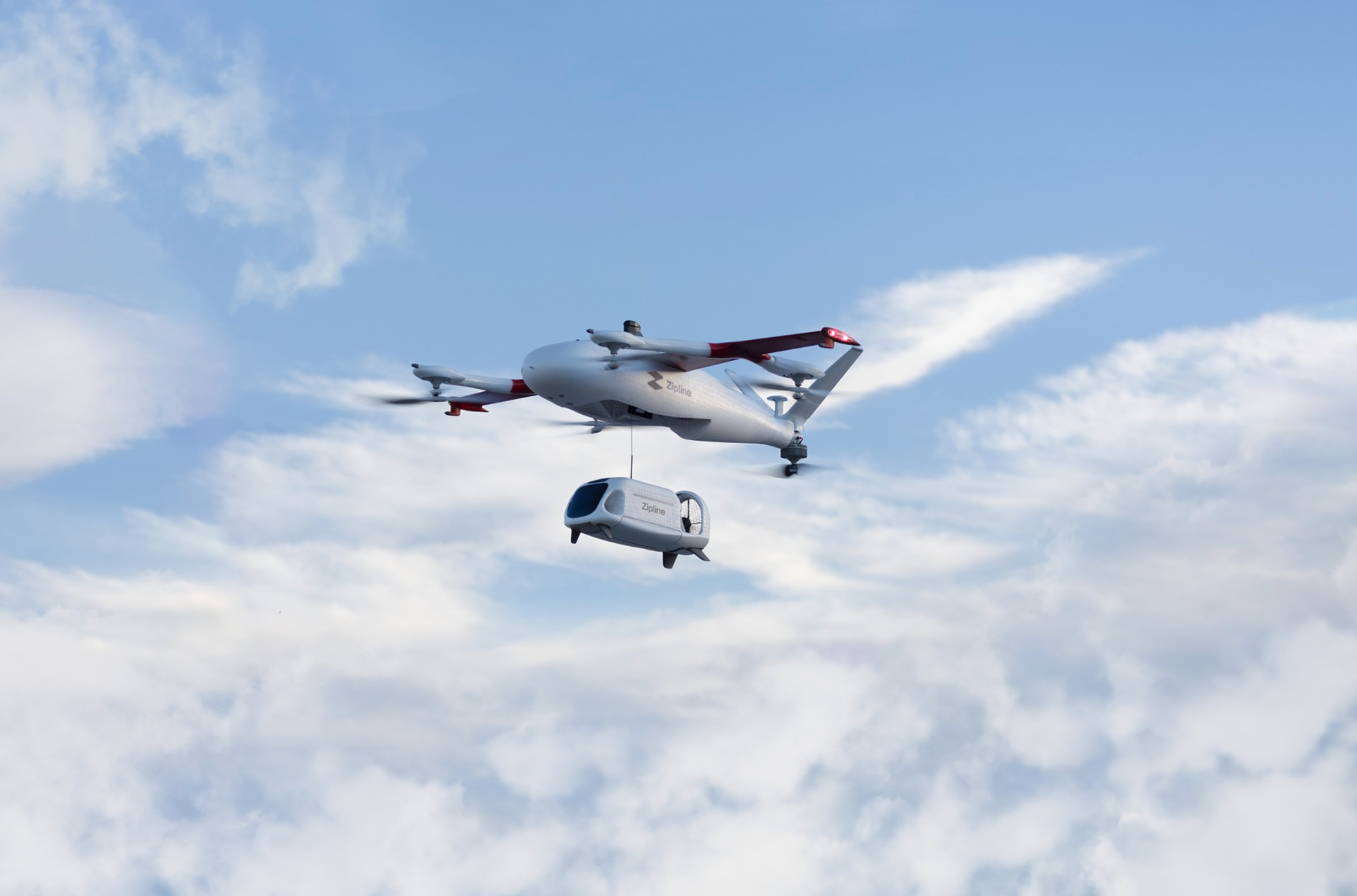
P2 takes a different approach to the final few feet. The larger aircraft stays overhead while a smaller, tethered delivery pod descends to the recipient. Zipline describes the pod as maneuverable, allowing it to position a package at an individual delivery location. The winged aircraft handles transit; the pod handles the close approach. That division is the important design choice for an operator considering service to individual homes or other small receiving spaces.
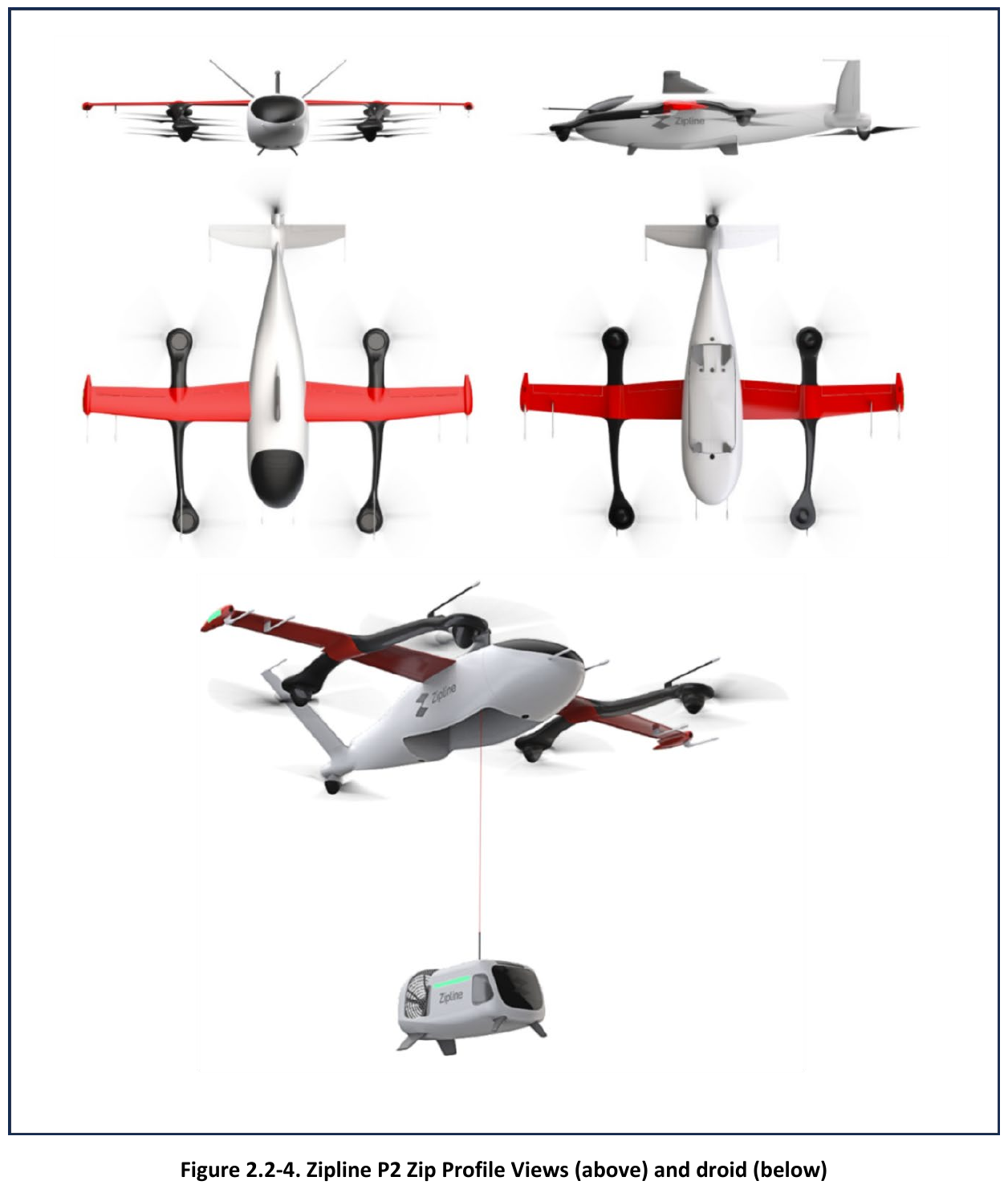
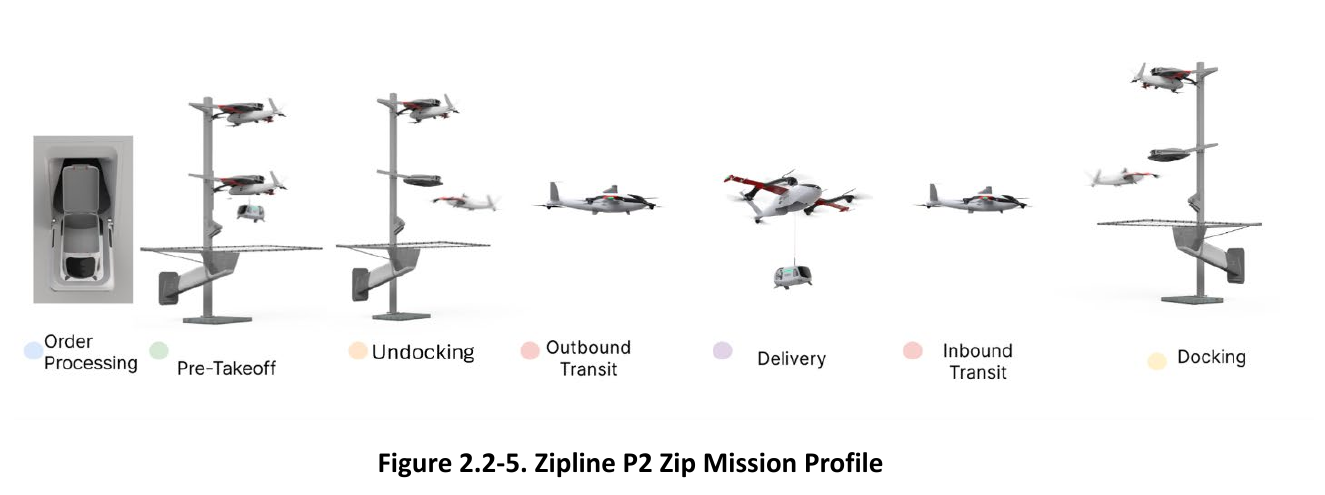
The FAA's December 2025 environmental assessment for proposed Dallas-Fort Worth operations describes P2 as an electric aircraft with vertical takeoff and landing capability and an eight-pound payload limit. Its mission diagram follows the order through loading, departure, transit, delivery, return and docking. The dock is part of the equipment needed to provide the service: it supports loading, charging and maintenance around the flight. Buying aircraft alone would leave much of that work unfunded.
An eight-pound limit also gives the network a particular job. Small, time-sensitive orders fit the aircraft's design more naturally than bulky replenishment loads. A retailer or health system still needs other transport for goods outside that envelope. For the delivery operator, the opportunity is to make a useful category of orders available quickly and repeatedly, while keeping the larger distribution system connected to the places that stock and load those orders.

The next delivery starts with stored energy
The same FAA assessment explicitly identifies rechargeable lithium-ion batteries in Zipline's aircraft. Lithium is on the final 2025 U.S. critical-minerals list. In this application, it participates in an electrochemical storage system: lithium ions move between electrode materials through the electrolyte while electrons travel through the external circuit, supplying electrical energy. Charging reverses the process and restores stored energy. The battery can therefore support repeated flights without consuming a fresh load of lithium on every trip.

That distinction matters when a growing delivery network becomes a materials story. More flights draw more energy from batteries already in service. New aircraft and replacement batteries require manufactured cells, but flight counts alone do not reveal the quantity of lithium the network will buy. Zipline's published battery class establishes a physical dependence on rechargeable storage; it does not establish a particular cathode formulation, pack inventory or replacement schedule. A larger service business and a larger mineral order are connected through those manufacturing and lifetime decisions.
Zipline says its new controls adjust flight to wind conditions and extend wing-supported travel, when most motors can be switched off. Less energy spent on a delivery could leave more available for subsequent work. Whether that becomes more orders, shorter charging interruptions or a better margin depends on network operation; the announcement does not establish those business outcomes.
Home-delivery routes end where people live. Zipline reports lower sound exposure against its 2025 fleet, based on internal modeling. Quieter flight and the small descending pod address neighborhood disturbance at different stages of the journey. Their value still depends on acceptance where the service operates.

Critical minerals: copper carries the current
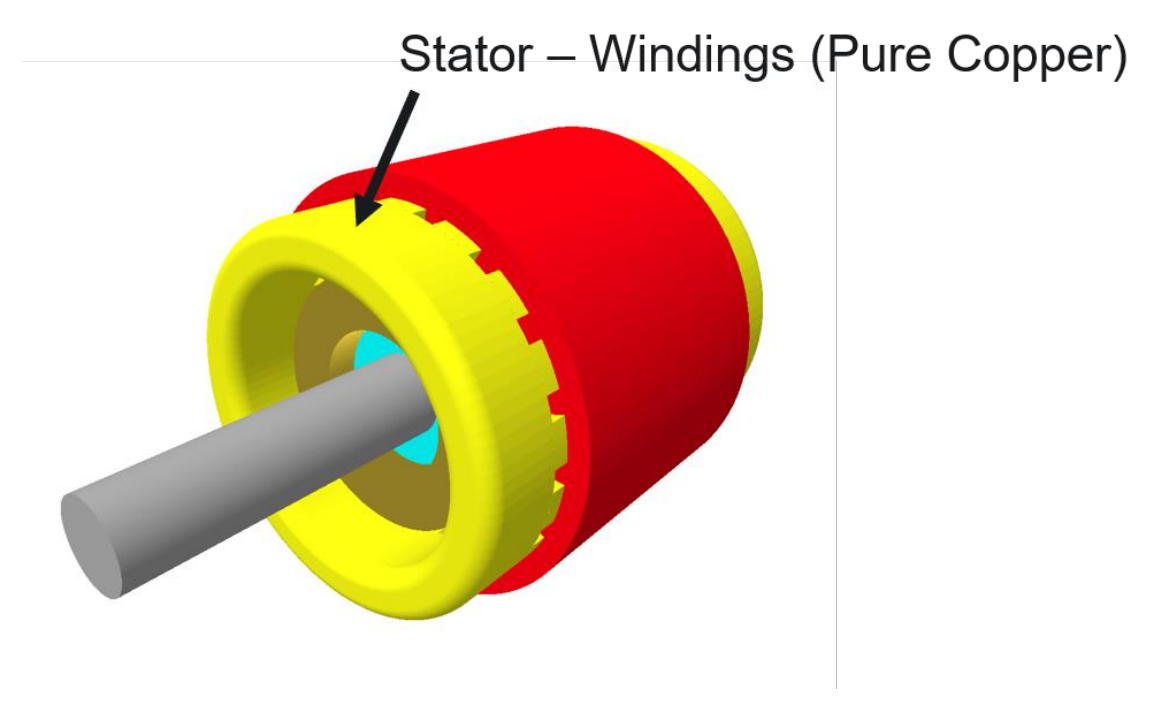
Critical minerals perform different jobs in an electric delivery system. Copper, like lithium, appears on the final 2025 U.S. critical-minerals list. Its established electrical role is easy to see in a conventional induction motor: alternating current passes through stationary coils, typically made of copper, creating a rotating magnetic field that drives the rotor. The windings also resist that current, turning some electrical energy into unwanted heat. Lower resistance reduces this loss at a given current. This is general motor engineering, rather than a specification of P2's motors.
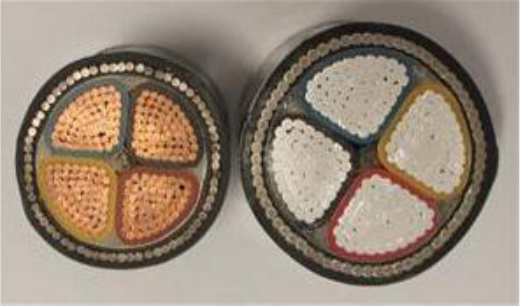
Copper's conductivity also makes it useful in power cables. In the cable comparison below, the copper conductor fits a similar current-carrying capacity into a smaller cross section than aluminum. That can matter where wiring space is limited, while aluminum's lower weight can favor it in other applications. The choice affects equipment dimensions, heating and installation. A delivery network's charging equipment therefore deserves attention alongside its battery capacity: stored energy must pass through a physical electrical system each time the aircraft is replenished.
The FAA assessment identifies P2's battery type without specifying its copper content. Zipline's patent literature also shows why conductor choice cannot be assumed: one application describes aluminum wiring and an entirely aluminum conductive path around battery connectors. A patent describes possible designs, not a production P2 parts list. For the operator, the relevant materials plan follows installed equipment specifications, performance and replacement needs.
Rwanda's expansion puts the service around the aircraft
The Rwandan plan makes the continuing operating commitment unusually visible. Zipline says the U.S. government will fund upfront infrastructure for the expansion, while Rwanda has committed to paying for ongoing operations. Facilities can be financed and built once, but a healthcare network needs the service to remain available as orders arrive. The announced arrangement funds those different obligations separately.
There is evidence that an established delivery network can change more than transit time. A 2022 study of 20 Rwandan health facilities associated drone delivery with a 67% reduction in blood-product expirations after 12 months. It was a retrospective observational study, and its road-delivery time comparisons used estimates. It does not establish P2's economics or predict the result of Kigali's expansion. It does show why a health system may value replenishment that can reach a facility promptly: less blood can expire while waiting to be needed.
For an operator considering a new route, a useful pilot follows eligible orders through a busy delivery window, including loading, charging and aircraft turnaround. Measure on-time completed orders alongside the full cost of providing that service: staff time, energy, maintenance, unsuccessful attempts, intervention and any fallback transport. If orders wait for charged aircraft, energy replenishment may deserve the next investment. If ready aircraft wait for compatible orders, more drones would add idle capacity. Expansion needs both dependable performance and an acceptable cost at the promised service level compared with the operator's existing delivery option. This is a proposed evaluation method, not a claim about Zipline's undisclosed route economics.
Rwanda's urban plan would extend a delivery method already operating in the United States into a country with a long-running medical network. Sustaining that service means funding charging, maintenance and eventual battery replacement across its operating life. The practical advantage is dependable access to what a clinic or household needs, including while other aircraft are charging. For the operator, that advantage earns further investment when the cost of sustaining it fits the service being sold.
Qualified Person
Dr. Roland Goodgame, Senior VP of Project Development of the Company is a Qualified Person as defined by NI 43-101. Dr. Goodgame has reviewed and approved the technical information contained in this report.
Forward-looking information
This report contains "forward-looking information" concerning anticipated developments and events that may occur in the future. Forward looking information contained in this report includes, but is not limited to, statements with respect to: (i) the intention to deploy the Nuton® technology at the Johnson Camp mine and future production therefrom; (ii) the continued funding of the stage 2 work program by Nuton; (iii) the details and expected results of the stage two work program; (iv) future production and production capacity from the Company's mineral projects; (v) the results of the preliminary economic assessment on the Gunnison Project; (vi) the exploration and development of the Company's mineral projects; (vii) the details and timelines associated with the Company’s PFS work program; (viii) the expected results of the Company’s PFS work program; and (ix) eligibility for future tax credits.
In certain cases, forward-looking information can be identified by the use of words such as "plans", "expects" or "does not expect", "budget", "scheduled", "estimates", "forecasts", "intends", "anticipates" or "does not anticipate", or "believes", or variations of such words and phrases or state that certain actions, events or results "may", "could", "would", "might", "occur" or "be achieved" suggesting future outcomes, or other expectations, beliefs, plans, objectives, assumptions, intentions or statements about future events or performance. Forward-looking information contained in this report is based on certain factors and assumptions regarding, among other things, Nuton will continue to fund the stage 2 work program, the availability of financing to continue as a going concern and implement the Company's operational plans, , the estimation of mineral resources, the realization of resource estimates, copper and other metal prices, the timing and amount of future development expenditures, the estimation of initial and sustaining capital requirements, the estimation of labour and operating costs (including the price of acid), the availability of labour, material and acid supply, receipt of and compliance with necessary regulatory approvals and permits, the estimation of insurance coverage, and assumptions with respect to currency fluctuations, environmental risks, title disputes or claims, and other similar matters. While the Company considers these assumptions to be reasonable based on information currently available to it, they may prove to be incorrect.
Forward looking information involves known and unknown risks, uncertainties and other factors which may cause the actual results, performance or achievements of the Company to be materially different from any future results, performance or achievements expressed or implied by the forward-looking information. Such factors include risks related to the Company not obtaining adequate financing to continue operations, Nuton failing to continue to fund the stage 2 work program, the breach of debt covenants, risks inherent in the construction and operation of mineral deposits, including risks relating to changes in project parameters as plans continue to be redefined including the possibility that mining operations may not be sustained at the Gunnison Copper Project, risks related to the delay in approval of work plans, variations in mineral resources and reserves, grade or recovery rates, risks relating to the ability to access infrastructure, risks relating to changes in copper and other commodity prices and the worldwide demand for and supply of copper and related products, risks related to increased competition in the market for copper and related products, risks related to current global financial conditions, risks related to current global financial conditions on the Company's business, uncertainties inherent in the estimation of mineral resources, access and supply risks, risks related to the ability to access acid supply on commercially reasonable terms, reliance on key personnel, operational risks inherent in the conduct of mining activities, including the risk of accidents, labour disputes, increases in capital and operating costs and the risk of delays or increased costs that might be encountered during the construction or mining process, regulatory risks including the risk that permits may not be obtained in a timely fashion or at all, financing, capitalization and liquidity risks, risks related to disputes concerning property titles and interests, environmental risks and the additional risks identified in the "Risk Factors" section of the Company's reports and filings with applicable Canadian securities regulators.
Although the Company has attempted to identify important factors that could cause actual results to differ materially from those contained in forward-looking information, there may be other factors that cause results not to be as anticipated, estimated or intended. There can be no assurance that such information will prove to be accurate, as actual results and future events could differ materially from those anticipated in such information. Accordingly, readers should not place undue reliance on forward-looking information. The Company does not undertake to update any forward-looking information, except in accordance with applicable securities laws.
25 Reps. 25 Grand. Show Us Your GUNNs!
The GUNN 25 Challenge invites eligible participants to complete 25 repetitions of any safe physical activity, whether push-ups, squats, bicep curls, jumping jacks or another activity of their choice. Participants enter at their own risk and should consult a physician before engaging in any physical activity.
Participants can enter the sweepstakes through two methods:
Show Us Your GUNNs: Record a video completing 25 repetitions, share it publicly on Instagram, TikTok or X, include #Gunnison25Contest at the beginning of the caption and tag Gunnison Copper on the applicable platform.
Enter Online: Participants can also enter directly through the online entry form without recording or posting a video. Both entry methods offer equal odds of winning.
One eligible winner will be selected through a random drawing to receive the US$25,000 grand prize.
The sweepstakes opens on November 5, 2026 at 12:00 p.m. ET and is scheduled to close on December 13, 2026, with the winner selected on or about December 16 , 2026. No purchase or investment is necessary to enter or win. The sweepstakes is open to legal residents of the 50 United States and DC, excluding New York, Florida and Rhode Island, 18 or older (19 in AL and NE, 21 in MS)
For complete details, entry instructions and Official Rules, visit: