 Strategic Resource Intelligence


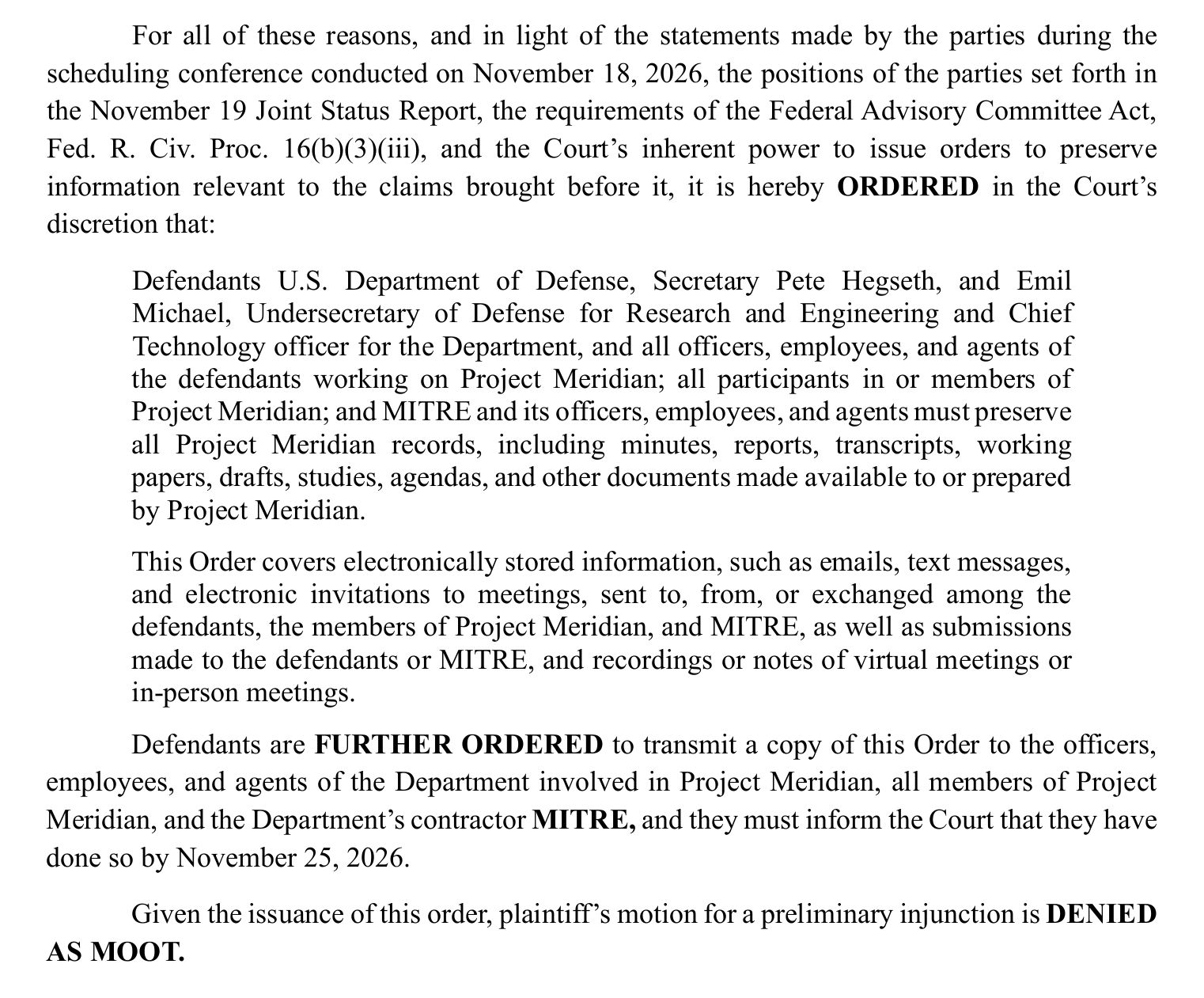
A federal judge has ordered the Pentagon, Project Meridian participants and MITRE to preserve the records behind the Pentagon’s study of future warfare. The November 23 order covers drafts, meeting notes, emails and texts. It also covers submissions sent straight to MITRE, even if the panel never saw them. The order applies to Meridian’s co-directors, too. Yes, Elon, that means you.
The Pentagon told the court it had already issued an internal litigation hold and that MITRE would retain material under its own policies. Judge Amy Berman Jackson said none of those policies had been provided to the court. MITRE isn’t a defendant, but the government’s description didn’t account for all relevant communications or submissions that stopped at MITRE. Jackson found that keeping only the Pentagon’s side of the record would leave an incomplete account of a project MITRE was hired to lead. Order, pp. 3–6
The choices before procurement
On September 30, Defense Secretary Pete Hegseth tasked Meridian with identifying gaps in U.S. military capabilities and recommending what to develop, test and field. MITRE named Elon Musk, Palmer Luckey and Newt Gingrich as co-directors. As SilverWars previously reported, SpaceX and Anduril, the companies associated with Musk and Luckey respectively, already do business with the government. That overlap makes it worth asking how their input was evaluated and whether financial interests were disclosed and managed. It does not show that either steered a recommendation.
MITRE says the initiative won’t write acquisition requirements or pick contractors, and that taking part in the open call gives no advantage in future acquisitions. It also published three criteria for screening ideas: fit with Meridian’s goals, novelty and relevance to its long-term horizon. Those criteria tell us how an idea gets considered. They don’t tell us what happens when two ideas compete, who signs off on the recommendation or how dissent and recusals are recorded.
Take the question we raised in October: when a satellite reaches the end of its planned service life, should the Pentagon replace it or extend its life? The government has already tested on-orbit servicing, so it’s an alternative worth comparing, not a claim that every spacecraft can or should be repaired. The answer depends on mission performance, what it costs to keep each option working and whether suppliers can deliver the parts on time. If Meridian prefers one approach, the record should show which alternatives it tested and what assumptions tipped the decision.

Why silver belongs in that comparison
Meridian doesn’t buy silver. But if the Pentagon adopts its recommendations, what it builds and replaces could change how much silver defense suppliers need and where they source it. Silver is already used in some spacecraft power systems and Navy batteries. Congress acknowledged depletion of the National Defense Stockpile’s silver reserve in 2002. The public record doesn’t establish that it has been rebuilt. What silver supply does Meridian assume will be available if its recommendations are put into practice?
What the court has yet to decide
CREW, Public Citizen and the Project On Government Oversight sued November 2, arguing that the Federal Advisory Committee Act’s rules on committee balance and public access apply to Meridian. Before suing, POGO asked for defense-budget specialist William Hartung or another POGO adviser to add a procurement-accountability perspective. The judge hasn’t decided whether the law applies, whether the panel is fairly balanced or which records the public can see. The study can continue. Jackson denied the request for a preliminary injunction as moot because her order already required preservation.
She also directed the Pentagon to circulate the order to relevant personnel, panel members and MITRE, and confirm by November 25 that it had done so. Tick-Tock. Order, pp. 6–7
Under the commissioning memo, Meridian’s recommendations are due to Hegseth on January 28, 2027. That is a delivery date, not a public release date. Regardless of how the court rules, the Pentagon and MITRE can explain how they reached the recommendations without publishing classified details: what they compared, which assumptions changed the outcome, and who reviewed the conclusions. A final report tells us what Meridian recommends. The record behind it is how we check why.