 Strategic Resource Intelligence
Ukraine may be burning Russian refineries while handing China greater leverage over the West’s chemical supply chains. The strategic risk for Western industry is that Russian production losses could shift replacement demand toward Chinese suppliers, increasing their bargaining power over buyers of chemicals used in civilian and military supply chains.
Reuters reported on October 16 that the previous day's attack on Russia's Ryazan refinery halted CDU-6 and damaged refinery pipelines, while three other crude-distillation units continued operating. Its report describes the refining disruption and fuel-production context. It does not trace the site's nonfuel products through downstream chemical supply chains. That limited reporting scope leaves the wider chemical exposure unassessed. [1]
China connects Russian and Western chemical demand
World Bank WITS tables drawing on UN Comtrade show that China exported approximately 86,464 tonnes of ethylene glycol, or EG, and 34,084 tonnes of propylene glycol, or PG, to Russia in 2024. Russia was China's largest export destination for both products in those tables. They also record PG exports to Poland, Canada and Australia, and EG exports to Japan and Australia. These historical trade flows establish a shared supplier base; they do not identify coolant qualification, final customers or an October reallocation. [2,3]
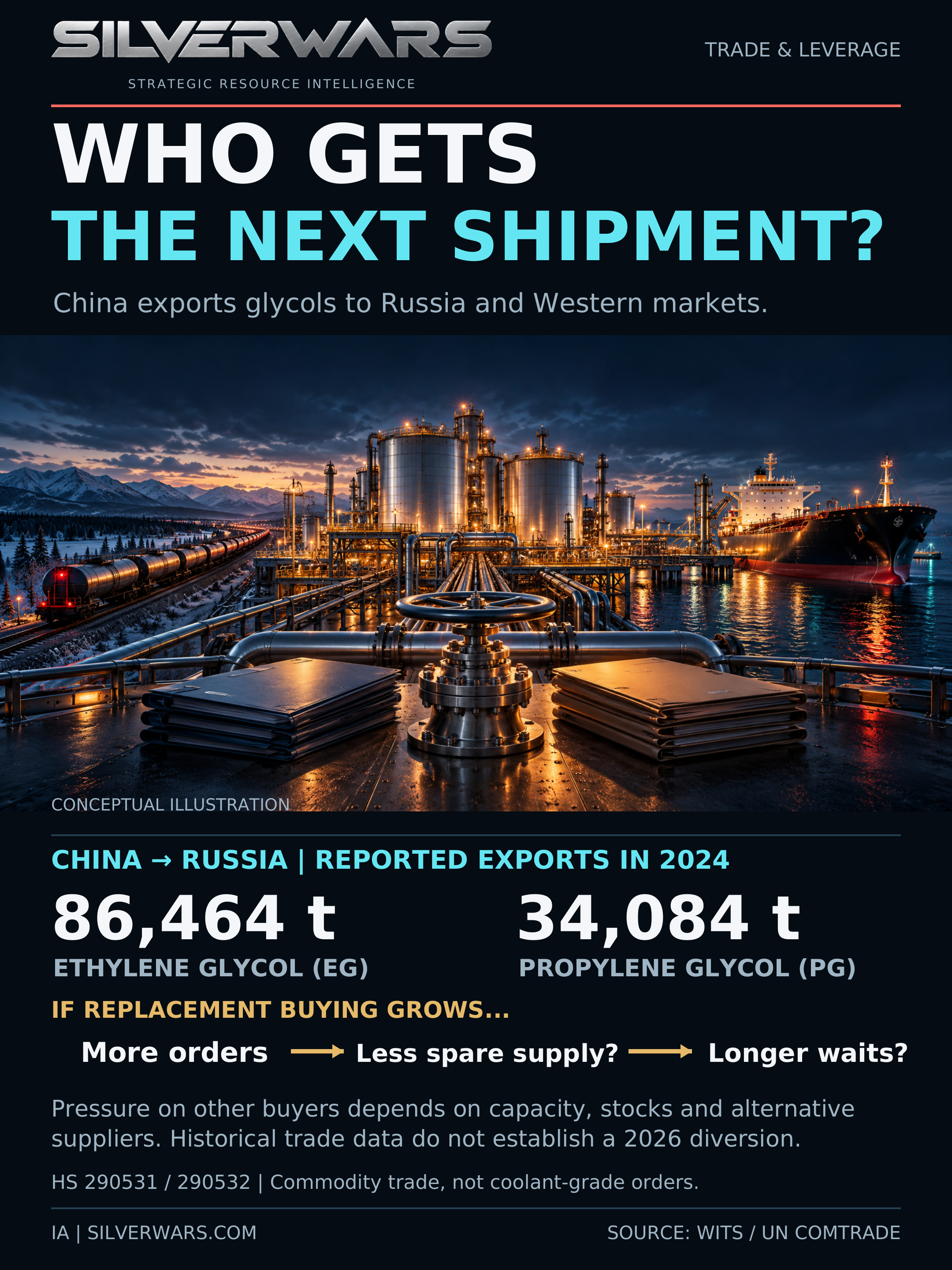
The strategic risk is a change in who can supply the next order. If lost Russian chemical output produces extra purchases from China, Chinese suppliers could gain business and stronger relationships with Russian buyers. If that demand also tightens supply available to Western customers, it could weaken their bargaining position and constrain policy options where industrial supply is strategic. Spare capacity, inventories and alternative suppliers determine whether that pressure develops.
Statecraft must account for the wider industrial system
DIMEFIL considers seven instruments of power: diplomatic, informational, military, economic, financial, intelligence and law enforcement. Air University uses these categories to organize its resources on national power. Applied here, they test whether battlefield damage strengthens the wider Western position. [4]
Ukraine's Ministry of Defence says the campaign aims to reduce Russia's economic capacity to wage war and fuel supplies to its armed forces. That stated military purpose belongs in the assessment alongside possible costs to civilian production and allied supply chains. [5]
Diplomatically, replacement dependence could make Russia more reliant on China while giving Beijing greater relevance to Western industrial resilience. Informationally, a fire or a fuel-throughput figure captures only part of the result. Public claims of success should account for production recovery, substitution and the customers who bear the costs.
Economic and financial effects include who wins replacement orders, how contracts are priced and how much capital buyers must tie up in inventory. Intelligence must establish actual unit damage, grades, stocks and supplier relationships. Law enforcement enters through sanctions, customs and diversion controls that shape which trade routes can be used.
The industrial connection behind the risk
Ryazan's industrial role extends beyond fuel. Rosneft's 2020 plant description includes liquefied petroleum gases and other feedstock for petrochemical facilities. Its product documentation also lists technical sulfuric acid from Ryazan. These disclosures explain why a refinery outage belongs in a chemical-supply assessment as well as a fuel-market report. [6,7]
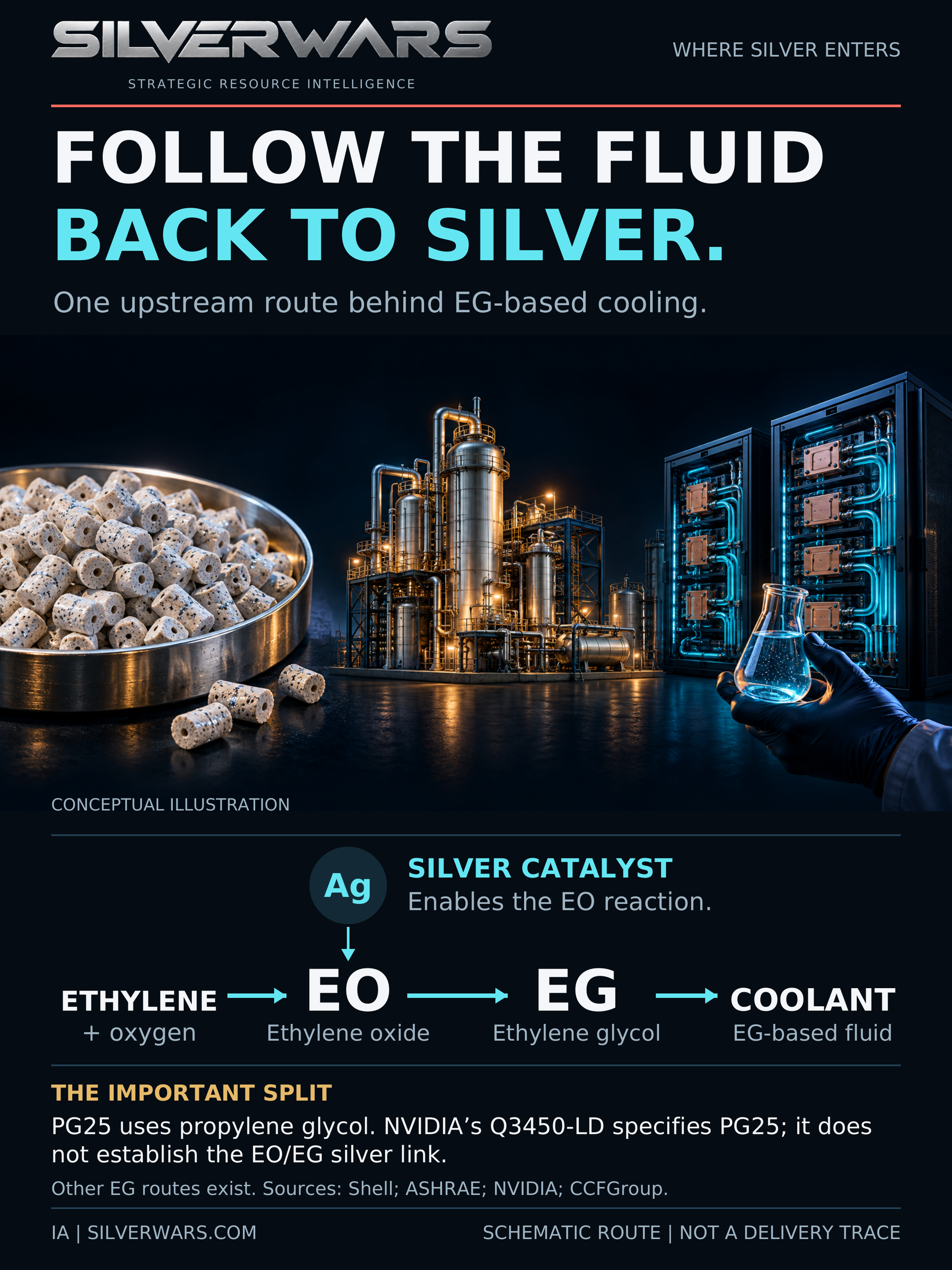
Part of the chemical supply chain behind cooling reaches back to silver. Ethylene oxide, or EO, is manufactured by reacting ethylene with oxygen over a silver-based catalyst. EO is then used to produce ethylene glycol, or EG, a chemical used in coolants and heat-transfer fluids. Where a cooling system uses EG made by this route, silver enables an upstream stage of production. [8]
An earlier attack provides a more specific industrial connection. Reuters reported that SIBUR Kstovo suspended production after the January 29, 2025 drone attack. SIBUR identifies ethylene pipelines from Kstovo to SIBUR Neftekhim for EO and glycols, as well as to RusVinyl for PVC. An upstream ethylene interruption can therefore concern linked chemical operations. [9,10]
Recovery must be included in the assessment. In June 2025, SIBUR chief executive Mikhail Karisalov told TASS that Kstovo was operating its full production cycle without restrictions on the plants it supplied. This is the operator's account of recovery. The historical attack establishes a connected production risk, rather than a continuing deficit today. [11]
Where EO connects cooling to silver
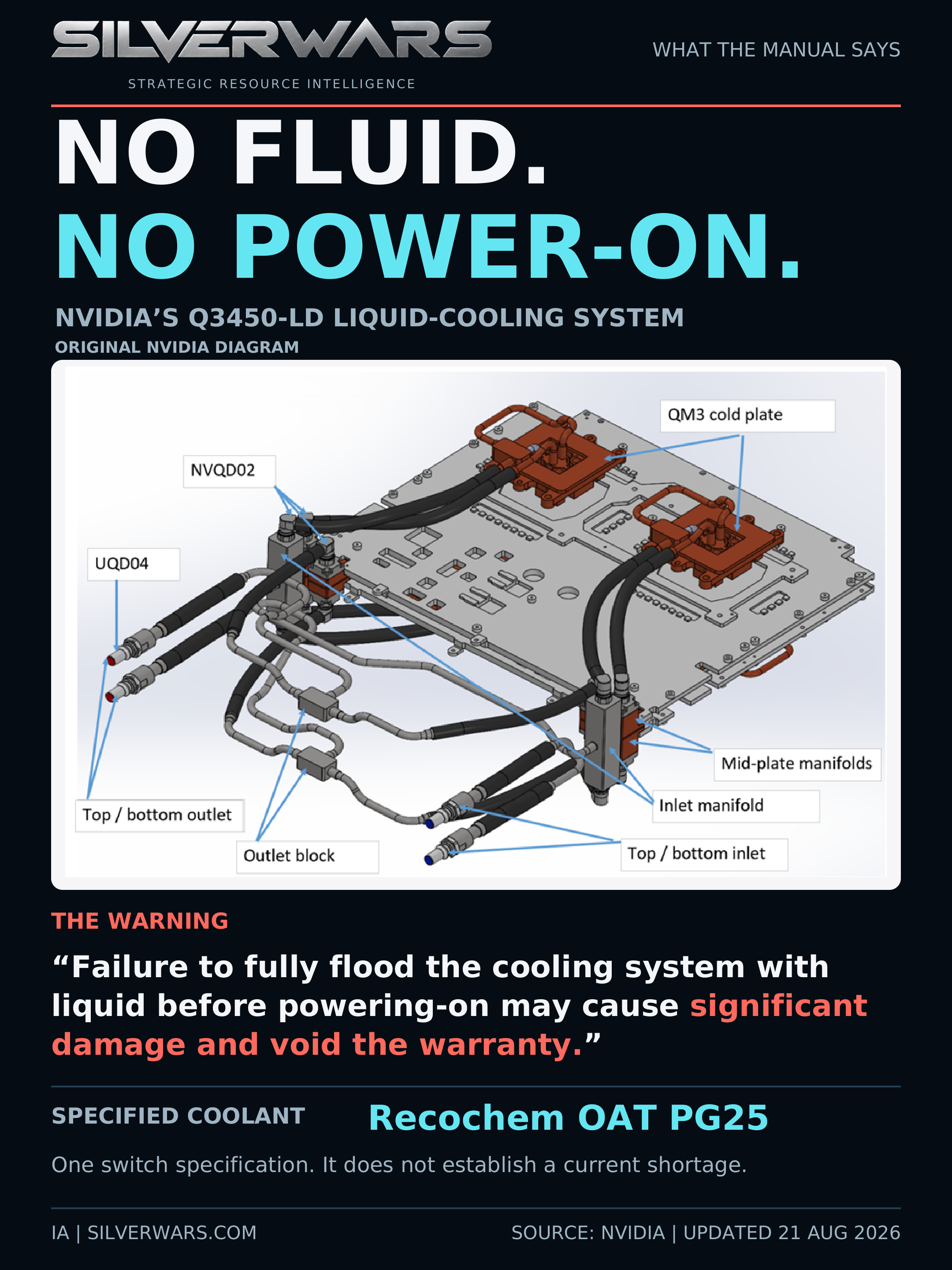
A missing approved coolant can delay bringing liquid-cooled computing equipment into service. NVIDIA warns that powering its Q3450-LD InfiniBand switch before fully filling the cooling system can cause significant damage and void the warranty. The manual specifies Recochem OAT PG25. A fluid delivery belongs on the commissioning schedule alongside the hardware. [12]
ASHRAE describes data-center cooling systems that use water, ethylene glycol or propylene glycol mixtures, refrigerants and other liquids. The facility circuit that rejects heat can differ from the circuit serving computing equipment. The chemical exposure must therefore be identified for each loop. [13]
The EO route gives silver an industrial role beyond its electrical applications. Catalyst performance helps determine how efficiently ethylene becomes EO. Shell identifies selectivity, activity and stability among the important operating measures. For an EO producer, suitable catalyst technology and an available replacement charge are part of maintaining production. [8]
That relationship does not extend automatically to every cooling fluid. Propylene glycol, or PG, is a different chemical. LyondellBasell identifies PG as a derivative of propylene oxide, or PO. The PG25 fluid in NVIDIA's switch specification cannot be used as evidence of demand for an EO silver catalyst. [14,12]
Even EG production is not a uniform proxy for EO demand. Chinese market assessor CCFGroup tracks syngas-based EG operating rates alongside the industry's overall operating rate. Establishing the production route matters before assigning a glycol shipment to the silver-catalyst chain. [15]
Qualified chemicals can constrain commissioning
A replacement shipment must meet the requirements of the system it will enter. The Open Compute Project's July 2026 PG25 specification requires high-purity PG, controlled water quality, impurity limits and documented product consistency. It also states that compliance does not establish interchangeability or functional equivalence between suppliers' fluids. [16]
An operator facing a late delivery consequently needs an acceptable formulation, with the necessary compatibility evidence and documentation. The existence of another glycol producer does not establish that a replacement coolant can arrive and be accepted before commissioning. Conversely, an already approved alternative with available stock could absorb an interruption.
Chemical qualification also matters earlier in the hardware chain. Chemtrade produces ultrapure sulfuric acid for semiconductor manufacture, with some contaminant levels measured in parts per trillion. It uses specialized production, handling and analytical equipment. These are chip-manufacturing chemicals, rather than fluids routinely purchased to run a data center. [17]
A loss of bulk sulfur or acid supply would therefore require a separate trace through the relevant semiconductor chemical producer before a chip-production effect could be established. The common issue is access to the required grade. The EO cooling pathway and the sulfuric-acid semiconductor pathway have different producers and process requirements.
Existing supply constraints and recovery both matter
Chemical supply can tighten for reasons independent of the latest strikes. Dow's 2025 annual report identifies the shutdown of a PO and PG plant in Freeport, Texas. That commercial closure predates the October attacks and belongs in the baseline against which any additional disruption is measured. [18]
Other interruptions can be repaired. Distributor GreenChem published a notice that LyondellBasell declared force majeure on all PG grades after its March 2026 Bayport fire. LyondellBasell's July 31 SEC-filed release subsequently reported that the Bayport PO/TBA operation restarted in June and ended the quarter at full operating rates. The earlier notice cannot establish an ongoing October shortage. [19,20]
New offerings also expand the options buyers can evaluate. BASF announced on October 8 that Glythermin DC PG25 had qualified as NVIDIA DSX Ready Coolant. The announcement identifies another qualified product, but discloses neither available tonnage nor delivery commitments to particular customers. [21]
Recent Chinese reporting also points to improving supply. On October 13, CCFGroup forecast Chinese EG imports of 260,000 to 270,000 tonnes for October, versus roughly 140,000 tonnes in September, mainly through increased Saudi shipments. Those were forecasts, dependent on shipping and actual discharges. They are a potential offset to tight supply, not evidence that every qualified coolant buyer is covered. [22]
Catalyst demand follows a longer operating cycle
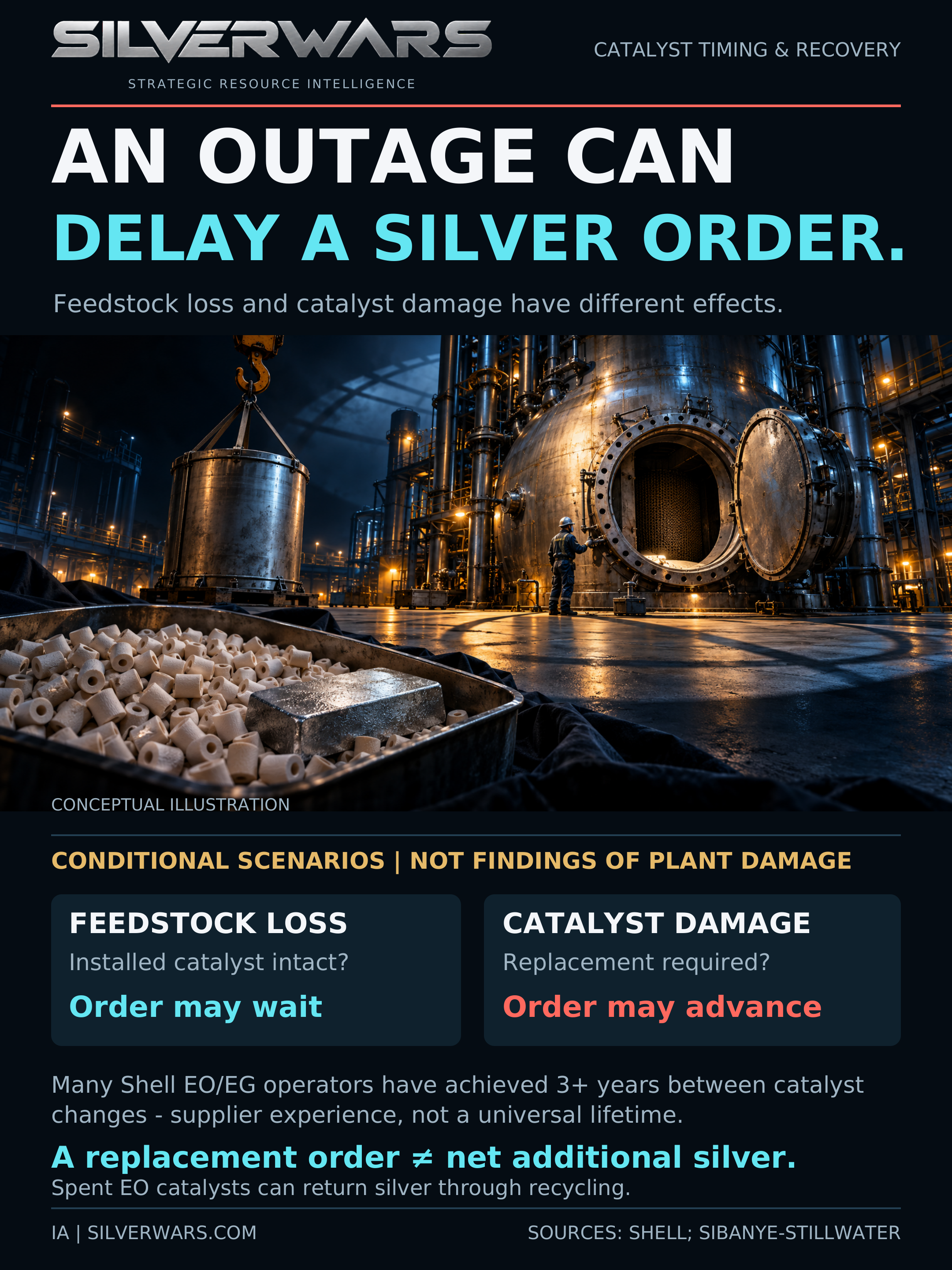
For the EO sector, the longer-term issue is how disruptions change production investment and catalyst purchasing. Shell reports that many operators using its EO technologies have achieved at least three years between catalyst changes. Scientific Design supplies three catalyst families for different production conditions and provides selection, change-out planning and turnaround support. [23,24]
A feedstock outage does not establish damage to an installed silver catalyst. Repairs could postpone a planned replacement. Confirmed reactor or catalyst damage could bring a purchase forward. A decision to replace lost EO production with a new plant could create a different requirement for an initial catalyst charge. These scenarios have different timing and cannot be combined into a single estimate of immediate silver demand.
Recovery changes the metal balance as well. Sibanye-Stillwater lists spent silver-based EO catalysts among its industrial recycling streams. A replacement catalyst order and a net requirement for additional silver are different quantities because recoverable metal can return through recycling. Repair schedules and the removal of spent material affect when that supply becomes available. [25]
China is investing in that part of the chain. A June 15, 2026 announcement from the Tianjin Economic Technological Development Area records construction of Sinopec Catalyst Tianjin's facility designed to process 1,200 tonnes a year of silver-bearing spent catalysts, with production expected in 2027. The figure measures spent-catalyst processing capacity, not silver output. The investment predates the latest strikes. [26]
Over successive operating cycles, reliable catalyst manufacture, technical support and metal recovery could influence where chemical producers place their business. For Western leverage, the material question is whether those relationships concentrate in suppliers Western buyers cannot readily replace. Orders, qualified capacity and delivery performance would have to demonstrate that shift.
The strategic test is Western freedom of action
The first effects of a sustained interruption could appear in replenishment orders, supplier allocations or longer delivery commitments. A later coolant shortage could then affect initial filling, expansion or scheduled replacement. Existing installations with usable circulating fluid and inventory would face a different timetable from projects awaiting their first fill.
The practical assessment begins with the approved chemical for each application and the producer behind it. Inventory coverage and alternative deliverable supply must be compared with the project schedule. Where the route passes through EO, catalyst access and silver recovery belong in the same assessment.
Treating Ukraine's refinery campaign as a loss confined to Russia is strategically shortsighted. A military gain can carry a wider cost if replacement demand strengthens Chinese suppliers while civilian and defense industries in the West face fewer options. The public evidence reviewed has not established that October's attacks have caused that shift or interrupted a named data center's chemical deliveries. The statecraft test is whether weakening Russian capacity also improves Western freedom of action.
Enjoy the Weekend!
Sources
Numbered links open the corresponding source. Russian and Chinese material is paraphrased in English. Sources were checked on 16 October 2026.
[1] Reuters | 16 October 2026
Ryazan CDU 6 shutdown and pipeline damage following the attack
[2] WITS and UN Comtrade | 2024 reported exports
China ethylene glycol exports by destination
[3] WITS and UN Comtrade | 2024 reported exports
China propylene glycol exports by destination
[4] Air University Library | Guide updated 19 February 2026
DIMEFIL instruments of power
[5] Ministry of Defence of Ukraine | 3 March 2026
Stated military and economic purpose of attacks on Russian oil infrastructure
[6] Rosneft | 2 November 2020
Ryazan product range including petrochemical feedstock
[7] Rosneft | Product documentation accessed 16 October 2026
Technical sulfuric acid product documentation for Ryazan
[8] Shell Catalysts and Technologies | Updated 31 October 2025
Ethylene oxide catalysts and downstream glycol applications
[9] Reuters | 13 February 2025
SIBUR planned restart after the January Kstovo attack
[10] SIBUR Kstovo | Operator disclosure accessed 16 October 2026
Kstovo ethylene pipelines to EO and glycol production
[11] TASS interview with SIBUR chief executive | 25 June 2025
Operator account of restored Kstovo operations
[12] NVIDIA | Updated 21 August 2026
Q3450 LD liquid cooling system and specified PG25 coolant
[13] ASHRAE Handbook Chapter 20 | Accessed 16 October 2026
Data center cooling loops and coolant selection
[14] LyondellBasell | Accessed 16 October 2026
Propylene oxide and its propylene glycol derivative
[15] CCFGroup | 8 October 2026
MEG operations including separate syngas production route
[16] Open Compute Project | 14 July 2026 pages 7 to 12
PG25 base specification version 1 0 0
[17] Chemtrade | Accessed 16 October 2026
Ultrapure sulfuric acid for semiconductor manufacture
[18] Dow | 2025 annual report published in 2026
Freeport propylene oxide and propylene glycol plant shutdown
[19] GreenChem Industries | Notice effective 13 March 2026
LyondellBasell force majeure on all propylene glycol grades
[20] LyondellBasell SEC filed earnings release | 31 July 2026
Bayport PO and TBA restart and June operating rates
[21] BASF | 8 October 2026
Glythermin PG25 qualification and data center coolant offering
[22] CCFGroup | 13 October 2026
Chinese MEG import forecast and recovering Saudi shipments
[23] Shell Catalysts and Technologies | Updated 31 October 2025
MASTER EO and EG process and catalyst operating cycles
[24] Scientific Design | Accessed 16 October 2026
SynDox catalyst families and turnaround support
[25] Sibanye Stillwater | Accessed 16 October 2026
Spent silver EO catalyst recovery and recycling
[26] Tianjin Economic Technological Development Area | 15 June 2026
Construction of the Sinopec Tianjin spent silver catalyst recovery facility