 Strategic Resource Intelligence
Cleaner coating chambers, refined design tolerances and better monitoring helped an Army coating effort lift yields from below 60% to above 90%, according to a September 23, 2025 report. Coating cost per component fell by 33%. Army ManTech optical-coatings report
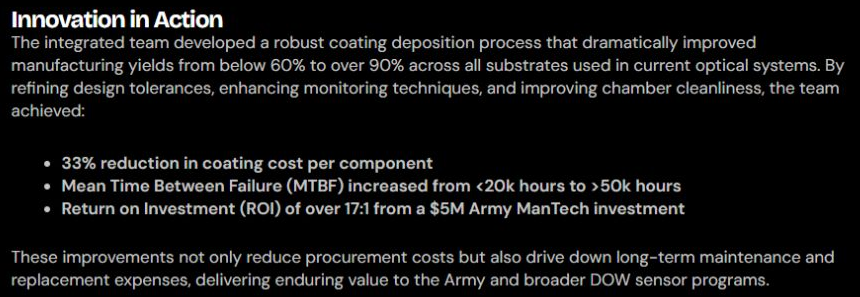
For an optical-component manufacturer, the two results belong together. Yield describes the share of production that meets requirements; coating cost describes the expense of that operation. Improving both means the reported saving came with more consistent manufacture. The account does not identify individual coating substrates or measure a 33% reduction in the cost of a complete sensor.
The difficulty had grown with the optical design. Dual-band coatings required three times as many layers as earlier systems, according to the same report. Work on preparation, deposition and testing helped make those more complex coatings reproducible. Tolerances, monitoring and chamber cleanliness were therefore part of delivering the design at an acceptable manufacturing cost. The report names advanced sensor applications, including FALCONS, but its measured result is at the coating stage.
What the Coating Must Deliver
Germanium gives that factory work a specific physical purpose. Listed among the United States’ critical minerals, the material transmits infrared radiation and can be shaped into lenses and windows for thermal-imaging systems. Those components provide an optical path to the sensor, but transmission can be lost at their surfaces. An antireflection coating reduces those losses, helping the finished germanium optic pass the radiation needed to form an image. USGS, Germanium in Infrared Optics
Jenoptik’s JENODUR 411 data sheet provides a concrete example of that finished-surface requirement. It reports typical average transmission above 98.5% across wavelengths of 8–11.5 micrometers for a 1-millimeter-thick germanium witness piece coated on both sides, with a listed incidence range of 0–15 degrees. These conditions define the supplier’s result; it is not an Army sensor measurement or evidence that this coating was used in the ManTech effort. Jenoptik JENODUR 411 data sheet, page 1
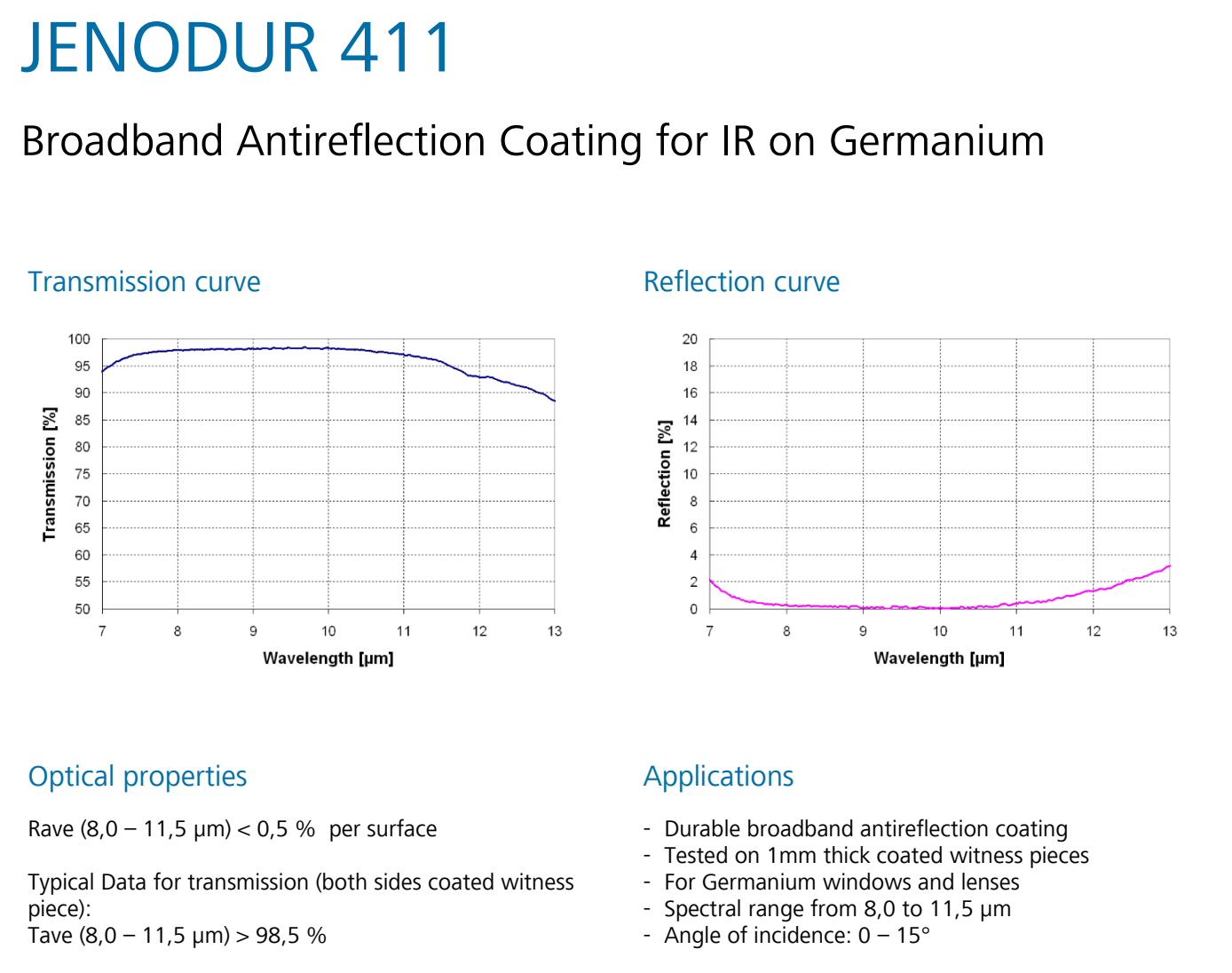
The data sheet answers a question the Army’s yield figure cannot: how well a particular coated germanium sample transmitted infrared radiation. It does not show how many components a coating line will get right. The Army result addresses that production problem, without supplying an equivalent germanium transmission measurement. A manufacturer needs the optical test and the production record together to assess whether a coating process consistently delivers usable components.
Control Begins Before Coating
In 2024, Army research topic A244-066 sought an economical way to certify the refractive index of infrared materials in the lens-blank form sold by material manufacturers. Germanium was among the named materials. The topic said findings under the 3GEN FLIR program required refractive-index accuracy of 0.001 to achieve the specified optical resolution. Army SBIR 2024 instructions, A244-066, page 46
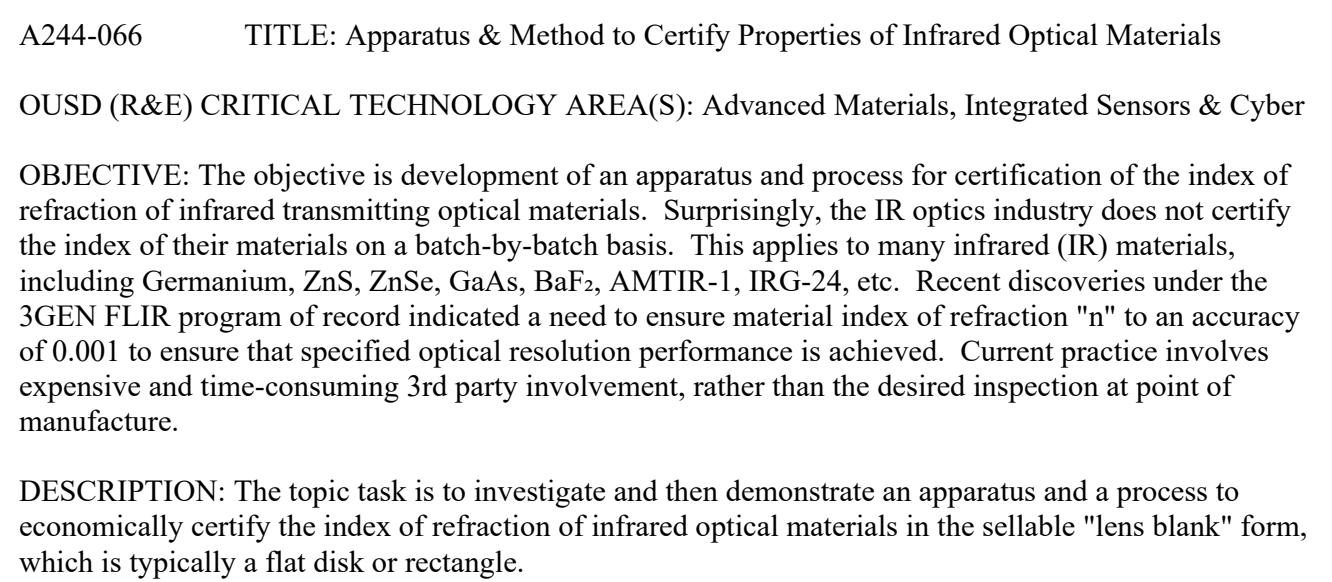
Refractive index describes how light bends in the material, so it is an input to the lens design. The proposed certification would establish that property while the material was still a flat disk or rectangle. Moving inspection to the material manufacturer was intended to replace expensive, time-consuming third-party involvement. That places useful knowledge earlier in production, before the blank becomes a finished lens. The request describes a development objective, not a verified delivery of that capability.
The two Army records show different kinds of manufacturing work: a demonstrated improvement in coating yield and cost, and a proposed improvement in measuring incoming optical material. They do not establish the next investment for every factory.
A manufacturer weighing another intervention needs a plant-level comparison: its present coating cost and yield, the improvement it expects, and the expense of getting there. The proposal must account for any new equipment, process-development and qualification work, and interruption to production. The Army account does not supply those costs, so its 33% result cannot settle the proposal. Keeping a line that already meets optical requirements at high yield and acceptable cost can be the better choice if the proposed change would cost more than it saves.
The reported 33% saving is valuable because the coating operation became less costly while a larger share of its output met requirements. For germanium optics, that is the manufacturing task worth keeping in view: carry the mineral’s ability to transmit infrared radiation through processing and into consistently usable components. The material provides the optical capability. Production control determines how reliably the factory delivers it.