 Strategic Resource Intelligence

PAID PROMOTION | Disseminated on behalf of Gunnison Copper Corp. Gunnison Copper Corp. has paid SilverWars LLC total cash compensation of US$[90,000] under a [August 2026-August 2027] investor-relations agreement that includes creating and distributing this post. SilverWars receives no securities compensation and does not hold or trade Gunnison securities. [Full compensation details].
Nexans bought about 449,000 metric tons of copper in 2025, according to its annual filing. That group purchase total excludes another 125,000 tons processed for customers. It describes material moving through factories, with customer orders at the other end—not a single mill’s cathode requirement.
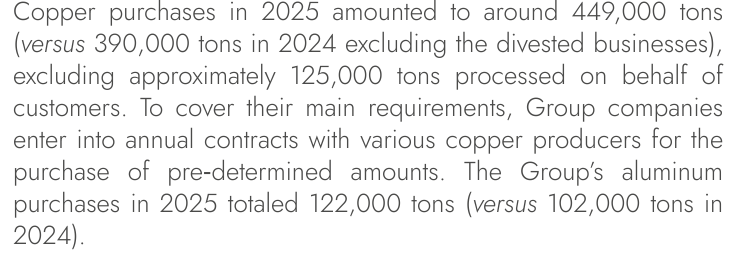
For those factories, copper has two prices worth watching: the price of acquiring the metal and the cost of holding enough of it to keep production moving. A cheaper shipment that arrives later can leave more cash tied up in copper inventory. A more expensive source can be worth considering when its accepted deliveries let the plant operate with less inventory.
The distinction gives the wider copper market a useful industrial question. Beyond the amount of metal a buyer purchases, what makes that supply usable? Electrical properties, conversion performance and arrival dates all contribute to the answer. A supply agreement earns its value when the mill can turn the copper into the product its customer ordered.
Gunnison Copper sits at the refined-metal end of this chain. In its September 22 announcement, the company reported that Johnson Camp had reached commercial production, producing finished copper cathode from Arizona mineralized material at the mine. Cathode is a feed material for rod production. Nexans’ manufacturing system shows why that form of copper has industrial value: it can be converted into the conductor that an electrical customer actually needs.
A cable order becomes a copper requirement
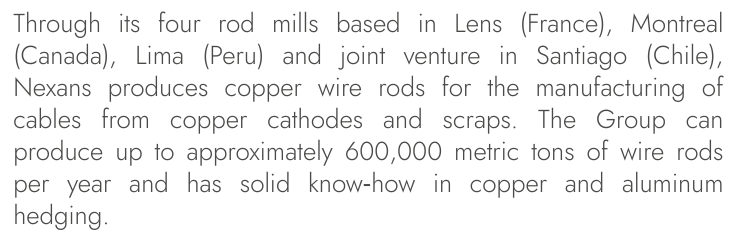
Nexans operates four rod mills that convert copper cathode and scrap into rod for Nexans factories and other cable manufacturers. This is the practical bridge between refined metal and a finished conductor. Cathode is melted and cast; rod is subsequently drawn into wire; the cable manufacturer builds the specified product around that conductor.
Copper, included on the United States’ final 2025 critical-minerals list, is useful here for a specific physical reason: electrical resistance consumes energy and produces heat under load, and copper conducts electricity well. As the Copper Development Association explains, conductor sizing affects voltage drop and resistive losses. The designer has to fit the required electrical performance into the available space, together with insulation, connections and installation clearances.
For a facility that runs continuously, those properties keep doing work long after the cable has been paid for. They help explain why a customer orders a particular conductor rather than an undifferentiated weight of metal. Aluminum can serve suitable designs, with different sizing and connection requirements. Changing conductor material in an existing order can therefore involve engineering and product changes as well as purchasing.
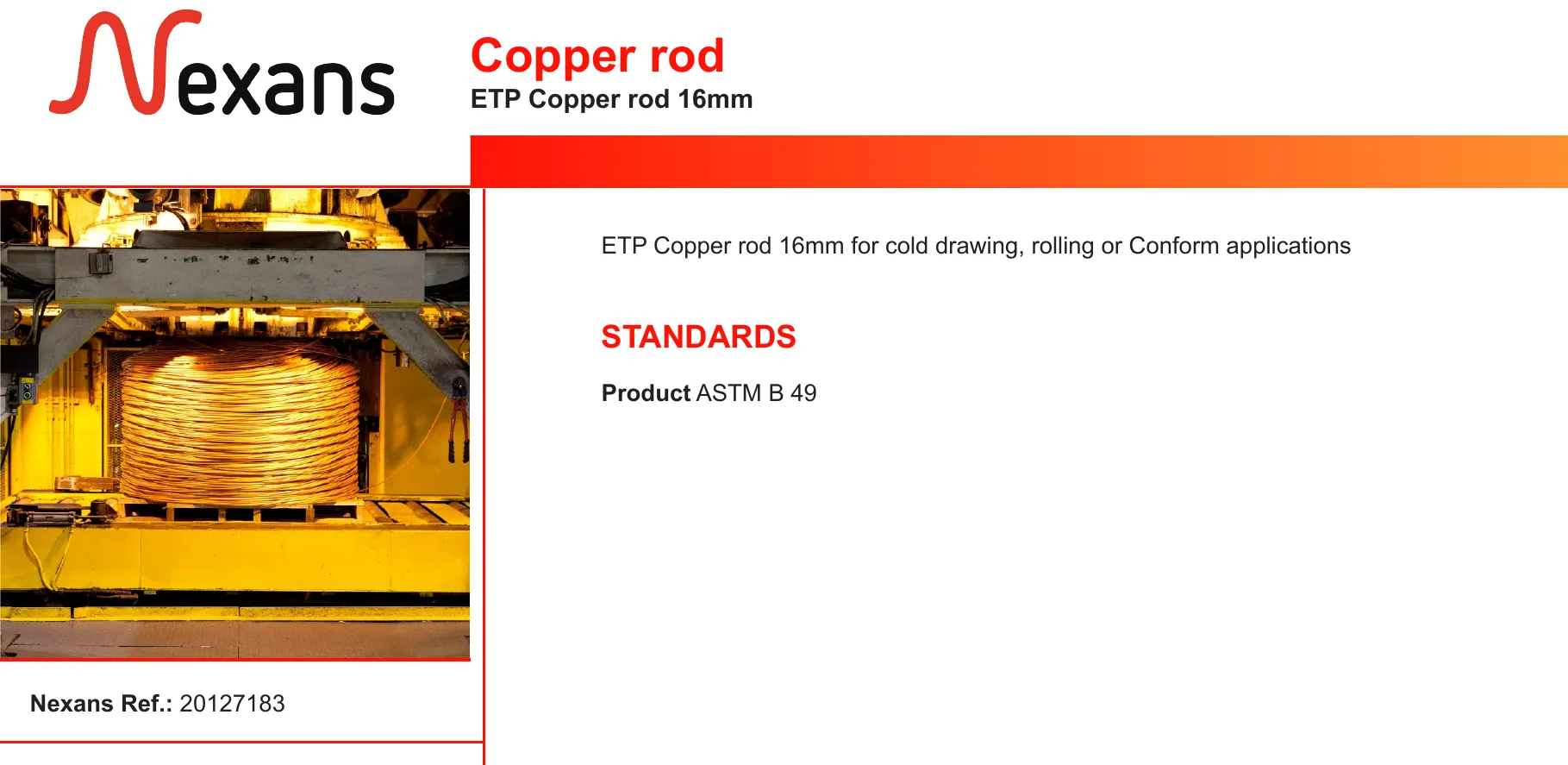
Nexans Canada’s product page makes the electrical requirement tangible: its listed electrolytic tough-pitch copper rod has a minimum conductivity of 101% IACS at 20°C. IACS is a conductivity reference based on a historical annealed-copper standard. A value above 100 compares with that reference; it is not a purity percentage. The mill is producing a defined electrical material.
Copper then has to survive manufacture. Drawing reduces rod through dies to the required wire dimensions. The metal’s ductility permits that deformation; work hardening changes its mechanical state, and annealing restores softness where the process requires it. A conductor has to emerge with both the electrical properties and the physical form the cable needs.
Horace Pops’ technical account of copper-wire metallurgy explains how impurities affect resistance and annealing behavior. This 1997 reference describes the mechanism, rather than any current Nexans production result. Its relevance is straightforward: lots that behave consistently help a converter keep the process consistent. A purchase-price saving has to survive the work required to turn the material into saleable wire.
The delivery date has a financing cost
Imagine a mill using 100 metric tons of accepted copper feed per operating day. It holds 500 metric tons ready for production. These are illustrative assumptions, not Nexans operating data. With no incoming material, the mill has five operating days of cover.
Now compare two delivery schedules. One shipment becomes usable before the sixth day’s run. Another becomes usable before the eighth. In the second case, two operating days have to be bridged by existing arrangements, an alternative delivery or another 200 metric tons held at the plant. Both shipments may contain equally suitable copper. They arrive with different inventory consequences.
Using an assumed inventory value of US$10,000 per metric ton, the extra 200 tons ties up US$2 million. If maintaining that permanent buffer carries an assumed annual financing cost of 10%, the cost is US$200,000 a year, before storage, insurance and handling. Neither assumption is a market quotation or a description of Nexans’ finances.
Suppose an alternative supply arrangement costs an extra US$120,000 a year in freight, metal premium and qualification work. If its deliveries genuinely allow the plant to remove that permanent buffer, the illustrative financing saving exceeds those extra costs by US$80,000 a year. The plant also releases US$2 million from inventory. Released working capital and annual savings are different benefits; adding the entire US$2 million to annual profit would count the same copper inventory incorrectly.
The phrase “allow the plant” carries most of the weight. A promised shipment that still leaves the two-day gap cannot support the modeled inventory reduction. Nor can a delivery that reaches the gate on time but remains unavailable while sampling or acceptance work is completed. The useful date is the date the mill can consume the metal.
The material check starts before that date. ASTM B115 specifies cathode chemistry, physical condition and electrical resistivity; those are feed requirements, distinct from the finished rod’s conductivity. Nexans says it feeds high-grade copper to its Montreal process. For a buyer considering another route, the practical question is whether the lot evidence meets the agreed incoming specification and whether the mill’s quality team has accepted its use in the required process. Any sampling, trial conversion or approval still needed belongs in the delivery schedule before the buyer counts that material as available for production. That is a purchasing implication, not a description of an unpublished Nexans test procedure.
This is why the lowest metal premium need not produce the lowest total cost. Price, lead time and copper inventory belong in the same comparison. The example also explains why holding more copper can be entirely rational: where delivery uncertainty remains, inventory provides time. A supply source becomes more valuable when it reliably provides some of that time instead.

The form of the metal changes the answer
At Montreal East, Nexans describes a continuous casting and rolling mill operating at 52 metric tons an hour. The company also identifies a nearby refinery as an established cathode source. The arrangement brings metal supply and conversion close together; it illustrates why the location and form of incoming copper matter alongside chemistry.
An additional cathode delivery can feed a suitable rod operation. It cannot go straight into a wire-drawing line. If the interruption is at the rod mill, more cathode at its gate may leave the cable plant waiting. Accepted rod from another functioning route addresses a different part of the problem. Calling both shipments “copper supply” obscures the manufacturing stage they can actually serve.
The 2025 Nexans filing describes annual producer contracts for predetermined quantities, longer-term arrangements with volume flexibility, and systematic qualification of alternative sources. Those practices can coexist. A manufacturer can maintain committed supply while developing another accepted route for a defined portion of its production.
Johnson Camp provides a concrete example of domestic production at the cathode stage. Gunnison says the operation reaches finished copper onsite without offshore smelting or refining. That places its product beyond mined material and upstream of rod casting and wire drawing. For the manufacturing chain, the useful addition is refined feed that a converter can process; the mine’s production figures alone cannot tell a cable buyer when accepted material would reach its own line.
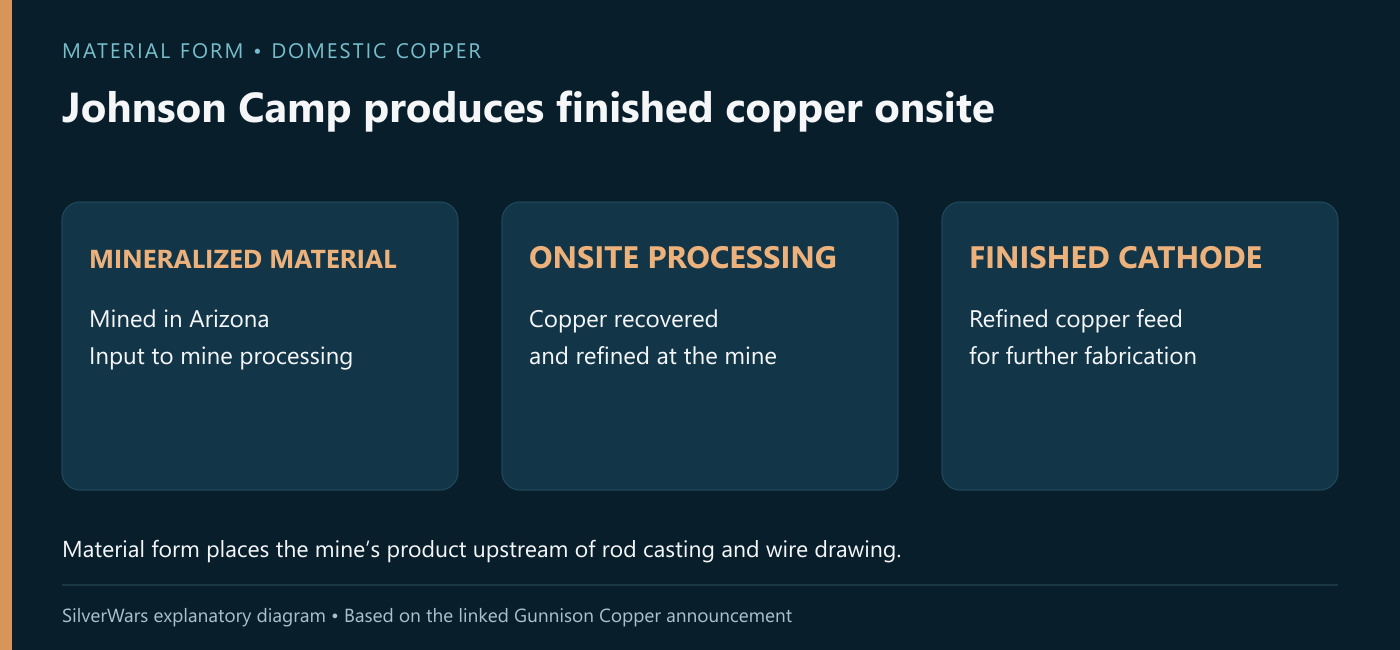
The commercial route is also specific. Johnson Camp’s March 2025 technical report disclosed Nuton’s right to market all of its cathode until Stage 2 funding was recouped. Gunnison’s June 2026 financial statements describe revised funding and copper-sales arrangements, without expressly releasing that marketing right. Those records give no basis for treating the output as uncommitted cathode inventory available directly to any cable maker. No Nexans–Gunnison supply agreement is established here, and the earlier inventory calculation describes a hypothetical mill—not savings demonstrated by Johnson Camp deliveries.
Recycling gives the mill another route
Nexans is also investing in the ability to change the mix of copper it processes. Its April 28, 2026 presentation describes the planned Lens casting and refining project as providing greater flexibility between scrap refining and primary copper use from 2027. The diagram brings different inputs into the same rod output. It describes a planned capability, rather than completed production.
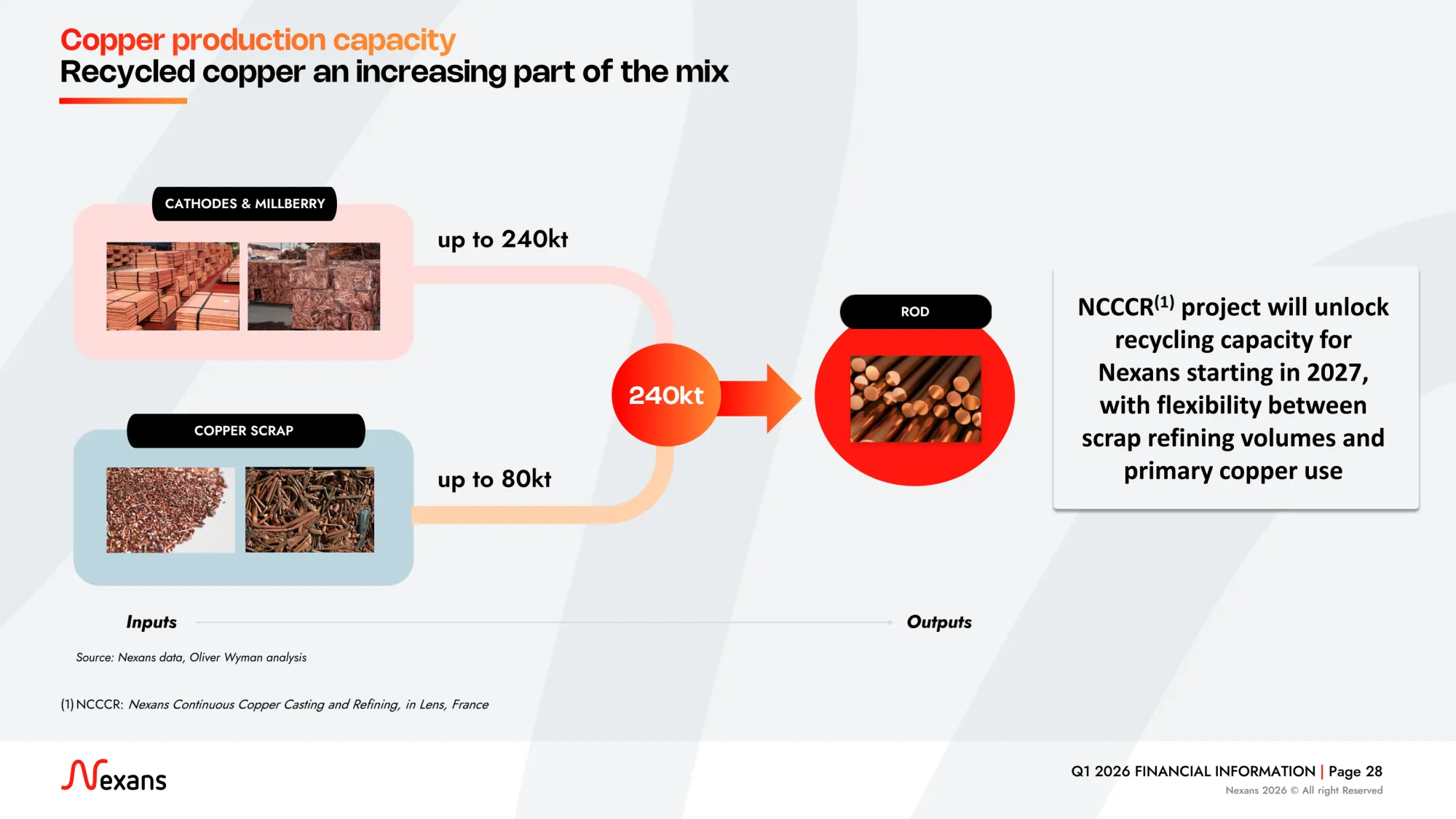
Recovered copper has to be collected, prepared and processed into material the receiving operation can use. Primary cathode reaches the chain as refined metal for further conversion. A plant equipped to work with both has more ways to supply the copper properties its customers require, within the limits of its process and available feed.
That is a more concrete picture of copper demand than a purchase total alone. Behind the tonnage are products that must conduct electricity, factories that must convert the metal and cash committed while the material waits. Better supply can improve that combination without changing how much copper sits in the finished cable.
In the mill example, the more expensive arrangement earns its place only because it makes usable copper available soon enough to carry less copper inventory. The cable customer still receives the same specified conductor. The difference is the time and capital the manufacturer has to commit to deliver it.
Qualified Person company source
Gunnison's September 22, 2026 commercial-production announcement identifies its Senior VP of Project Development, Dr. Roland Goodgame, as a Qualified Person under NI 43-101 and attributes approval of that announcement's technical content to him. This statement concerns that company news release; it does not claim that Dr. Goodgame reviewed or approved this SilverWars article.
Cautionary Note Regarding Forward-Looking Information
Where this article discusses future events, those statements are forward-looking information rather than established results. Depending on the matters discussed, they include anticipated production and capacity; Nuton technology, Stage 2 funding and work programs; expected payments or tax-credit receipts; exploration, engineering, permitting and project development; preliminary economic assessment or pre-feasibility outcomes and schedules; anticipated contributions from personnel; and a proposed NYSE American listing or ADR program. Such expectations depend on the assumptions in the cited company disclosures, including continued partner funding, adequate financing, resource estimates and recoveries, metal prices, project and operating costs, access to labour and supplies, and receipt of required permits and regulatory or exchange approvals. Actual outcomes and timing may differ materially because of funding or liquidity constraints, operational or construction difficulties, cost changes, commodity-market conditions, estimation uncertainty, environmental or title issues, personnel changes, or delayed or refused approvals. Capacity, development plans and study estimates are not guaranteed production; expected receipts are not cash already received; and listing pre-clearance is not final listing approval. Readers should consider the assumptions, conditions and risk discussions in the linked company announcements and current filings alongside the relevant statements. A future event is not assured merely because it appears in this article.