 Strategic Resource Intelligence
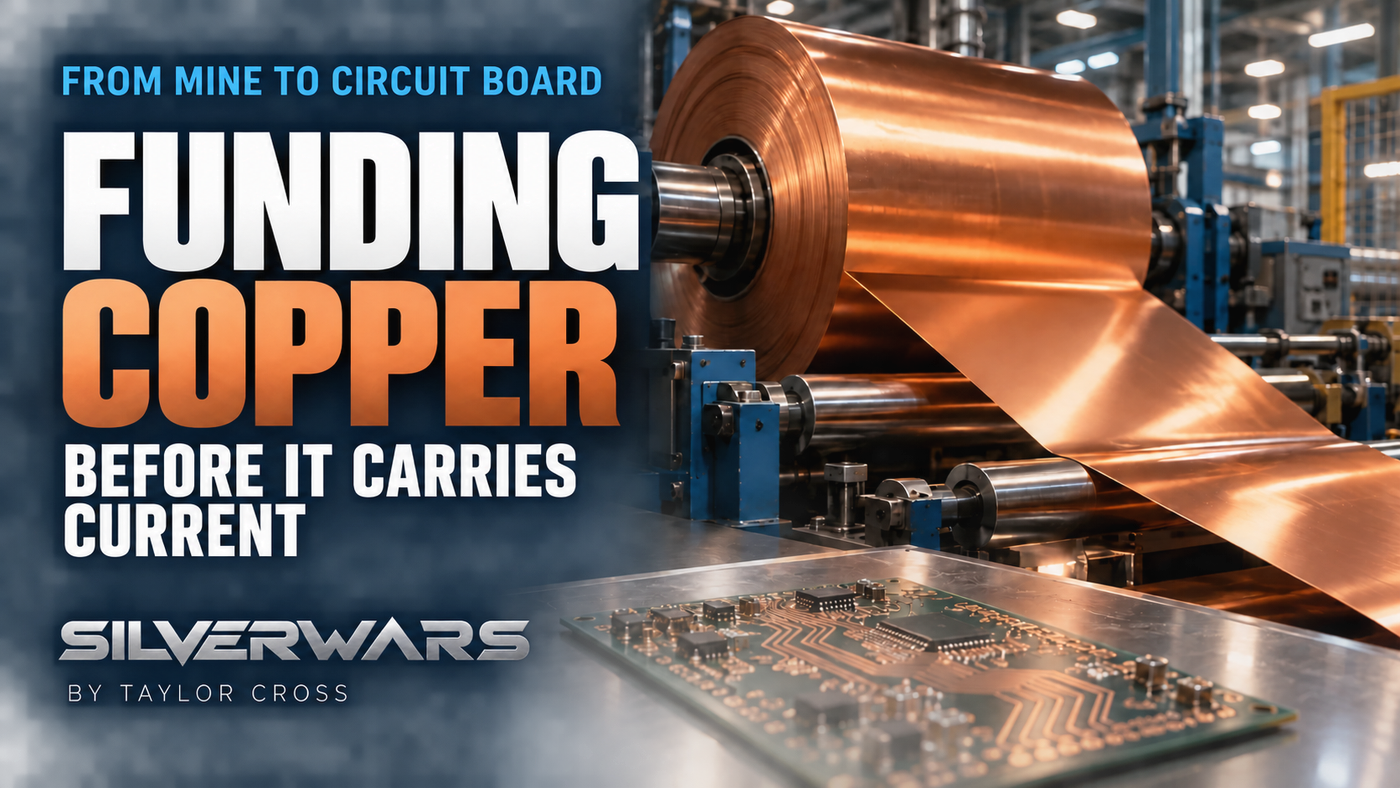
The War Department announced a $37.2 million contract supporting electrodeposited copper-foil production in South Carolina. Awarded on April 27 with a 30-month term, the contract concerns a manufactured copper input used in printed circuit boards, advanced radio-frequency systems and electromagnetic shielding.
The copper in a circuit board has already been through several businesses. Metal had to be recovered and refined, then made into foil with properties suited to the next manufacturing step. Each operation paid for equipment and material before the finished board could be sold. The funding announcement describes one part of that physical and financial sequence.
This helps explain why two announcements about “copper funding” can concern quite different industrial activities. One may finance production equipment. Another may support inventory while an order is being completed. A third may provide credit to an investment fund that subsequently finances companies. The metal can be essential to all three transactions while the borrower, use of proceeds and timing differ.
A thin sheet with an electrical job
Copper foil is the conductive basis of printed circuit boards and the anodic current collector in lithium-ion batteries, as electrode-technology supplier De Nora describes. These are separate applications for a manufactured sheet of the same metal. In both, copper has a function within the product rather than merely a presence in the bill of materials.
Electrodeposition creates foil from copper-bearing solution. Subsequent production steps give the sheet the form required by its customer. The factory’s output therefore contains two things a buyer needs together: copper and the manufacturing work that makes that copper usable in the next process. Purchasing refined metal alone leaves that work to be done somewhere else.
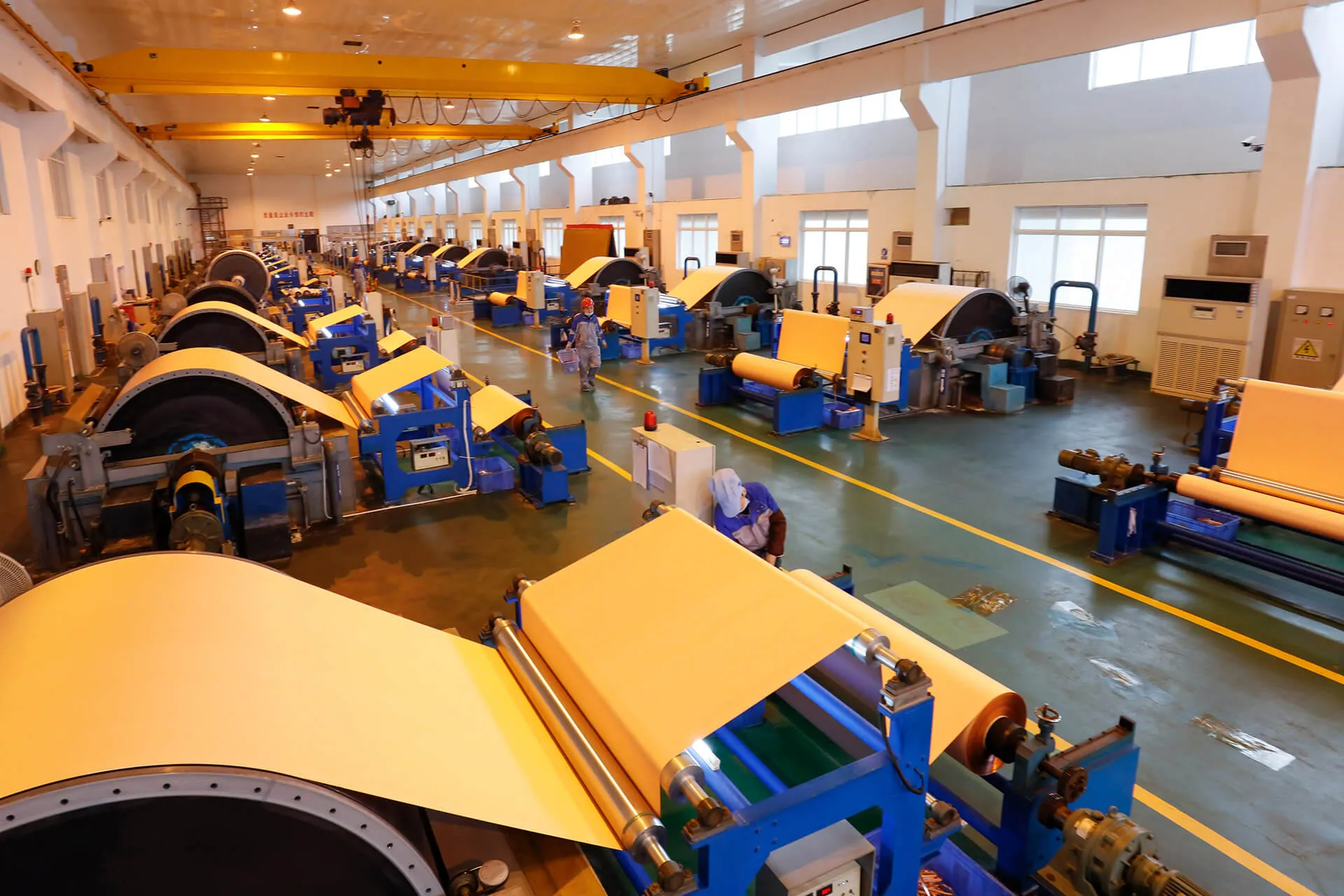
The U.S. manufacturing chain extends well beyond foil. USGS’s 2026 copper summary describes refined copper and scrap entering about 30 brass mills, 14 rod mills and several hundred foundries and other manufacturers. Copper and copper-alloy products then serve construction, electrical and electronic products, transportation and machinery. Primary metal and recovered copper enter this system through different routes.
The physical reason for those uses includes copper’s conductivity, ductility and malleability. A conductor must carry current; a manufacturing process must also be able to make the required shape. The commercial transaction concerns the resulting material or component, with its form and production history, as well as the metal contained in it.
 Taylor Cross
Building the line and supplying the line
A production line can operate for years. The copper entering it changes with each production cycle. That difference separates the cost of establishing capacity from the cash needed to keep material moving through it.
Consider a hypothetical fabricator that pays for metal before its customer pays for the finished order. The copper first appears as inventory, then as work in progress and finally as a product ready to ship. The sale may create a receivable before cash is collected. The timing depends on the actual purchase and sales contracts; this example supplies no assumed price, volume or collection period.
Several stages of that cycle can be active at once. One order may be waiting for payment while another is on the line and material for the next has already arrived. Equipment finance and working capital consequently relate to different assets and cash flows, even when they support the same facility. A building and its installed machinery do not describe the full amount of money occupied by production.
EXIM’s critical-minerals page gives a specific example of financing linked to that cycle. Its working-capital guarantees support international sales orders and allow inventory and foreign accounts receivable to serve as collateral for participating lenders. The same page describes supply-chain finance guarantees that finance receivables of U.S. suppliers to exporters. These products address transactions in an operating supply chain.
EXIM’s Make More in America description concerns another use: capital investment to establish or expand domestic manufacturing or infrastructure associated with exports. For covered critical-minerals projects, the stated export connection is 15% of production or expected shipments, compared with the normal 25% requirement. Those percentages describe an export relationship, not the share of construction cost financed. Other program requirements also apply.

What an operating record tells a lender
Production equipment has a planned output. Financing analysis also examines whether the operation can produce and sell that output in a way that supports repayment.
DOE’s May 2026 Title 17 guidance, printed page 15, places repayment prospects alongside technical viability and commercial readiness among its baseline criteria. The technology evidence concerns performance under expected process conditions at near-commercial scale. Repayment concerns the borrower’s ability to pay principal and interest on the guaranteed loan and other project debt.
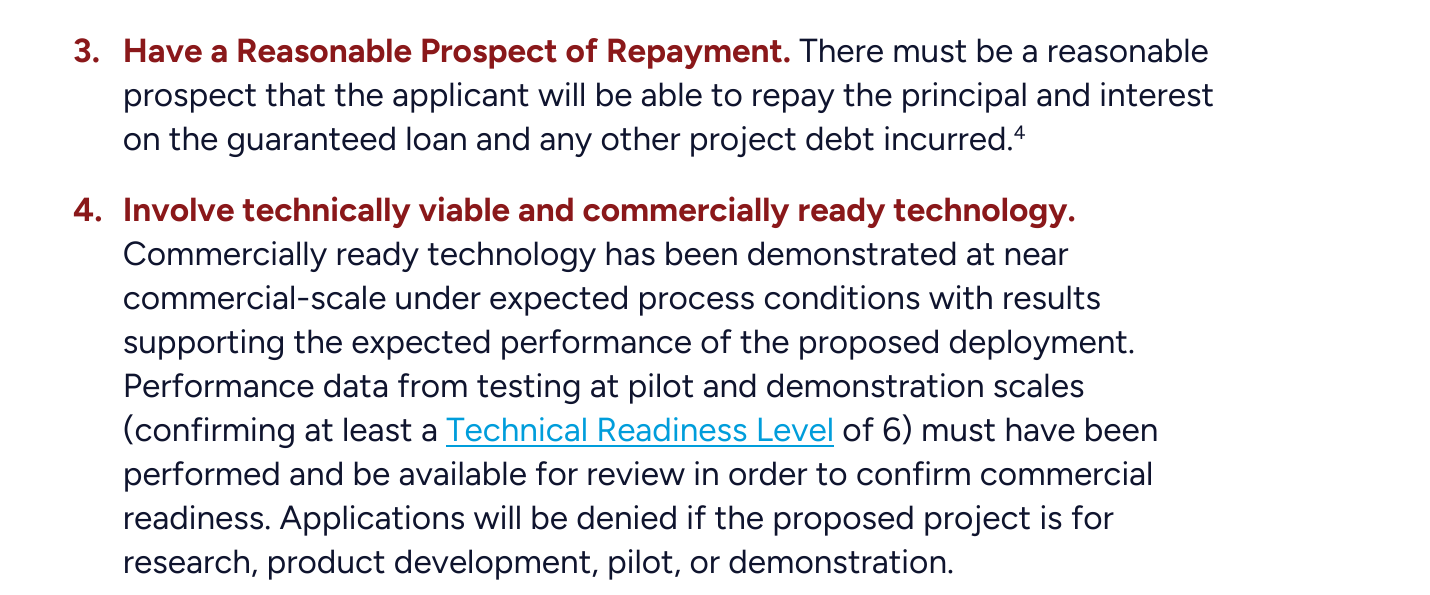
These subjects connect engineering to cash flow without making them interchangeable. A process result describes what equipment and material did under particular conditions. A repayment assessment includes the financial obligations of the proposed project. Production is part of the connection because an operation’s output, costs and sales affect the money available to service debt.
The guidance accepts prior pilot or demonstration results as part of the technical evidence while excluding proposed projects whose purpose is research, product development, pilot work or demonstration. That distinction concerns the purpose of the financing being requested. It does not mean that a commercial technology lacks a testing history. The guidance contains further eligibility and transaction requirements, so these provisions alone establish no company’s eligibility.
When the borrower is an investment fund
The Office of Strategic Capital’s National Security Fund Finance program introduces another relationship. It provides loans to qualified investment fund managers, which combine that borrowing with private capital to invest in companies addressing specified critical-mineral and material needs. Its current page states a November 1, 2026, 5 p.m. EDT deadline for complete proposals.
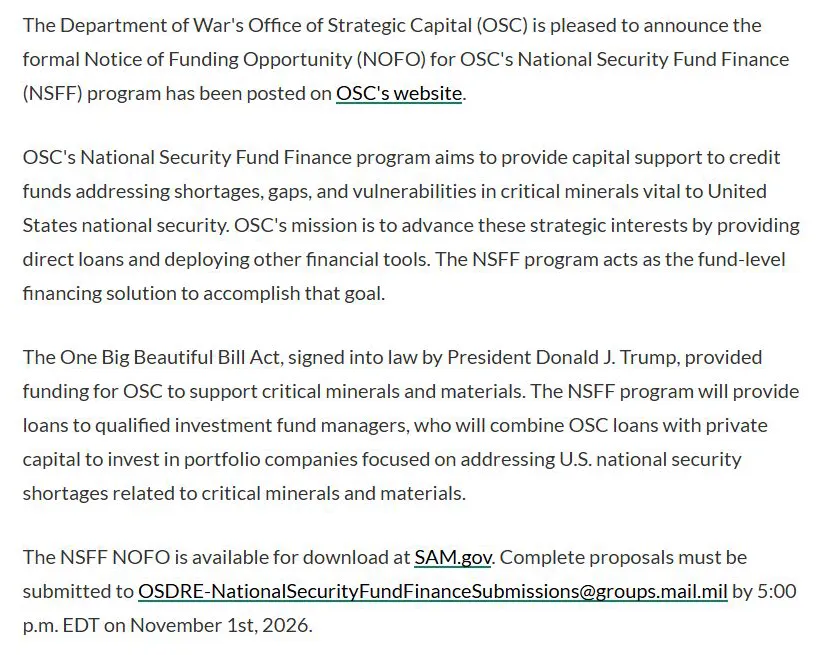
The fund manager is the applicant described by the program. A business financed by the fund occupies a different position. The public loan and the company-level investment are separate transactions, with the fund between them. A program announcement at the first level therefore describes a financing structure; a particular company’s investment requires its own record.
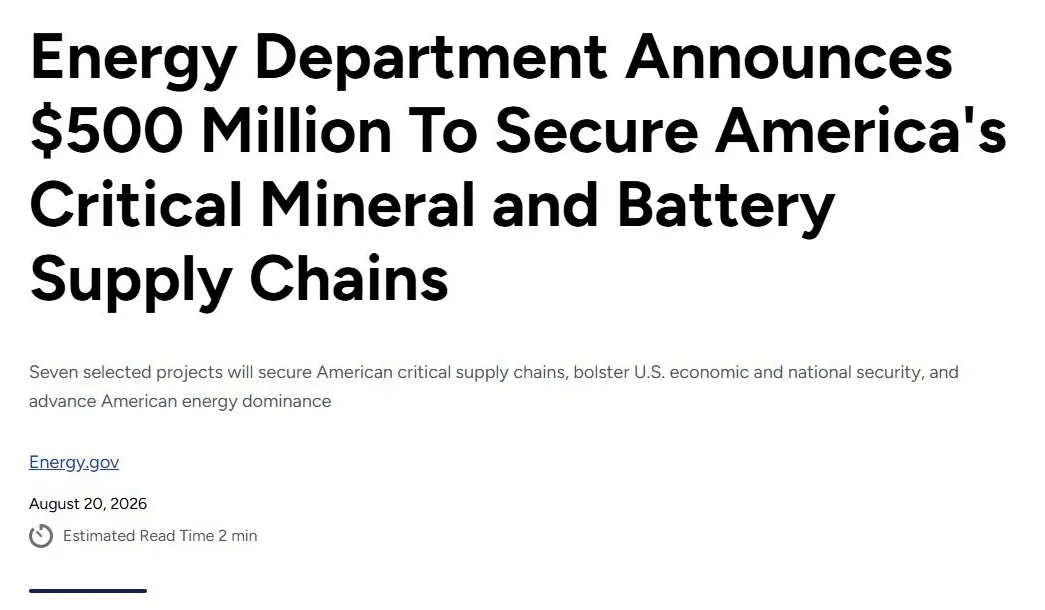
Other recent announcements describe different stages again. DOE’s August 20 announcement identifies $500 million across seven selected processing, manufacturing and recycling projects. Its July 24 common screening application is an intake and referral mechanism that can send information to participating federal partners. A selected project and an initial submission are at different points in a process; neither phrase supplies the terms or payment history of a completed transaction.
 Taylor Cross
The product at the other end of the financing
The South Carolina contract connects a dollar amount and a performance period to copper-foil production. Working-capital support concerns assets moving through sales cycles. A project loan ties financing to a borrower and an operating proposal. Fund-level credit adds a separate investment decision before money reaches a company.
For a business using copper, the connection among these activities is the input it receives. Cathode can be the product sold by one operation and the material purchased by another. Foil is further along a different manufacturing route. Each transfer changes the work already completed and the work the next customer still has to perform.
That is where the industrial and financial descriptions meet. The finished circuit board contains copper that has carried costs through recovery, refining and fabrication before it carries current. Funding records describe how particular parts of that sequence are financed. The production record describes the material that comes out of it.