 Strategic Resource Intelligence

PAID PROMOTION | Disseminated on behalf of Gunnison Copper Corp. Gunnison Copper Corp. has paid SilverWars LLC total cash compensation of US$[90,000] under a [August 2026-August 2027] investor-relations agreement that includes creating and distributing this post. SilverWars receives no securities compensation and does not hold or trade Gunnison securities. [Full compensation details].
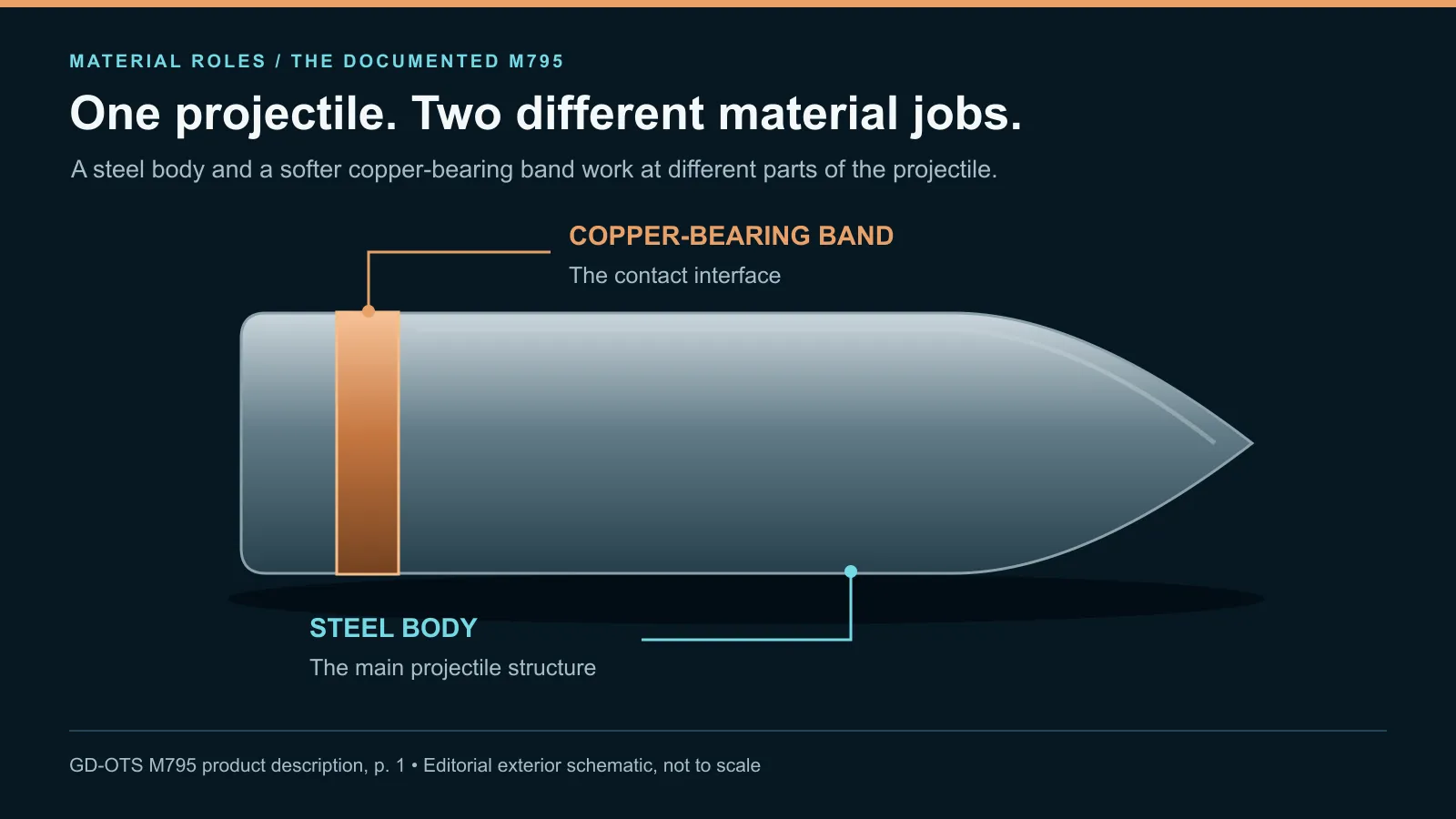
A steel artillery shell has a job for a softer metal. On the Army's M795, a copper-bearing band around the body helps the projectile engage the barrel and leave it spinning. The material at that contact surface has a different job from the steel body.
General Dynamics Ordnance and Tactical Systems describes the M795 as a steel-body projectile with a “gilded metal rotating band.” An Army photograph from Scranton Army Ammunition Plant identifies the copper band in production. Together, those records place copper in a specific mechanical component, where its ability to change shape is useful. The band earns its place during launch, before the projectile reaches its destination.
Softness does useful work
The Army's explanation of the rotating band begins with soft metal. During firing, pressure forces that material into the barrel's rifling, the grooves that impart rotation. The band forms a seal that keeps propellant gases from passing around the projectile. Its engagement with the rifling also transfers spin, helping stabilize the shell in flight. Copper-bearing metal at this interface therefore contributes two connected functions: sealing and rotation. The ability to conform is part of the component's purpose.
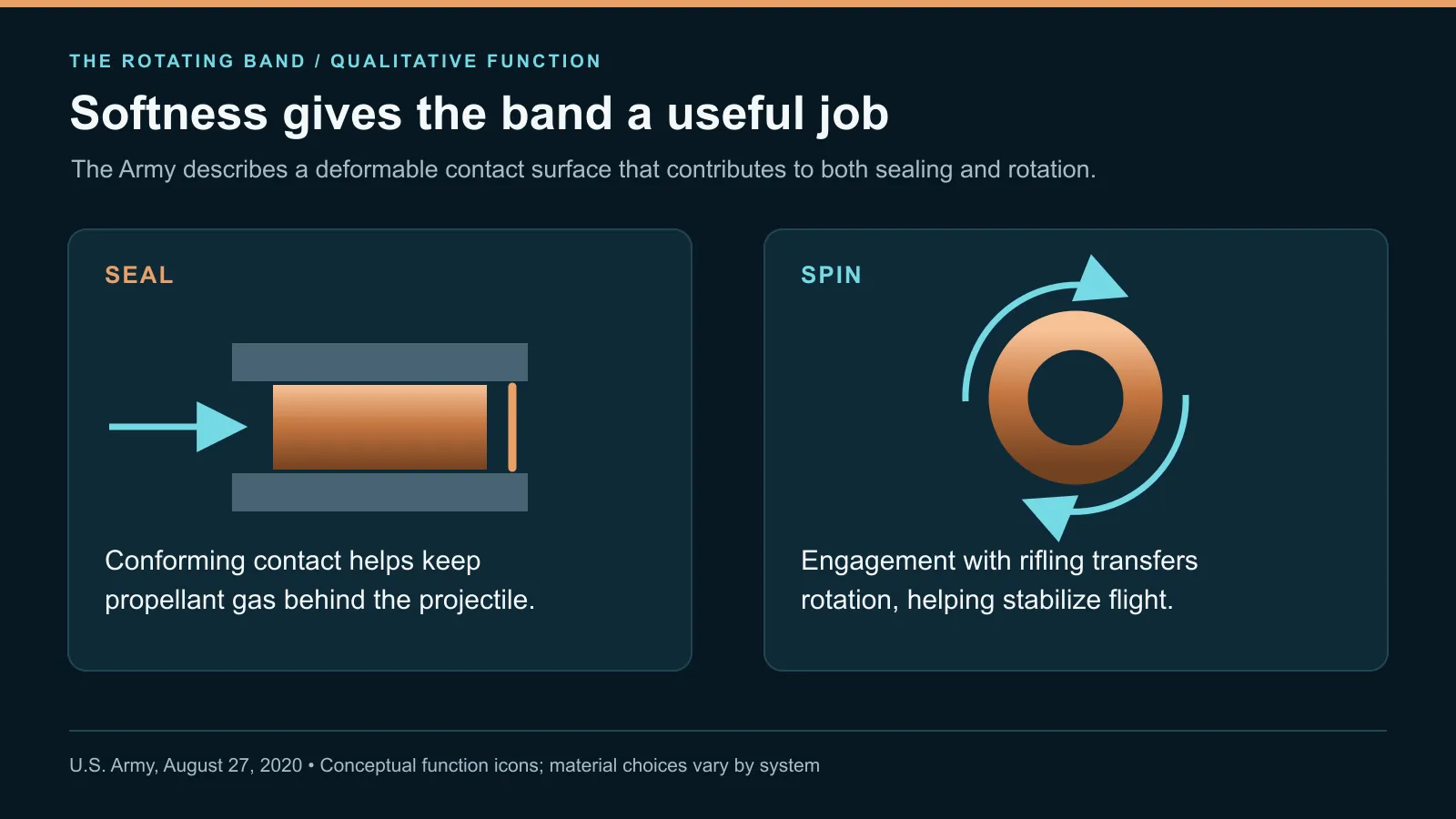
Copper has historically supplied those functions while limiting damage to the gun tube, according to the Army's account. That makes the contact surface a place where comparative softness has a practical advantage: it lets the band conform against the barrel rather than asking the main steel body to do the same work.
This is a different side of copper from the one familiar in cables and motor windings. There, electrical conductivity carries the argument. Here, the important behavior is deformation under contact. The band changes shape to engage another surface. A mineral's relevance to defense manufacturing can therefore be missed if the search stops at wiring or at the largest material in a product.
The steel body supplies the projectile's main structure; the copper-bearing band supplies a deformable interface around it. Describing the product as steel identifies its dominant construction, but misses the different behavior required at that contact surface.
The material description also deserves care. The manufacturer's wording identifies a copper-bearing metal rather than establishing a pure-copper band. The Army's broader technical account discusses copper and copper alloys, alongside research into other band materials for different operating conditions. The M795 gives this article a documented example; it is not a reason to assign the same material to every projectile design.

The band has its own place on the factory floor
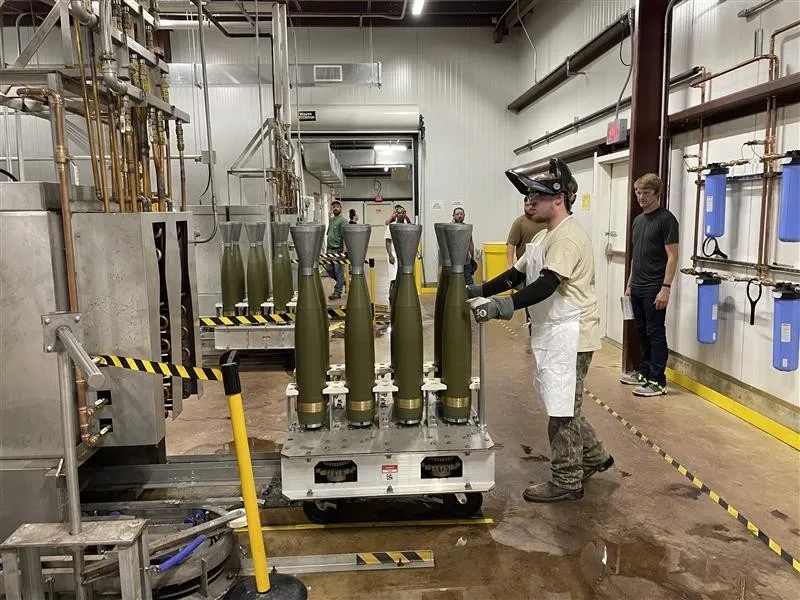
The Scranton photograph makes that distinction visible on the factory floor. Published with a December 2025 Joint Munitions Command report, it shows an employee preparing an M795 for the automated process that attaches its copper rotating band. Making the steel body is one part of the work. Adding the component that supplies the sealing and spin-transferring interface is another.
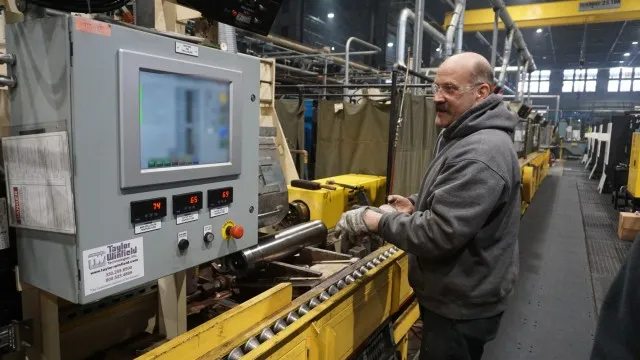
That extra manufacturing work is the practical meaning of a material choice. A useful property must arrive in the right component, and that component must become part of the finished assembly. A stock of refined metal, a metal part and an accepted finished product represent different stages of industrial capability. The copper band makes the distinction unusually easy to see because its separate material and function are visible on the outside of the steel body.
The same Army report describes modernization built around flexible production lines and skilled workers. Automation is intended to support that workforce and improve safety, with people retaining responsibility for work that requires judgment. The report says trained personnel review X-rays for defects and describes artificial intelligence as a possible aid while keeping humans involved in critical decisions. The inspection example concerns munitions generally; it is not a specific test of this band.
The skilled workforce therefore belongs in the material story. A useful metal property becomes dependable industrial capability through repeatable manufacture and inspection. The Army's account places people alongside automation in achieving that result.
American production stretches across several factories
The Army's recent expansion shows why one factory photograph cannot represent the whole manufacturing chain. Its May 29, 2024 opening announcement for the Universal Artillery Projectile Lines facility in Mesquite, Texas, described a new metal-parts operation with automation and digital data capture. The announcement concerned the stage that makes the metal components. It was one addition to a wider production base.
A different stage appears in the Army's August 2025 account of the new Camden, Arkansas, facility. That plant opened on April 22, 2025 and was established for later assembly and packing of M795 projectiles. The distinction is useful even without following every factory operation: creating a projectile body and completing the product are separate industrial tasks, supported by different facilities and equipment.
Metal-parts expansion and later assembly investment contribute at different points in this network. Copper's mechanical role in the band belongs within that connected system, where several distinct capabilities must come together to produce a completed item.
New buildings, better coordination and skilled production
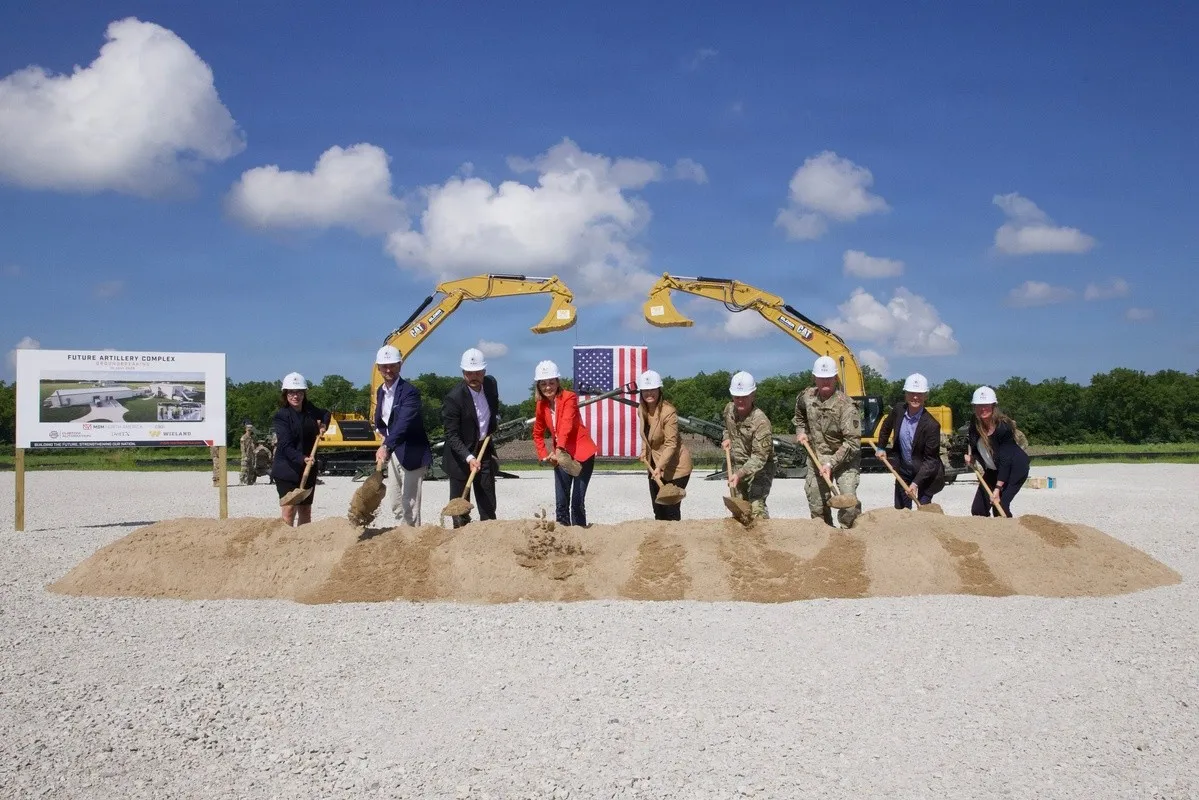
In Iowa, a July 15, 2026 groundbreaking marked the start of construction on the Future Artillery Complex. The Army says the project will replace an aging M795 production line and provide more flexible production of 155 mm ammunition. The announcement describes a facility being built. It puts the material story in a wider setting: investment in American ammunition manufacturing includes the work of turning different materials into functioning components.
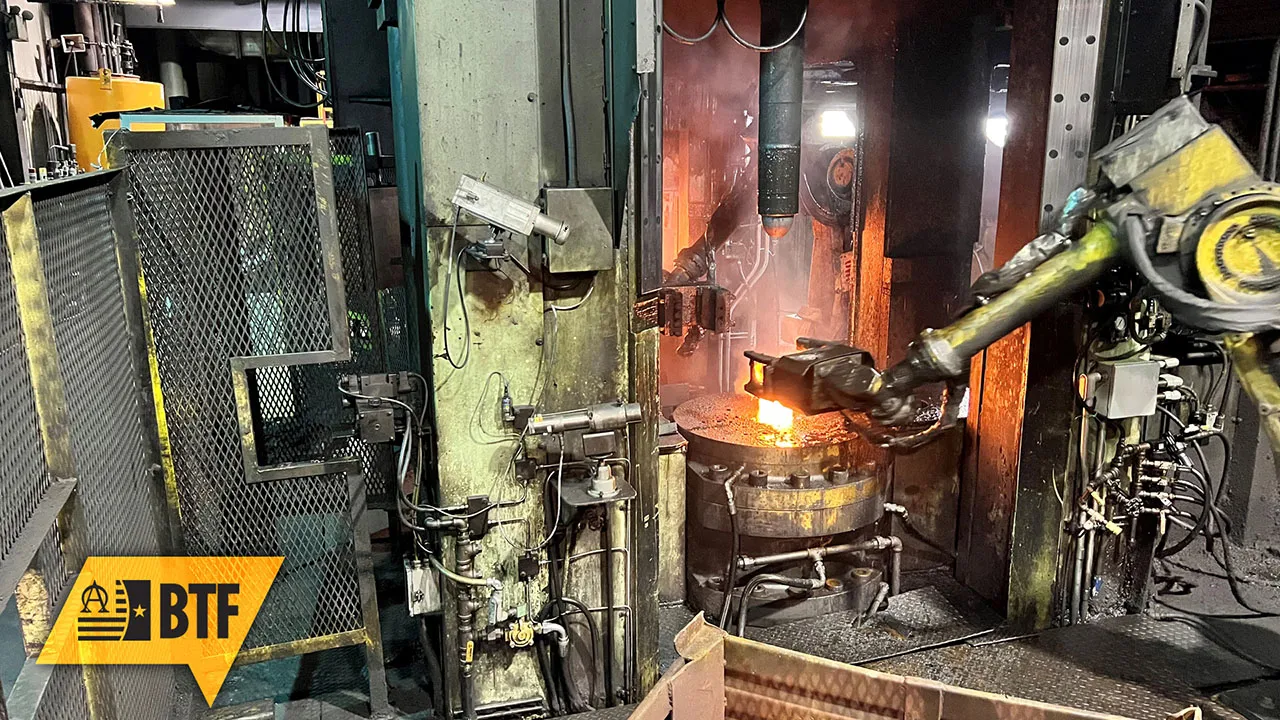
A November 2025 Army Acquisition account describes another part of that investment: digital models connecting metal-parts manufacturing at Scranton with later assembly operations at Iowa. The models let planners examine how activities fit together and assess proposed changes before committing to equipment. The article describes simulated, theoretical improvements, so those results should be read as planning evidence rather than completed production gains.
A new building and a working production line also mark different milestones. In its July 2024 report on Mesquite, Army Contracting Command explained that the facility had held its opening ceremony while a production qualification run was still being prepared. That dated example shows how investment progresses toward usable capacity. Construction, equipment, trained personnel and demonstrated production each contribute something different to the result.
Domestic copper gives manufacturing a starting material
At the refining end, Gunnison has a tangible Arizona product: finished copper cathode. The company reported commercial production at Johnson Camp in September 2026, following more than 1.3 million pounds of cathode output in August. Its operation finishes the copper onsite, supplying a refined form of metal for downstream manufacturing. In its October 22 announcement, Gunnison also described itself as a supplier of American-made copper to the U.S. defense sector.
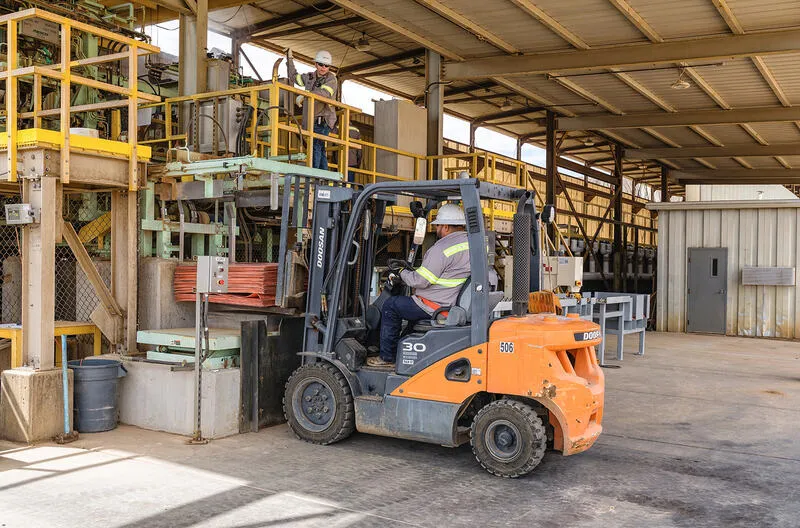
Cathode is a finished product for the mine and an input for manufacturers further along the chain. Copper can be made into different shapes and combined with other metals to produce alloys suited to particular uses. The U.S. Geological Survey's 2026 copper summary describes a domestic network of rod mills, brass mills, foundries and other manufacturers consuming refined copper and scrap. These operations give the metal forms and properties that an end-use component can employ.
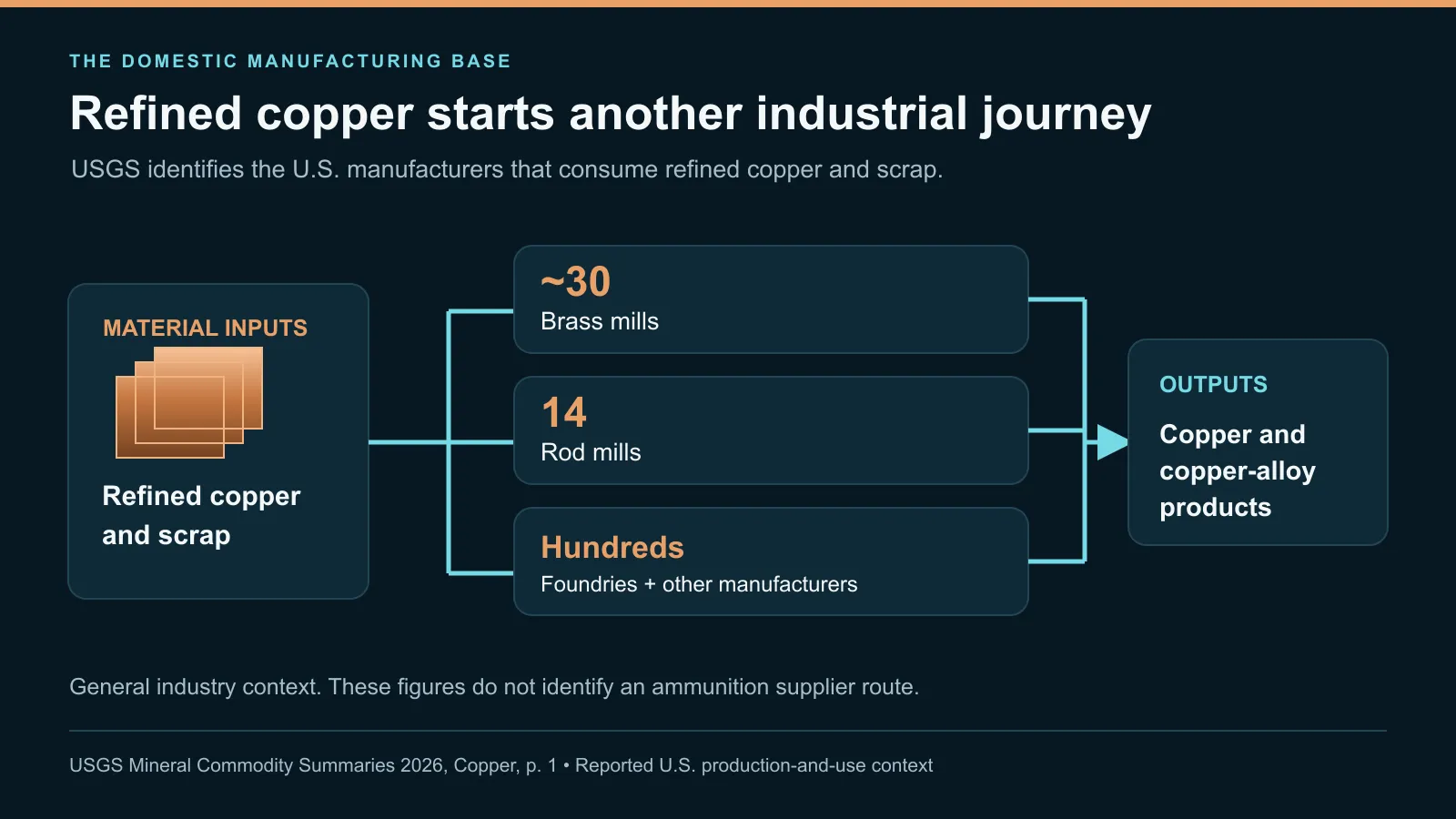
That gives Gunnison a documented place in the domestic industrial picture. Its disclosed contribution is refined copper production and defense-sector supply; the company announcement does not identify a supply route into the M795. Fabricators give copper its application-specific form, including the copper-bearing components illustrated by the Army's records. Keeping those stages clear makes the producing mine's contribution more tangible: it supplies useful metal upstream of the work that creates the specialized part.
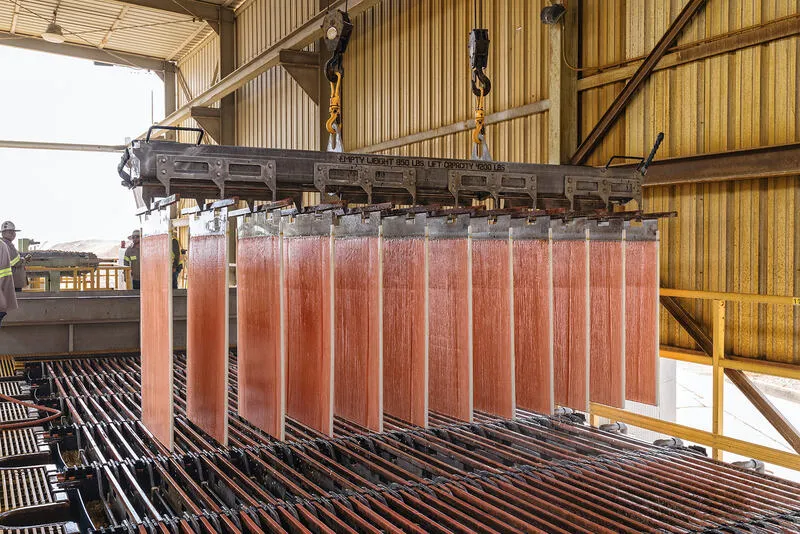
Copper's inclusion on the United States' final 2025 critical-minerals list gives that production a national context. The rotating band supplies the physical explanation behind one application. Its significance comes from a particular behavior at a particular interface, not simply from appearing on a list. Refined domestic copper and downstream manufacturing capability belong in the same industrial picture because one supplies material that the other turns into useful forms.
The steel body is the obvious part of the shell. The copper-bearing band reveals something less obvious about industrial strength: an assembled product can depend on properties that its largest component does not supply. Understanding the band means recognizing the value of a metal that can conform, seal and transfer rotation where those behaviors are needed. It also explains why America's manufacturing story includes the mine, the converter and the specialist factory, with a distinct contribution from each.
Qualified Person
Dr. Roland Goodgame, Senior VP of Project Development of the Company is a Qualified Person as defined by NI 43-101. Dr. Goodgame has reviewed and approved the technical information contained in this report.
Forward-looking information
This report contains "forward-looking information" concerning anticipated developments and events that may occur in the future. Forward looking information contained in this report includes, but is not limited to, statements with respect to: (i) the intention to deploy the Nuton® technology at the Johnson Camp mine and future production therefrom; (ii) the continued funding of the stage 2 work program by Nuton; (iii) the details and expected results of the stage two work program; (iv) future production and production capacity from the Company's mineral projects; (v) the results of the preliminary economic assessment on the Gunnison Project; (vi) the exploration and development of the Company's mineral projects; (vii) the details and timelines associated with the Company’s PFS work program; (viii) the expected results of the Company’s PFS work program; and (ix) eligibility for future tax credits.
In certain cases, forward-looking information can be identified by the use of words such as "plans", "expects" or "does not expect", "budget", "scheduled", "estimates", "forecasts", "intends", "anticipates" or "does not anticipate", or "believes", or variations of such words and phrases or state that certain actions, events or results "may", "could", "would", "might", "occur" or "be achieved" suggesting future outcomes, or other expectations, beliefs, plans, objectives, assumptions, intentions or statements about future events or performance. Forward-looking information contained in this report is based on certain factors and assumptions regarding, among other things, Nuton will continue to fund the stage 2 work program, the availability of financing to continue as a going concern and implement the Company's operational plans, , the estimation of mineral resources, the realization of resource estimates, copper and other metal prices, the timing and amount of future development expenditures, the estimation of initial and sustaining capital requirements, the estimation of labour and operating costs (including the price of acid), the availability of labour, material and acid supply, receipt of and compliance with necessary regulatory approvals and permits, the estimation of insurance coverage, and assumptions with respect to currency fluctuations, environmental risks, title disputes or claims, and other similar matters. While the Company considers these assumptions to be reasonable based on information currently available to it, they may prove to be incorrect.
Forward looking information involves known and unknown risks, uncertainties and other factors which may cause the actual results, performance or achievements of the Company to be materially different from any future results, performance or achievements expressed or implied by the forward-looking information. Such factors include risks related to the Company not obtaining adequate financing to continue operations, Nuton failing to continue to fund the stage 2 work program, the breach of debt covenants, risks inherent in the construction and operation of mineral deposits, including risks relating to changes in project parameters as plans continue to be redefined including the possibility that mining operations may not be sustained at the Gunnison Copper Project, risks related to the delay in approval of work plans, variations in mineral resources and reserves, grade or recovery rates, risks relating to the ability to access infrastructure, risks relating to changes in copper and other commodity prices and the worldwide demand for and supply of copper and related products, risks related to increased competition in the market for copper and related products, risks related to current global financial conditions, risks related to current global financial conditions on the Company's business, uncertainties inherent in the estimation of mineral resources, access and supply risks, risks related to the ability to access acid supply on commercially reasonable terms, reliance on key personnel, operational risks inherent in the conduct of mining activities, including the risk of accidents, labour disputes, increases in capital and operating costs and the risk of delays or increased costs that might be encountered during the construction or mining process, regulatory risks including the risk that permits may not be obtained in a timely fashion or at all, financing, capitalization and liquidity risks, risks related to disputes concerning property titles and interests, environmental risks and the additional risks identified in the "Risk Factors" section of the Company's reports and filings with applicable Canadian securities regulators.
Although the Company has attempted to identify important factors that could cause actual results to differ materially from those contained in forward-looking information, there may be other factors that cause results not to be as anticipated, estimated or intended. There can be no assurance that such information will prove to be accurate, as actual results and future events could differ materially from those anticipated in such information. Accordingly, readers should not place undue reliance on forward-looking information. The Company does not undertake to update any forward-looking information, except in accordance with applicable securities laws.
25 Reps. 25 Grand. Show Us Your GUNNs!
The GUNN 25 Challenge invites eligible participants to complete 25 repetitions of any safe physical activity, whether push-ups, squats, bicep curls, jumping jacks or another activity of their choice. Participants enter at their own risk and should consult a physician before engaging in any physical activity.
Participants can enter the sweepstakes through two methods:
Show Us Your GUNNs: Record a video completing 25 repetitions, share it publicly on Instagram, TikTok or X, include #Gunnison25Contest at the beginning of the caption and tag Gunnison Copper on the applicable platform.
Enter Online: Participants can also enter directly through the online entry form without recording or posting a video. Both entry methods offer equal odds of winning.
One eligible winner will be selected through a random drawing to receive the US$25,000 grand prize.
The sweepstakes opens on November 5, 2026 at 12:00 p.m. ET and is scheduled to close on December 13, 2026, with the winner selected on or about December 16 , 2026. No purchase or investment is necessary to enter or win. The sweepstakes is open to legal residents of the 50 United States and DC, excluding New York, Florida and Rhode Island, 18 or older (19 in AL and NE, 21 in MS)
For complete details, entry instructions and Official Rules, visit: