 Strategic Resource Intelligence

NASA's 1968 vacuum-deposited silver work still describes a live spacecraft problem: a reflective film is not just a surface finish. It is a thermal-control component whose beginning-of-life numbers can mislead the program before the mission is over.
Thermal margin is a poor place to discover an assumption late. Smaller buses pack electronics into less volume, and body-mounted solar cells compete with radiator area. A compact vehicle may have to survive different attitudes, eclipses, duty cycles and radiation environments without much powered thermal-control equipment.
The operating decision is whether a silver surface is being bought as a commodity film or qualified as part of the spacecraft thermal budget. That number only starts the review. The harder question is how the coating stack behaves after assembly handling, launch, ultraviolet exposure, charged particles, atomic oxygen where applicable, and years of heating and cooling.
Silver earns attention here for a physical reason, not because it has become fashionable as a critical mineral or because policy now gives it a sharper label. In the right stack, it reflects incoming solar energy while the surrounding dielectric, polymer or glass layer helps set the surface's infrared behavior and protects the metal.
The film may be thin. The decision reaches design, purchasing and mission assurance.
The Old Report Marks the Boundary
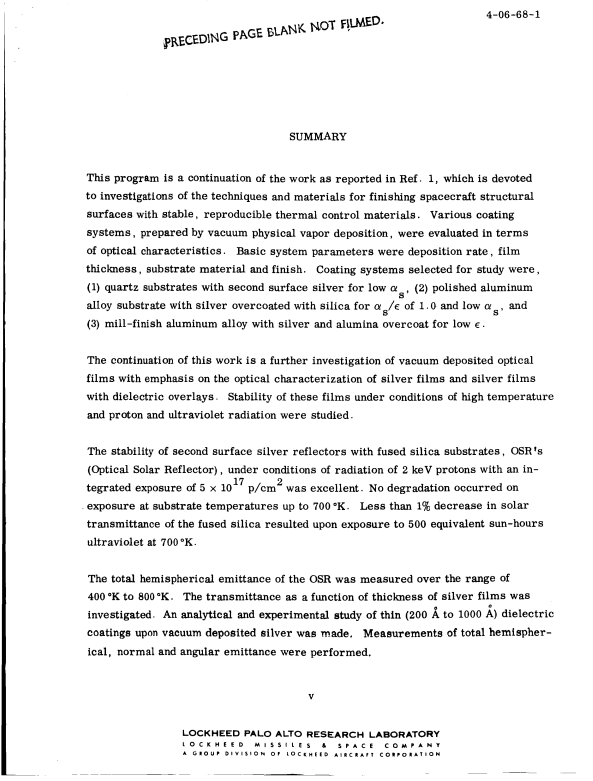
The NASA Ames report that Lockheed delivered in March 1968 studied low solar absorptance and emittance surfaces made by vacuum deposition. The program evaluated optical coatings by deposition rate, film thickness, substrate material and finish. Selected systems then went through high temperature, ultraviolet radiation and low-energy proton radiation tests.
The silver examples carried the point. One system used fused silica with second-surface silver for optical solar reflectors. Other systems put silver and dielectric layers on metal substrates to alter absorptance and emittance. Follow-on work stayed with silver films.
A supplier can sell a tape, coating or reflector as a part number. A mission buys a thermal balance, and it inherits every material choice hidden inside that balance.
That difference is not semantic, and it is not a paperwork distinction. The reflective metal, substrate, overcoat, adhesive, thickness control and contamination history all sit inside the balance that decides whether a radiator area is actually useful.
The report is also useful now because it resists easy generalization, which is where procurement language often gets too broad. Prepared second-surface silver reflectors on fused silica were stable under the stated proton exposure and temperature conditions. The same program found less than a 1% decrease in fused-silica solar transmittance after 500 equivalent sun-hours of ultraviolet exposure at 700 K.
That boundary is why the old report still matters. It argues for qualification discipline, not a blanket assurance for every silvered surface.
 IA
IA
Silver Reflects; Everything Around It Decides How Long
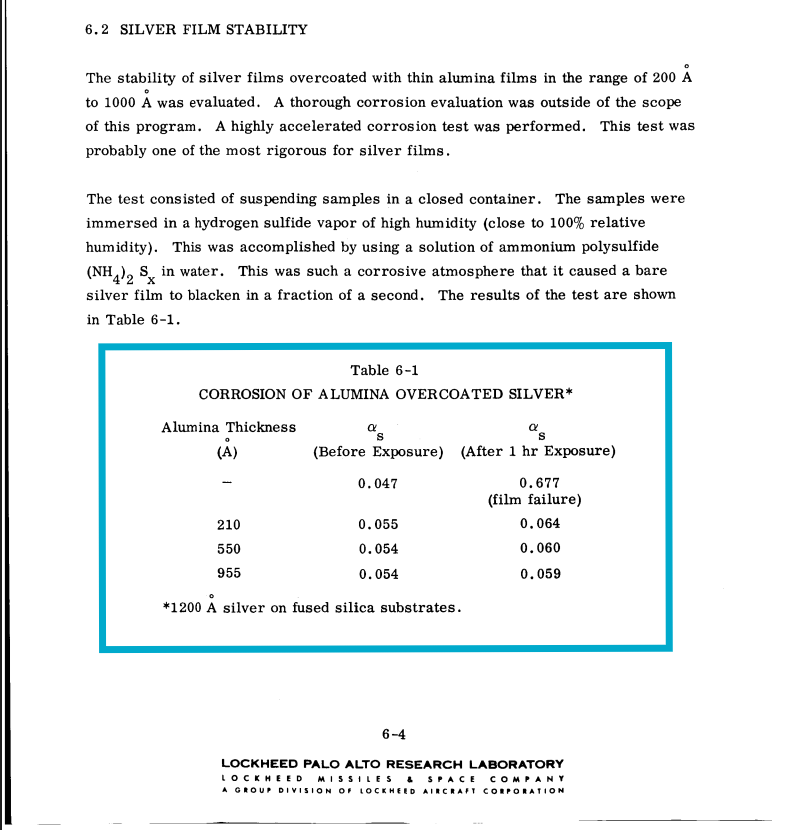
NASA/Lockheed’s 1968 test showed bare silver film failing in a severe corrosion environment, while alumina-overcoated silver changed far less. Source: NASA NTRS, report 4-06-68-1, Table 6-1.Silver's role in the surface is straightforward enough to say plainly: it is the reflector. USGS lists high reflectivity among silver's physical properties and identifies mirrors among its applications. In a spacecraft thermal surface, that reflectivity can lower absorbed solar heat when the surface is designed to reject or manage heat rather than absorb it.
Durability is where buying language thins.
The 1968 report suspended silver samples in a humid hydrogen sulfide atmosphere so severe that a bare silver film blackened almost immediately. Alumina-overcoated silver samples with reported overcoat thicknesses of 210, 550 and 955 angstroms changed far less in that accelerated corrosion test. Alumina is not a universal answer. The answer is never just "silver."
NASA's current Small Spacecraft thermal-control chapter makes the same operating point in modern language. It says spacecraft surface properties can be modified with paints, coatings, finishes or adhesive tapes. It describes second-surface silver FEP tapes as radiator coatings that reflect incident solar energy while emitting spacecraft thermal energy efficiently. It also warns that beginning-of-life optical properties change through the mission as coatings darken under atomic oxygen, ultraviolet light and other radiation effects.
A BOL absorptivity number is not procurement evidence. NASA's current chapter specifically says BOL datasheet values should not be used for end-of-life modeling. When the coating stack is treated as a late assembly choice, thermal margin can be spent by aging, handling or geometry before the program has noticed the loss.
 IA
IA
A Thin Film Can Hide the Material Ledger
The public record thins out exactly where management would want a ledger. The verified public evidence supports silver's function in the coating stack, film-thickness examples from the NASA report, and current NASA-listed silver FEP and silver composite coating categories. It does not provide the square footage of silver-backed thermal surfaces on a named spacecraft, the silver mass per square meter, production yield, scrap, replacement stock, recycling recovery or annual demand.
That absence should not be turned into a demand forecast. Spacecraft thermal surfaces could consume more silver if more vehicles use more silver-backed radiator area and if coating thickness, scrap and qualification loss are material. They could also consume less through substitution or lower-silver constructions. USGS notes that aluminum and rhodium can substitute for silver in mirrors and other reflecting surfaces.
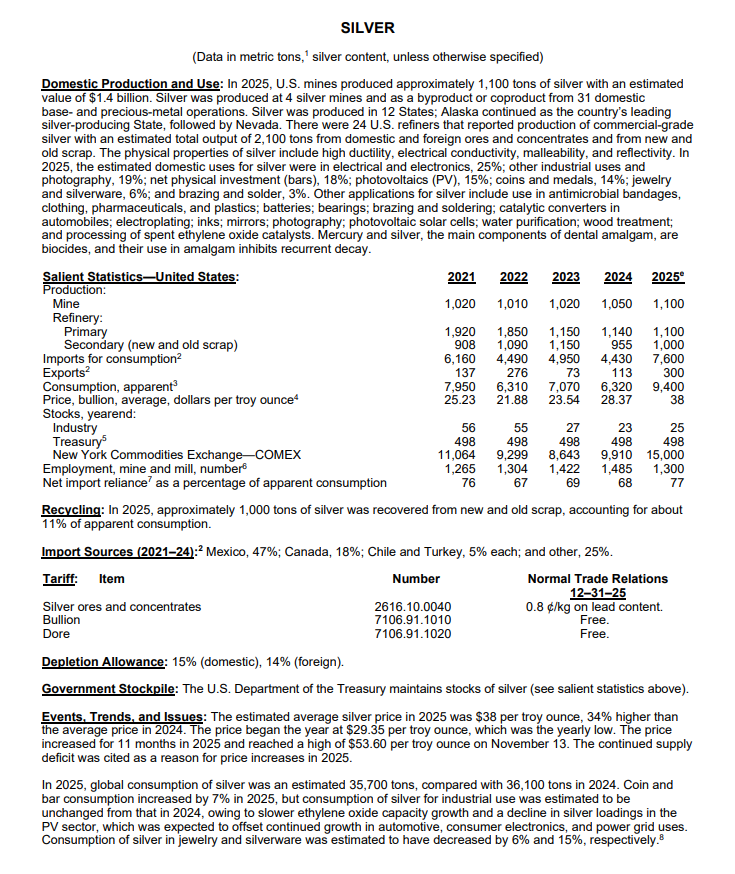
USGS estimated 77% U.S. net import reliance for apparent silver consumption in 2025, while listing silver across industrial, investment and reflective-surface uses. Source: USGS Mineral Commodity Summaries 2026.The case that survives the evidence is qualification and traceability. Silver was added to the U.S. Final 2025 List of Critical Minerals, and USGS estimated 77% U.S. net import reliance for apparent silver consumption in 2025. That status does not prove a spacecraft shortage.
It does make unmanaged material identity harder to defend when the same film stack is carrying thermal margin.
The record does not need to become a bureaucracy. For each qualified silver-backed surface, it can show the supplier, product construction, substrate, silver layer basis when disclosed, lot, BOL optical values, EOL-biased model values, surface area, scrap, rework, replacement stock and recovery route.
Without those fields, a company cannot separate a genuine mineral exposure from a small laboratory fact that sounds more important than it is. The distinction matters. One calls for supplier qualification and recovery planning; the other belongs in the technical file and should not be inflated into a supply thesis.
The same ledger also prevents a quieter mistake. If a coating is changed to solve a schedule problem, the old record shows which thermal assumptions moved with it: solar absorptance, infrared emittance, adhesive behavior, surface geometry, handling limits and any EOL bias already used in the model. That information is dull until the substitute arrives late and the thermal team has to decide whether the spacecraft still has the margin it appeared to have on paper.
Purchasing Enters Earlier Than It Wants To
The factory objection is real. Thermal engineers already model coatings, and silver is only one small material inside a spacecraft that contains far more expensive avionics, payload hardware, propulsion equipment and software labor. Treating every film as a strategic input can slow a build that is already schedule constrained.
Some missions only need ordinary discipline. A film does not deserve to dominate the program review just because the metal has a critical-minerals label. If the surface is available from multiple qualified constructions and the mission has comfortable margin, a normal approved-materials list may be enough.
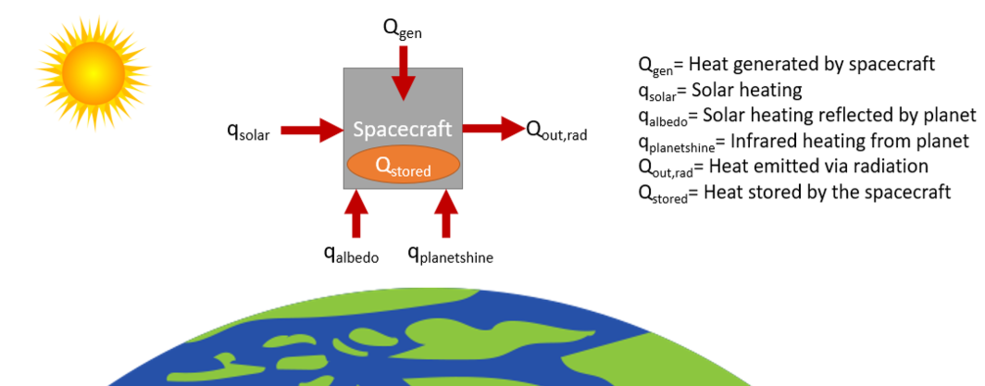
NASA’s SmallSat thermal-control overview shows why surface choices affect the full heat balance: solar input, internal heat, stored heat and radiated heat all move through the spacecraft’s exterior surfaces. Source: NASA.The risk appears when the coating choice is doing more work than the purchasing record admits. A small satellite with limited radiator area, a high-duty payload or a thermal design that depends on low absorptance may have less room for substitution than the bill of materials suggests. A replacement surface that looks similar in purchasing language can behave differently after radiation, contamination or aging.
Purchasing enters earlier than it wants to because a substitute surface can be a thermal event. Unit cost is the wrong test. The question is whether the qualified surface has enough approved alternates, lot-level traceability and end-of-life data to survive a supply interruption without reopening the thermal model.

Qualification Is the Investment Case
The 1968 report remains useful because it frames silver as a tested optical system rather than a shiny input. It measured films, overcoats, radiation exposure, temperature and emittance relationships. The current NASA SmallSat chapter brings the decision forward: coating performance changes over a mission, and the values used for cold-biased beginning-of-life cases cannot carry hot-biased end-of-life cases.
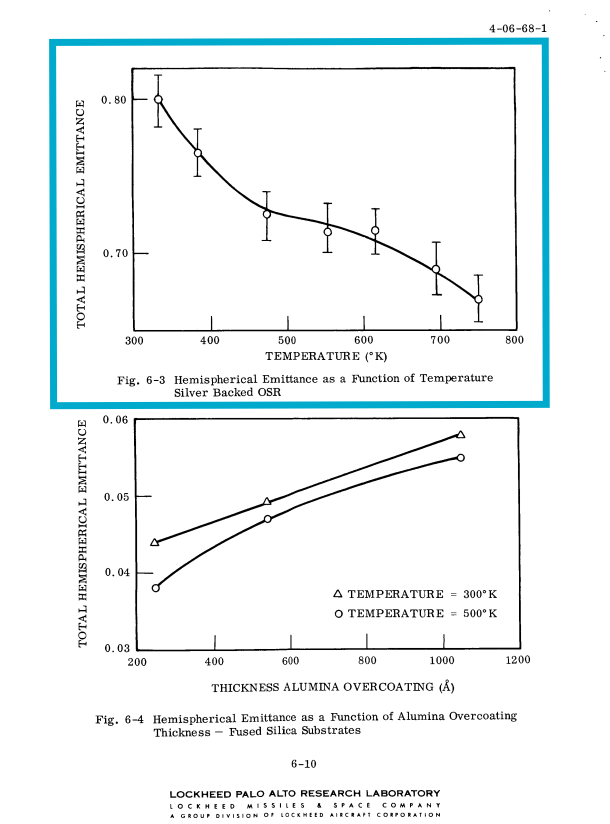
That is enough to define the investment implication without inflating the mineral claim, because the operational weakness appears before the tonnage does. The investment is not a silver-volume bet. It is qualification capacity, measurement and traceability around silver-bearing thermal surfaces.
For a spacecraft CEO, the release gate is simple but not ornamental. Approve silver-backed thermal surfaces only when the coating stack has a mission-specific end-of-life optical record, a qualified alternate or a documented reason no alternate is acceptable, and a material ledger that ties surface area to supplier, lot and recovery path. If that record is missing, the next step is not a speech about critical minerals. The CEO is pausing because the company may be changing a thermal assumption that operators and customers will only test once the vehicle is already committed to flight.