 Strategic Resource Intelligence
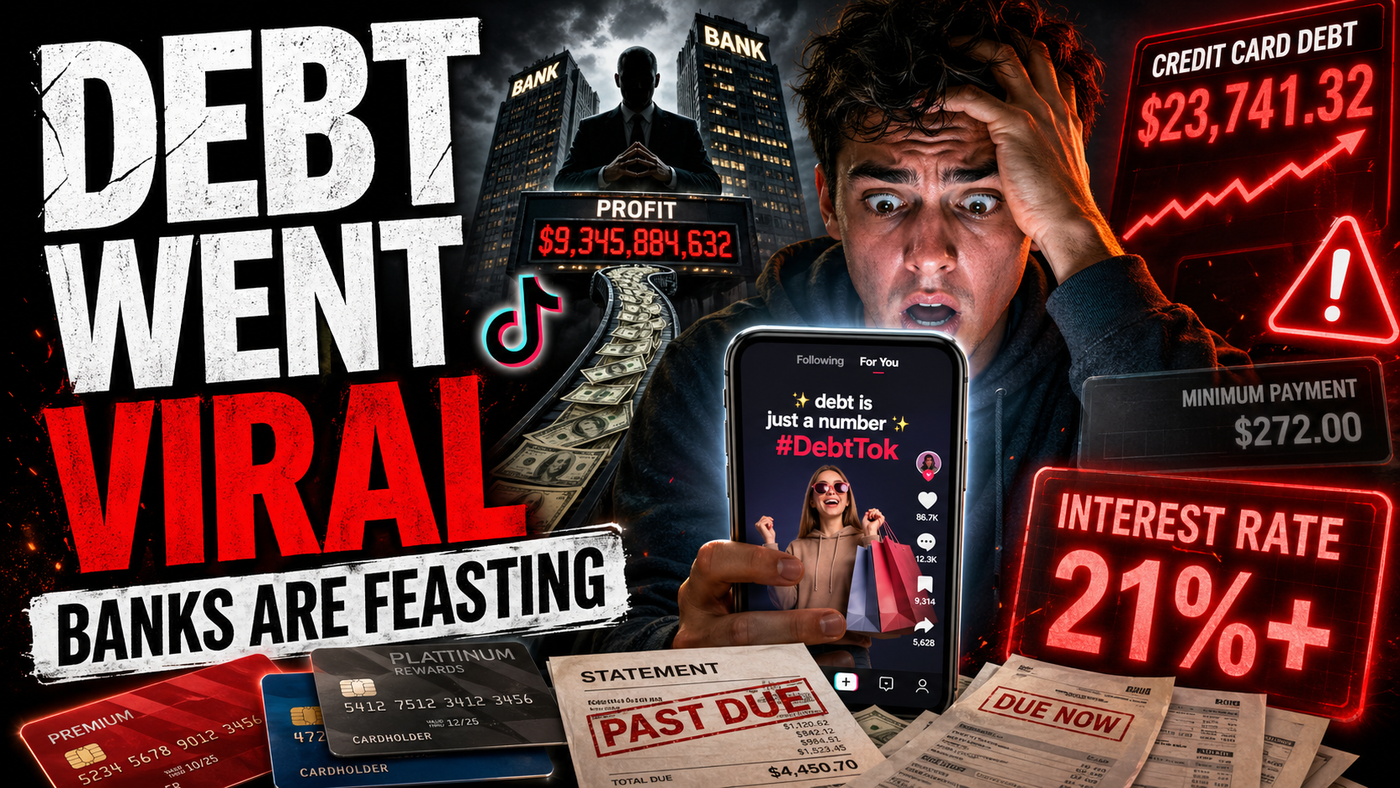
Credit Card Debt Became A TikTok Trend, And The Banks Are Feasting
We need to talk about this.
There is a new genre of social media where people sit down, turn on the camera, and casually reveal financial numbers that should make the room go silent.
$29,000 in credit card debt.
$63,000 in credit card debt.
$160,000 in total debt.
A six-figure boat loan.
A HELOC.
Student loans.
Retail cards.
Personal loans.
And then the caption is always some version of:
“Pay off debt with me in 2026.”
Here is the reality. A lot of this is not just debt payoff content. It is financial disaster content with a motivational font slapped on top.
And the incentives are insane.
The creator gets views.
The audience gets drama.
The app sponsor gets trust.
The bank gets interest.
The borrower gets a comment section yelling at them to sell the boat.
This is actually genius, in the worst possible way.
Because the entire machine runs on one brutal fact: the worse the debt is, the better the video performs.
 Speedwagon Foundation
Credit Card Debt Became A Viral Confession Booth
The viral formula is painfully simple.
Someone opens with a giant number.
Then they break it down card by card:
- Credit card one: $7,513
- Credit card two: $8,912
- Credit card three: $10,229
- Credit card four: $10,317
- Credit card five: $11,812
- Credit card six: $16,582
Total credit card debt: $63,227.
Then comes the kicker.
That does not include the student loans.
That does not include the personal loans.
That does not include the car.
That does not include the medical bills.
That does not include the mortgage.
And this is where the content turns into a car crash you cannot stop watching.
Because everyone understands the psychology immediately. The $63,000 number is shocking. The individual cards make it feel real. The creator sounds embarrassed but hopeful. The comments become a mix of support, horror, judgment, and advice.
That is viral math.
But it is also debt math.
And debt math is much less cute.
Average credit card APRs are still brutal. LendingTree reported that the average APR for cards accruing interest was 21.52% in Q1 2026, while Forbes Advisor listed the average credit card APR in its database at 25.30% in late April 2026. (LendingTree)
So when someone says they have $30,000, $50,000, or $60,000 sitting on credit cards, that is not just a balance.
That is a fire.
Minimum Payments Are The Great American Illusion
The minimum payment is one of the most diabolical inventions in consumer finance.
Not because it is hidden.
It is right there on the statement.
But psychologically, it does something very powerful.
It makes the borrower feel responsible while keeping the lender rich.
The minimum payment tells you:
- You did not miss the bill
- You avoided the late fee
- Your account is still open
- Your credit score might survive another month
- You are technically “handling it”
But here is the scammy part.
You are not really handling it.
You are feeding the machine just enough to keep it alive.
If your payment is mostly getting eaten by interest, the balance barely moves. That is how someone can make payments for months and still feel like they are standing in the exact same spot.
This is why people get so confused.
They say:
“I keep making payments. Why is the balance still there?”
Because the bank did not design the minimum payment to free you.
The bank designed it to keep you in the game.
The Minimum Payment Trap Works Because It Feels Normal
The trap is not that people ignore the bill.
The trap is that people pay the bill wrong.
A minimum payment lets someone preserve the lifestyle that caused the debt in the first place.
They can still go out.
Still swipe.
Still order.
Still finance.
Still tell themselves next month will be different.
Then next month comes, and the balance is still ugly.
This is the part people miss: being current is not the same as escaping.
IA
Retail Credit Cards Are Tiny Debt Factories
Retail cards are where the whole thing gets even more predatory.
Best Buy cards.
Furniture store cards.
Dental financing.
Vet financing.
Camera financing.
Store checkout cards.
“Save 10% today if you apply.”
That line has probably created more financial chaos than half the personal finance advice on the internet can fix.
Because it always starts small.
You are not thinking, “I am making a long-term debt decision.”
You are thinking:
“I was already buying this anyway, and now I get a discount.”
Then the card sits there. You use it again. The balance grows. The promo expires. The interest hits. Now you have $5,650 on a Best Buy card and you are wondering how a TV, laptop, headphones, and a few accessories turned into a financial side quest.
This is why retail cards are so dangerous.
They do not feel like real credit cards.
They feel like store perks.
And that is the trick.
| THE CREDIT CARD DEBT MACHINE |
|---|
|
THE LIMIT FEELS LIKE INCOME
A $10,000 credit limit does not feel like borrowed money when the approval screen hits. It feels like permission. That is the first trap, turning access into confidence before the borrower has a payoff plan. |
|
THE MINIMUM PAYMENT HIDES THE DAMAGE
Minimum payments keep the account alive, not the borrower. They create the illusion of progress while interest quietly eats the payment and resets the pain for next month. |
|
THE ALGORITHM REWARDS THE DISASTER
Debt payoff content performs because the numbers are shocking. That creates a weird incentive where the biggest financial mess becomes the strongest content hook, even when the actual repayment plan is weak. |
The Boat Loan Is The Whole Story
One debt payoff video had the kind of balance sheet that makes you stop scrolling.
Five credit cards.
Student loans.
A HELOC.
A business loan.
A mortgage.
And a boat loan around $118,000.
The stated goal was to pay off about $100,000 in debt during 2026.
The comments immediately found the problem:
If the boat is not for sale, you are not serious.
That sounds harsh, but it is the entire article in one sentence.
Because a lot of debt payoff content has this weird emotional split.
People want the redemption arc, but not the sacrifice.
They want:
- the accountability video
- the cute tracker
- the “debt free journey” hashtag
- the supportive comments
- the public transformation story
But they do not want to sell the thing causing the bleeding.
That is why the boat matters.
The boat is not just a boat. The boat is the lifestyle people are trying to protect while claiming they want to escape the consequences of that lifestyle.
That is not a plan.
That is branding.
Debt Payoff Content Gets Weird When Sponsors Show Up
Now we get to the part that makes this whole niche feel gross.
Some debt payoff videos are genuine. People are embarrassed, scared, and trying to get control of their lives. That can be useful. A lot of viewers really do use these videos as a financial horror movie.
They see the balances and think:
“Okay, I am never letting this happen to me.”
Fine. Good. Scared straight works.
But then the sponsorships show up.
The creator reveals a giant debt number.
The video feels intimate and vulnerable.
The audience trusts them.
Then the caption quietly turns into an ad for an app.
Budgeting app.
Balance app.
Debt app.
Lifestyle app.
Some financial product nobody had heard of until it appeared under a breakdown of someone’s worst decisions.
This is where the incentives start to rot.
Once the debt journey becomes monetized, everyone wants something:
- The creator wants views
- The sponsor wants conversions
- The platform wants watch time
- The audience wants drama
- The borrower still needs discipline
That is a dangerous mix.
Because financial pain becomes a funnel.
The Real Addiction Is Frictionless Spending
People love saying, “They should teach this in school.”
Sure. Teach interest. Teach APR. Teach amortization. Teach budgeting.
But let’s not pretend education alone fixes this.
The modern economy is built to make spending feel painless.
You do not hand over cash anymore.
You tap.
You swipe.
You click.
You split into four payments.
You finance at checkout.
You subscribe.
You DoorDash.
You Venmo.
You autopay the minimum.
You ignore the statement.
IA
And then one day you call the bank because you think there must be fraud.
There is no fraud.
It was you.
That is the scary part.
One person described calling Chase because the balance kept staying negative even though payments were being made. The representative helped add up the charges.
Every purchase was real.
That is the moment the system wants. Not because the borrower is dumb, but because the borrower has been trained to spend without feeling the impact.
Modern consumer finance is not just selling access.
It is selling numbness.
The “I’ll Get Rich Someday” Mindset Is Financial Brain Rot
One of the most insane attitudes in these clips is the person who sees a 24% APR and says they are fine with it because they think they will get rich someday.
That is not optimism.
That is cope with a billing cycle.
“I’ll get rich someday” is the financial equivalent of saying:
“The house is on fire, but I might own a mansion later.”
Cool.
The fire is still happening.
Credit card interest does not wait for your glow-up. It does not care about your future business idea, your crypto plan, your imagined salary, your future inheritance, your dream job, or your main character arc.
It compounds now.
And that is why this mindset is so toxic. It uses a fake future to avoid a real present.
You are not borrowing from the bank.
You are borrowing from the version of yourself who has to clean this up.
Through The Looking Glass of Despair
Here is what is actually happening:
- Americans are using credit to bridge the gap between income and lifestyle.
- Banks are making minimum payments feel like responsibility.
- Retailers are turning checkout counters into debt traps.
- Social media is turning financial distress into entertainment.
- Sponsors are moving into the debt payoff niche because pain converts.
What matters most is not the viral balance reveal.
It is the APR.
It is the payment size.
It is whether new debt is still being added.
It is whether the lifestyle actually changes.
The noise is the cute tracker. The hashtag. The motivational caption. The “day one of my debt-free journey” video. The soft piano music over a balance that is getting mauled by interest.
The signal is much uglier.
IA
Did they cut up the cards?
Did they stop using the retail accounts?
Did they sell the boat?
Did they downgrade the car?
Did they cancel the luxury spending?
Did they build a real payoff plan after the dopamine wore off?
Because the banks do not need you to collapse overnight.
They just need you to keep paying the minimum.
And right now, millions of people are doing exactly that.
Market Updates
Average Credit Card APR Holds Near 25% (Forbes Advisor) - April 27, 2026
When the average APR is around 25%, “I’ll pay it later” is not a plan, it is a donation to the bank. (Forbes)
2026 Credit Card Debt Statistics Show High APR Pressure (LendingTree) - April 17, 2026
The scary number is not just the balance, it is the interest rate attached to the balance, because that is what turns a bad month into a multi-year problem. (LendingTree)
Buy Now, Pay Later Services May Not Be What They Seem (Ohio Attorney General) - April 8, 2026
BNPL is marketed like convenience, but the real risk is that it trains people to treat every purchase like it can be chopped into tiny pieces forever. (Ohio Attorney General)
FAQ: Credit Card Debt, TikTok Debt Payoff, And Minimum Payments
Why are debt payoff videos going viral?
Because the numbers are shocking, the stories are emotional, and the audience gets to watch a financial crisis unfold in real time. It is accountability content, but it is also spectacle.
Are minimum payments bad?
Minimum payments are useful for avoiding late fees, but they are terrible as a payoff strategy. If the balance has a high APR, minimum payments can keep someone stuck for years.
Why are retail credit cards so dangerous?
Retail cards are often opened impulsively at checkout. The discount feels immediate, while the interest shows up later. That makes the debt feel smaller than it really is.
What is the biggest sign someone is not serious about paying off debt?
They keep the lifestyle that created the debt. If the boat, car, shopping habit, travel habit, or luxury spending stays untouched, the payoff plan is probably cosmetic.