
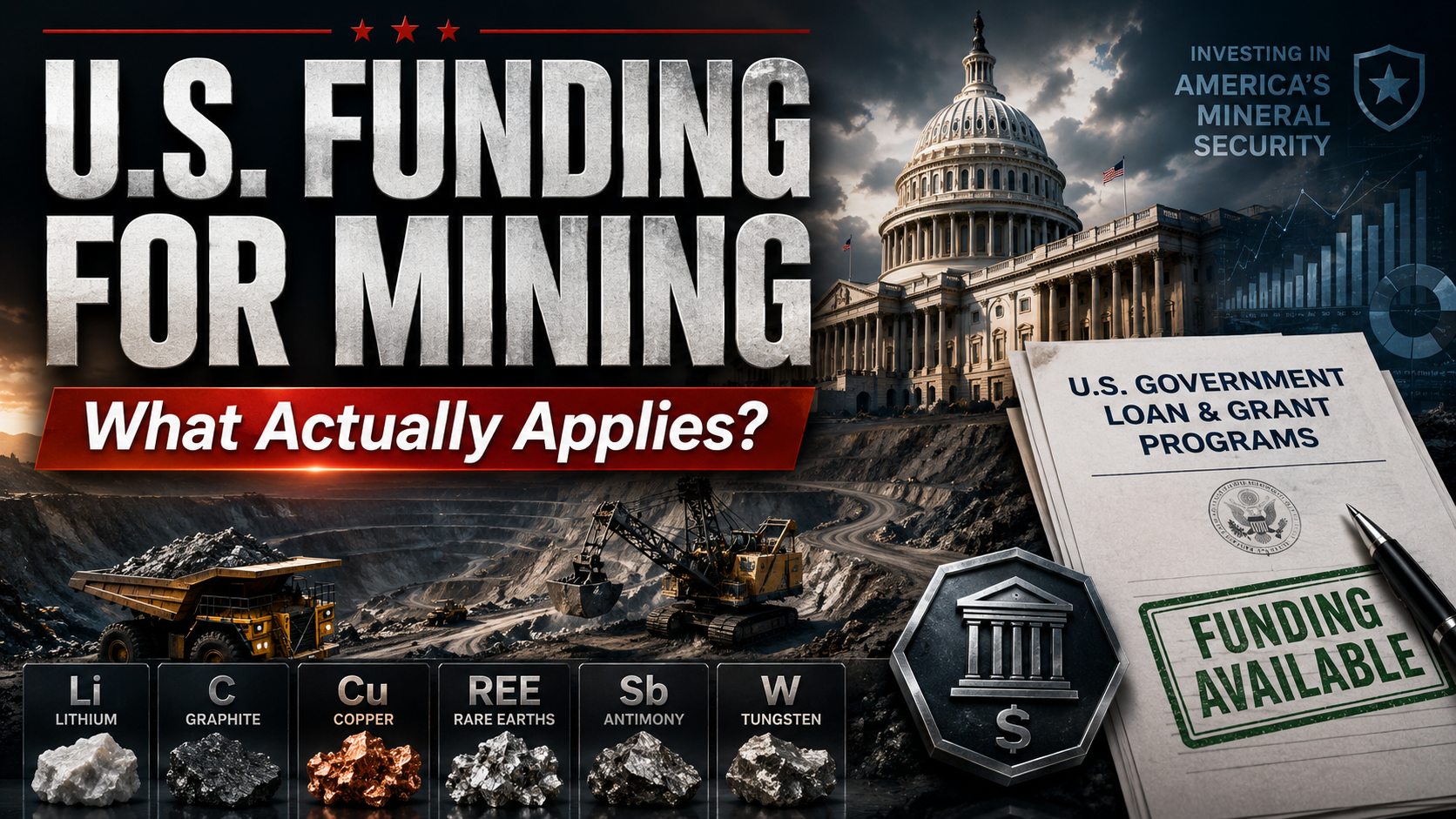
U.S. Government Funding Programs for Mining Companies
If you follow mining stocks long enough, you hear the same pitch over and over: the U.S. government wants domestic minerals, Washington needs lithium, graphite, nickel, copper, rare earths, antimony, tungsten, and every other material that keeps the defense, energy, and technology economy alive, so the money is coming.
That is partly true, but this is also where a lot of investors get sloppy. There are real U.S. critical-materials funding programs that can matter for mining and critical-minerals companies. Some have already backed real projects. Some can change the financing story for a company almost overnight. But they are not all “mining grants.”
That is the trap. A DoD Defense Production Act Title III award is not the same thing as a DOE Title 17 loan guarantee. A production tax credit is not the same thing as upfront construction money. Export finance is not the same thing as a domestic mine subsidy. And a processing plant is not the same thing as a mine, even if they sit on the same property.
If investors blur those lines, every press release starts to look bullish. If investors understand the lines, they can tell which companies have a real federal funding angle and which ones are just wrapping a normal mining story in Washington buzzwords.
The Short Version
The cleanest direct federal funding path for upstream U.S. critical-minerals projects is DoD’s Defense Production Act Title III authority. That is the program investors should pay close attention to when a company is talking about domestic mining, strategic minerals, defense supply chains, or national security.
DOE Title 17 also matters, but it is not a generic mine-financing program. DOE’s own critical-materials project language is much more focused on processing, manufacturing, and recycling than plain mine construction.
45X and 48C can matter too, but they are often overstated. 45X is not automatically available just because a company mines a critical mineral. 48C is not a broad mine-development credit. Both are more tied to production, processing, refining, recycling, and facility-level investment than most mining-stock chatter admits.
EXIM and DFC belong in the conversation, but for a different reason. They usually matter when a project has U.S. offtake, export links, overseas supply-chain exposure, or strategic foreign mineral supply tied back to U.S. demand.
So the real question is not, “Can the government fund mining?” The real question is, “Which part of the project fits which federal program?” That is where the money is, and that is where the hype usually breaks down.
A Simple Map of the Main Programs
| Program | What It Is | Strongest Fit | Common Investor Mistake |
|---|---|---|---|
| DoD DPA Title III | Strategic industrial-base funding and agreements | Upstream mining, mine-adjacent development, processing, defense-linked minerals | Assuming it is an open grant pool for any U.S. miner |
| DOE Title 17 | Large federal loan guarantees | Processing, integrated projects, manufacturing, recycling, major project finance | Treating it like broad mine-construction financing |
| 45X | Production tax credit | Qualifying processed applicable critical minerals produced and sold under the rules | Calling it a simple mining credit |
| 48C | Competitive investment tax credit | Refining, processing, recycling, qualifying advanced-energy facilities | Treating it like a mine-development credit |
| EXIM SCRI | Offtake-linked finance for international supply-chain projects | Foreign critical-minerals projects tied to U.S. buyers | Ignoring the need for U.S. offtake and other program conditions |
| EXIM MMIA | Domestic export-oriented financing | U.S. processing or manufacturing projects with a real export nexus | Assuming any domestic mine automatically fits |
| DFC | International development finance | Overseas critical-minerals projects, infrastructure, and strategic supply-chain links | Confusing it with a U.S. domestic mine-finance program |
The table matters because “government support” is not one thing. It can mean a grant-like award, a loan guarantee, a tax credit, an export-finance structure, or international development finance. Those are completely different animals for valuation, timing, dilution risk, and project financing.
How These Funding Programs Actually Work
DoD Title III
DoD Title III is the most important program to understand if you are looking at upstream U.S. critical-minerals companies. This is not a normal grant program. It is a defense industrial-base tool. Washington uses it when a material is viewed as strategically important enough to justify direct government support.
That could mean minerals tied to:
- Batteries
- Munitions
- Defense electronics
- Military supply chains
- Grid resilience
- Advanced manufacturing
- Non-Chinese supply chains
This is why DoD Title III is different from most of the other programs. It can reach closer to the mine level. The official record already shows DoD support tied to domestic graphite, nickel, and lithium supply-chain work. The Defense Department announced a $37.5 million agreement with Graphite One, a $20.6 million agreement with Talon Nickel, and an $11.8 million award to Lithium Nevada. That matters because it proves this is not just a theoretical policy idea. It has already been used.
For investors, this is the cleanest place to start when a mining company says it has a real federal funding angle. The key question is simple: does the project solve a real U.S. supply-chain problem, or is the company just using national-security language because it sounds good?
DOE Title 17
DOE Title 17 is a major program, but it gets misunderstood constantly. This is large project-finance support. It is not small grant money. It is not a handout. It is not something every junior miner can realistically point to and say, “That is our path.”
DOE loan guarantees are usually for very large projects. The DOE says LPO loan guarantees are typically $100 million or more, can cover up to 80 percent of eligible project costs, and cannot finance research, development, or demonstration projects. The important detail is that DOE’s own critical-materials language focuses heavily on processing, component manufacturing, and recycling.
That does not mean a mining company can never benefit. It means the company usually needs more than a hole in the ground. If there is a qualifying processing facility, refining step, recycling operation, or integrated project structure, DOE may become much more relevant.
This is where investors need to slow down. A company saying “DOE financing may be available” is not the same thing as a company having a qualifying project that has moved through the actual process. The difference matters.
45X
45X is one of the most abused terms in critical-minerals investing. A lot of people talk about it like it is a mining tax credit. It is not that simple.
45X is a production tax credit. It can apply to eligible components, including certain applicable critical minerals, but extraction alone is not enough. The final 45X regulations are the part investors need to pay attention to, because the project has to produce something that qualifies under the rules.
A company cannot just say, “We mine a critical mineral, therefore 45X.” The processing step, the final product, the sale, and the facility setup all matter.
For some companies, 45X could be a real advantage. For others, it is just a word in a slide deck. The way to tell the difference is to look at the actual flow sheet.
Investors should ask:
- What does the company produce?
- Where is it produced?
- What form is it sold in?
- Does the product meet the definition of an eligible component?
- Is the company talking about extraction, processing, or both?
- Is the tax credit already part of the project economics, or only a possible upside case?
If the company does not answer those questions clearly, the 45X claim should be treated carefully.
48C
48C is also valuable, but it is not a broad mining subsidy. It is a competitive investment tax credit for qualifying projects. In the critical-materials lane, the official language is focused on refining, processing, and recycling.
That is a huge distinction. A refinery may fit. A processing plant may fit. A recycling facility may fit. A plain mine-development budget is a much weaker claim.
This does not make 48C irrelevant to mining companies. It just means investors should look at the facility being built, not just the mineral being mined. If a mining company has a downstream processing plan, 48C may be part of the story. If the company is only talking about exploration or mine construction, investors should be careful before assigning value to it.
EXIM and DFC
EXIM’s Supply Chain Resiliency Initiative and the U.S. International Development Finance Corporation are not usually the first programs retail mining investors talk about, but they deserve more attention. They just need to be understood correctly.
EXIM’s Supply Chain Resiliency Initiative is tied to international projects with U.S. offtake. In plain English, that means a foreign project may be more relevant if a U.S. buyer has a long-term need for the material.
That can matter a lot in critical minerals. If the U.S. needs non-Chinese graphite, rare earths, nickel, copper, tungsten, antimony, or other strategic inputs, offtake becomes more than a normal commercial contract. It becomes part of the financing story.
EXIM’s Make More in America Initiative is the domestic side, but even there, it is not a free-for-all. The project still needs to fit EXIM’s export-oriented structure. EXIM says the required export nexus is 15 percent for small businesses, transformational export areas, and climate-related transactions, and 25 percent for projects in other sectors.
DFC is different again. It is focused on overseas development finance. The DFC says it offers direct loans and guarantees for tenors as long as 25 years, and its eligibility checklist focuses on commercially viable and developmental projects in countries where DFC programs are available. That means DFC can matter for foreign critical-minerals projects, especially if they support U.S. strategic supply chains, but it is not a domestic U.S. mine-finance program.
That is the main point. EXIM and DFC can be very relevant. They are just not the same kind of relevance as DoD Title III or DOE Title 17.
What Actually Fits Mining?
The answer depends on the part of the value chain. That is the part a lot of investors miss. A mining company is not one thing. It may have exploration, mine development, crushing, concentration, refining, chemical conversion, recycling, transport infrastructure, power infrastructure, offtake agreements, and downstream partnerships all tied into the same story.
Different programs hit different pieces of that chain.
| Value Chain Area | Strongest Program Fit | Investor Read |
|---|---|---|
| Exploration and resource definition | DoD Title III | Strongest where the mineral has a clear national-security or industrial-base use |
| Mine development | DoD Title III, sometimes integrated DOE-related structures | More conditional, especially outside direct defense or supply-chain need |
| Processing | DOE Title 17, 48C, 45X, DoD Title III, sometimes EXIM | Stronger fit than plain mining |
| Refining | 48C, 45X, DOE Title 17, DoD Title III | Often where tax-credit and loan-guarantee claims become more credible |
| Recycling | DOE Title 17, 48C | Much stronger fit than plain mine development |
| Transport and power infrastructure | Depends on whether it is part of a larger qualifying project | Investors should not assume infrastructure support automatically funds the mine |
| Offtake-backed foreign supply | EXIM, DFC | Stronger when U.S. buyers or strategic supply-chain needs are involved |
The big mistake is treating all of this as one bucket. It is not one bucket. It is a chain. Different programs hit different links in that chain.
What This Means for Mining Investors
For mining investors, the federal funding story is real. But the edge is not just knowing that Washington wants critical minerals. Everybody knows that now. The edge is knowing which companies have a project that actually matches a program.
A real DoD Title III candidate should have a national-security mineral, a domestic supply-chain argument, and a project that fits the industrial-base need. A real DOE Title 17 candidate should probably have a large, serious project with processing, manufacturing, recycling, or integrated infrastructure that fits DOE’s scope.
A real 45X story should be able to explain the eligible product, not just the raw mineral. A real 48C story should be tied to a qualifying facility, not just a mine plan. A real EXIM or DFC story should involve offtake, exports, overseas supply chains, or foreign strategic minerals that connect back to U.S. demand.
That is how investors should read these announcements. Not “government support equals bullish.” More like:
- Which agency is involved?
- Which program is actually relevant?
- Which part of the project fits the program?
- What conditions does the company still need to meet?
- Has anything actually been awarded?
- Is this approved funding, a conditional commitment, an application, or just management commentary?
- Is the company describing the program accurately?
That is the difference between a serious funding thesis and a press-release pump.
Common Claims Investors Should Treat Carefully
“The U.S. government gives grants to mining companies.”
Sometimes, but that is way too broad. Some support comes through DoD strategic funding. Some comes through loan guarantees. Some comes through tax credits. Some comes through export finance. Some comes through overseas development finance. Those are not the same thing.
“45X is a mining credit.”
Not really. 45X may apply to qualifying production of applicable critical minerals, but extraction alone does not get you there.
“48C covers mining.”
That is too loose. The critical-materials side of 48C is about refining, processing, and recycling.
“DOE finances mines.”
Sometimes DOE Title 17 can be relevant to mining companies, especially integrated projects, but the stronger official language is around processing, manufacturing, and recycling.
“EXIM or DFC can fund any critical-minerals company.”
No. EXIM needs the right U.S. offtake or export structure. DFC is focused internationally. These programs can matter, but only when the deal structure fits.
The Main Risk for Investors
The biggest risk for investors is not that these programs are fake. They are real. The risk is that companies and investors talk about them in ways that are too vague.
A company can say a program exists. That does not mean the company qualifies. A company can say its mineral is strategically important. That does not mean the project will receive funding. A company can say tax credits may be available. That does not mean the tax credit applies to its actual product, facility, or sales structure. A company can say government agencies are interested. That does not mean financing is approved.
This is where mining investors need discipline. Federal funding can change a project, but only when the program fit is real.
Quick Investor Checklist
Before assigning value to a government-funding angle, investors should ask:
- Is the company naming a real program, or just saying “government support”?
- Is the support upstream, downstream, export-linked, or international?
- Does the project fit the official program scope?
- Is there an actual award, loan, credit allocation, or signed agreement?
- Is the company relying on a future application?
- Is the funding direct cash, debt support, a tax credit, or export finance?
- Does the company need matching private capital?
- Is the claim tied to mining, processing, refining, recycling, or offtake?
- Are management’s claims backed by official documents?
- Is the market already pricing the funding as if it is guaranteed?
That checklist matters because government support is not automatically bullish. It is bullish when it lowers financing risk, validates the project, attracts private capital, or turns a stranded asset into a strategic supply-chain asset.
Government Funding Next
The U.S. government is clearly trying to rebuild parts of the domestic and allied critical-minerals supply chain. That part is not hype. The hype comes when people treat every program like it funds the same thing.
DoD Title III is the cleanest direct upstream signal for mining-related support. DOE Title 17 can matter, but usually where processing, manufacturing, recycling, or integrated infrastructure are part of the project. 45X can be valuable, but extraction alone is not enough. 48C can be valuable, but the official focus is refining, processing, and recycling. EXIM and DFC can matter a lot, especially where U.S. offtake, exports, or overseas strategic supply chains are involved.
That is the real map. The winners will not just be companies that say “critical minerals” the loudest. The winners will be the companies whose projects actually fit the programs Washington is using.
Official Sources
- DoD, Defense Production Act Title III Presidential Determination for Critical Materials
- DoD, Graphite One DPA Title III Agreement
- DoD, Talon Nickel DPA Title III Agreement
- DoD, Lithium Nevada DPA Award
- DOE, Critical Materials Projects
- DOE, Title 17 Frequently Asked Questions
- IRS, Advanced Manufacturing Production Credit 45X
- Federal Register, Final 45X Regulations
- DOE, Qualifying Advanced Energy Project Credit 48C Program
- EXIM, Supply Chain Resiliency Initiative
- EXIM, Make More in America Initiative
- DFC, Debt Financing
- DFC, Eligibility Checklist