

In 1953, inside a secured room in the White House, the United States conducted a strategic exercise that would quietly shape the next century. Not a war game of tanks or missiles, but something far more enduring. This was a simulation of power itself. Not how to win a battle, but how to manage a world.
The exercise was called Project Solarium. Its premise was simple, almost clinical: how does the United States remain the dominant force in a world it does not fully control?
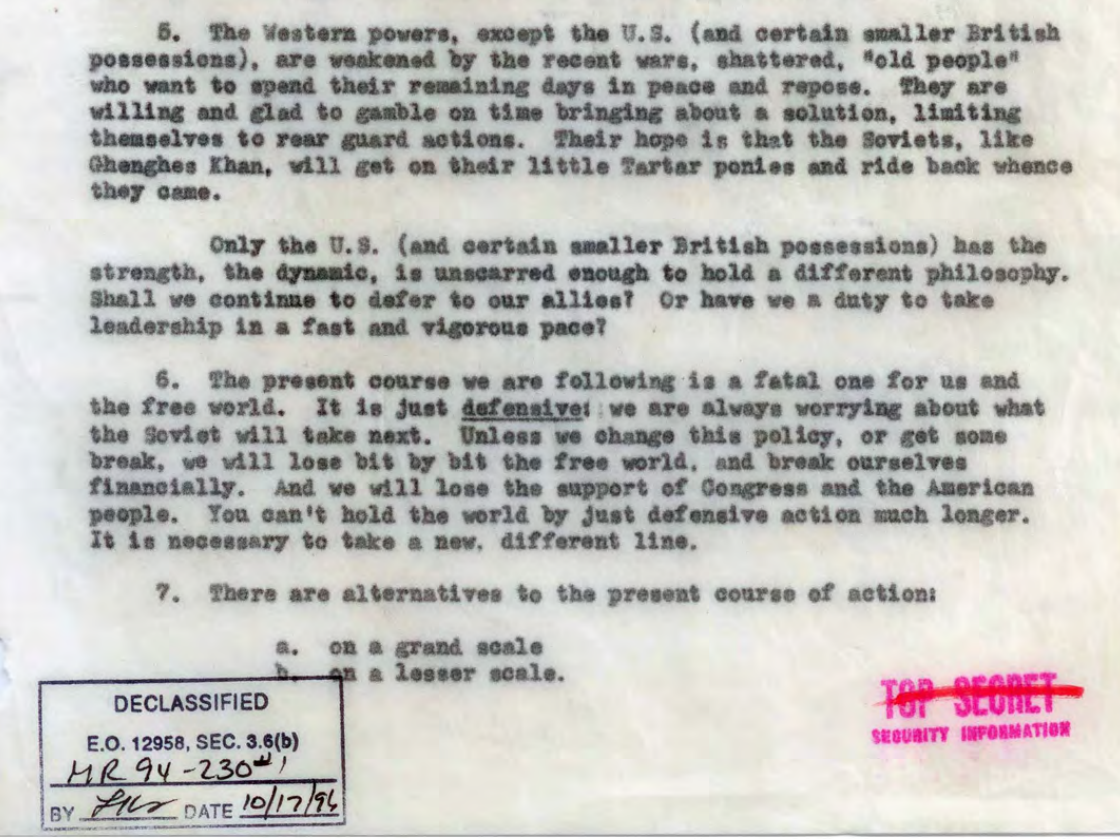
What emerged was not a speech, not a doctrine, and not something the public would ever be asked to approve. It was a framework. A system. The kind that does not arrive with a nameplate, but instead embeds itself across agencies, alliances, and decisions until it becomes indistinguishable from the environment itself.
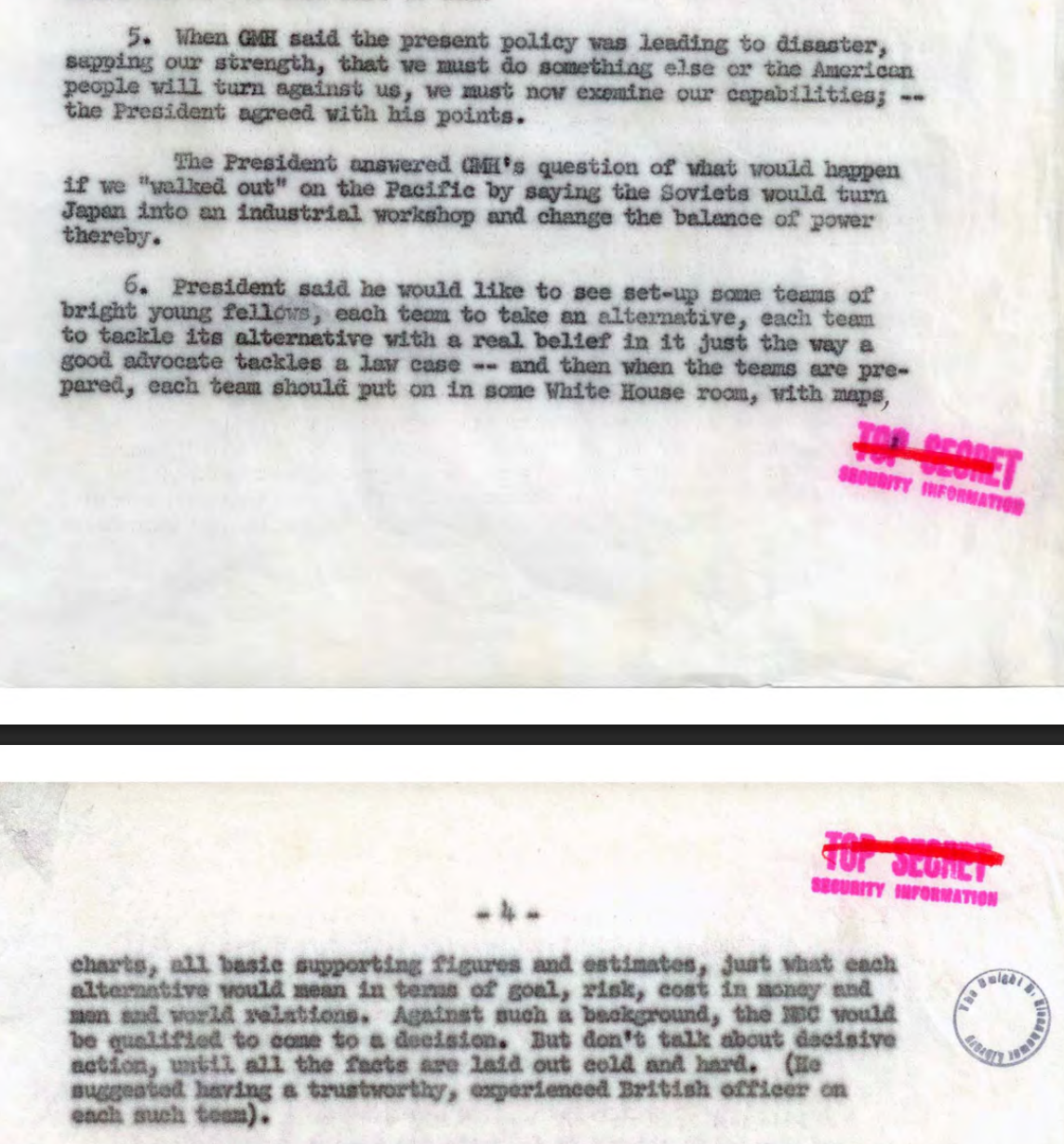
It was never introduced as a single strategy. It did not need to be. Like certain programs you only glimpse in fragments, it was distributed, compartmentalized, and sustained through continuity rather than attention. What Solarium produced was more than Cold War policy. It was an architecture for organizing global power, one that persists regardless of leadership, elections, or headlines. You were never meant to see the whole structure. Only the outcomes.
Time has shown that a system powerful enough to organize the world also becomes complex enough to be examined from within, creating the very tools through which it reveals itself.
THE PROBLEM: POWER WITHOUT ENOUGH
At the end of World War II, the United States stood at the peak of global power. Its industrial output dwarfed every other nation. Its military had demonstrated overwhelming capability. Its currency became the backbone of the international financial system. On the surface, there was no challenger capable of matching it.

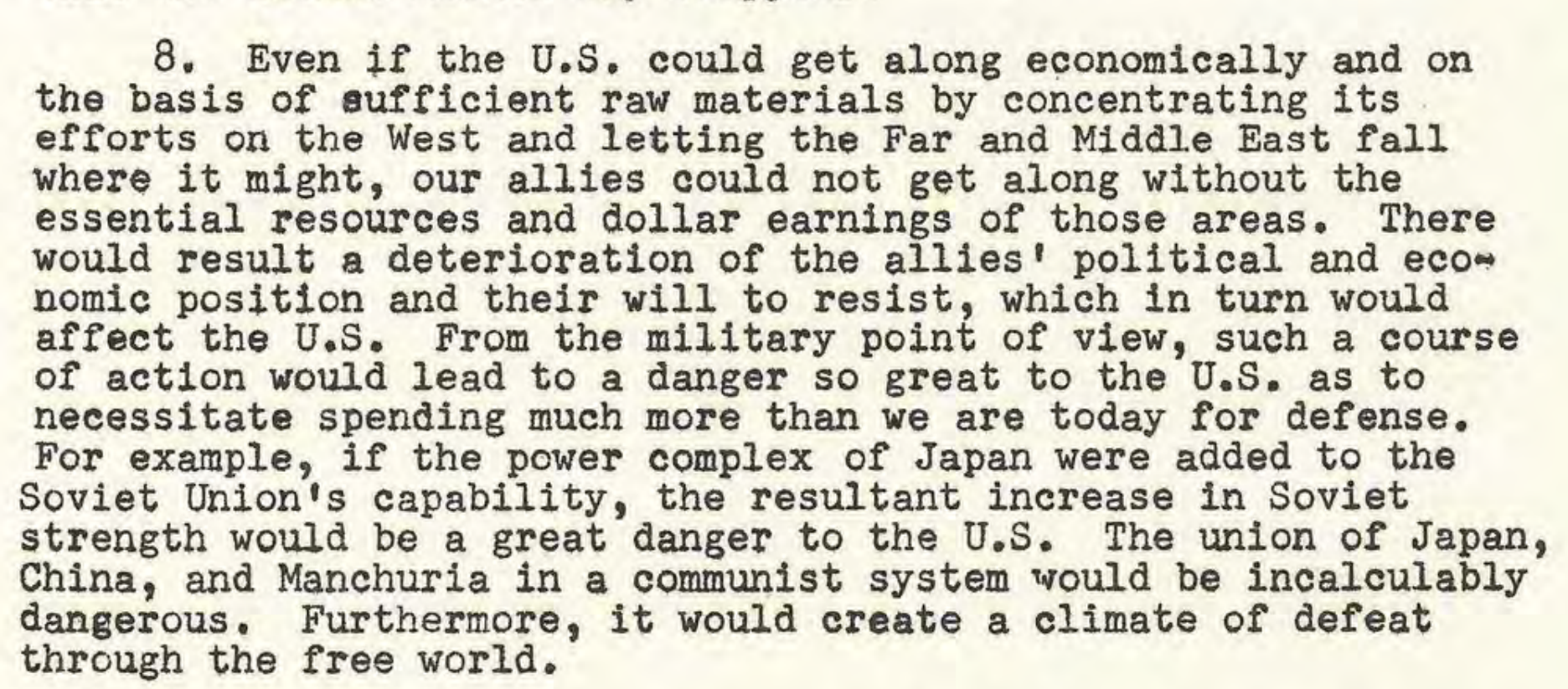
But beneath that dominance was a structural constraint that Solarium confronted directly. The United States did not control enough raw materials, territory, or population to guarantee permanent supremacy on its own. Meanwhile, the Soviet Union controlled vast land, deep resource reserves, and strategic positioning across Eurasia. Over time, those advantages could translate into parity– or even dominance.
This concern is reflected clearly in the Solarium materials, which emphasize that time would only favor the United States if deliberate action was taken to build and sustain power. As one summary states, the strategy assumes success only "provided that we build up and maintain... United States military strength". That conditional phrasing reveals the underlying reality. Without continuous intervention, time was not an ally.
The conclusion was unavoidable. The United States could not remain a superpower by relying solely on its own borders. It would have to shape the world itself.
THREE PATHS: A, B, AND C
Project Solarium did not produce a single answer. It produced three.
Each task force was assigned the same objective: determine how the United States could maintain global dominance in a world where it did not control the majority of resources. What they delivered were not theoretical exercises, but fully developed frameworks for how power could be organized, projected, and sustained over time.
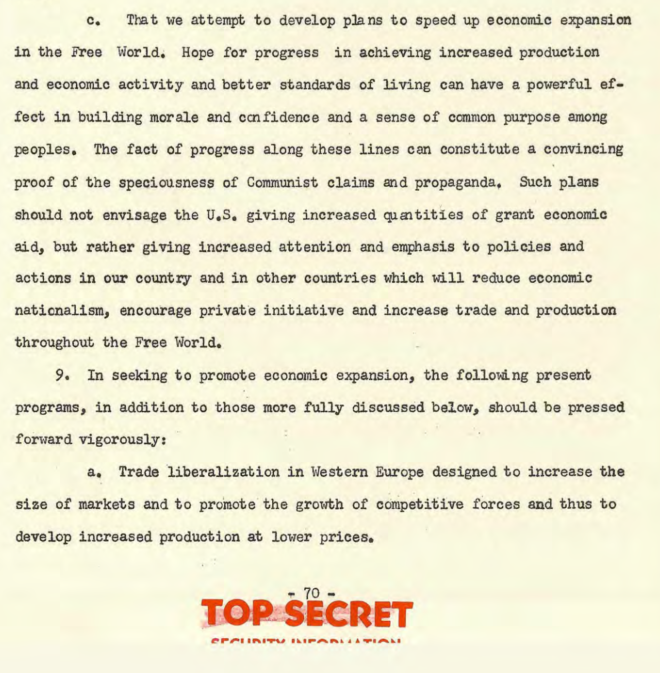
The first approach, Task Force A, outlined a system built on structure rather than force. It emphasized long-term containment through stability, proposing that the United States could secure its position by constructing a global network of aligned nations. This would be achieved through sustained military strength, combined with large-scale economic assistance programs designed to stabilize allies and integrate them into a broader system.
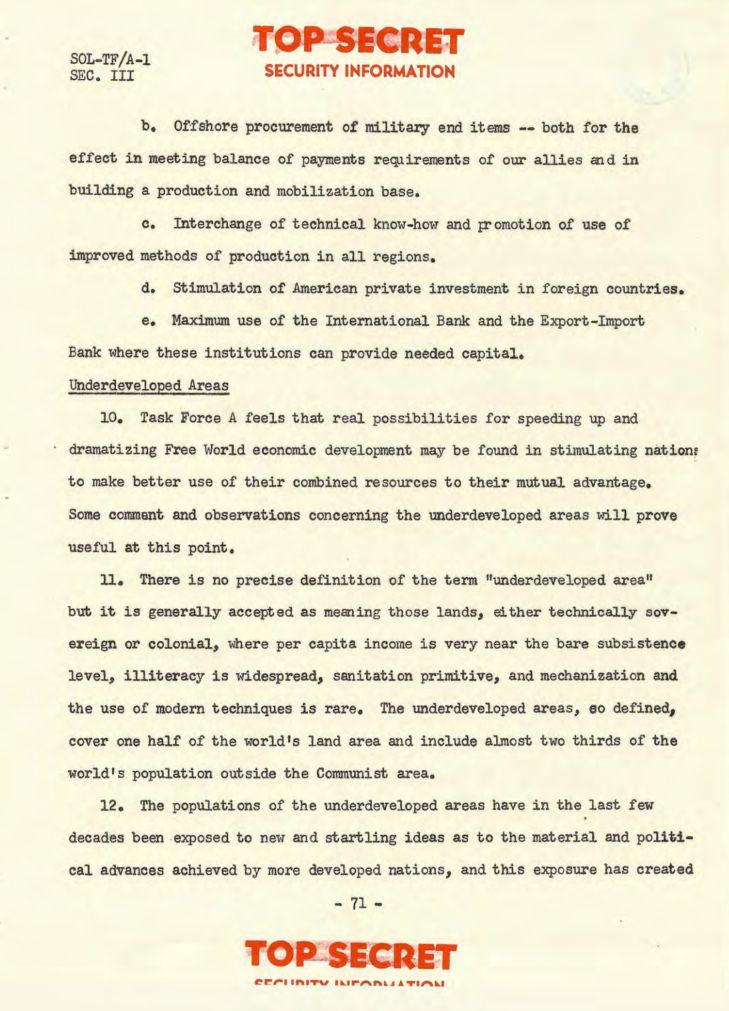
The intent was not humanitarian. It was strategic. By strengthening foreign economies and political systems, the United States could extend its influence far beyond its own borders without direct control. The documents are explicit in this logic, calling for expansive foreign assistance tied directly to both military capability and economic alignment. At the same time, this approach did not exclude pressure. It included ongoing efforts to exploit vulnerabilities within opposing systems, reducing their ability to compete without triggering open conflict. Even at its most restrained, this was not passive policy. It was continuous, low-visibility intervention.
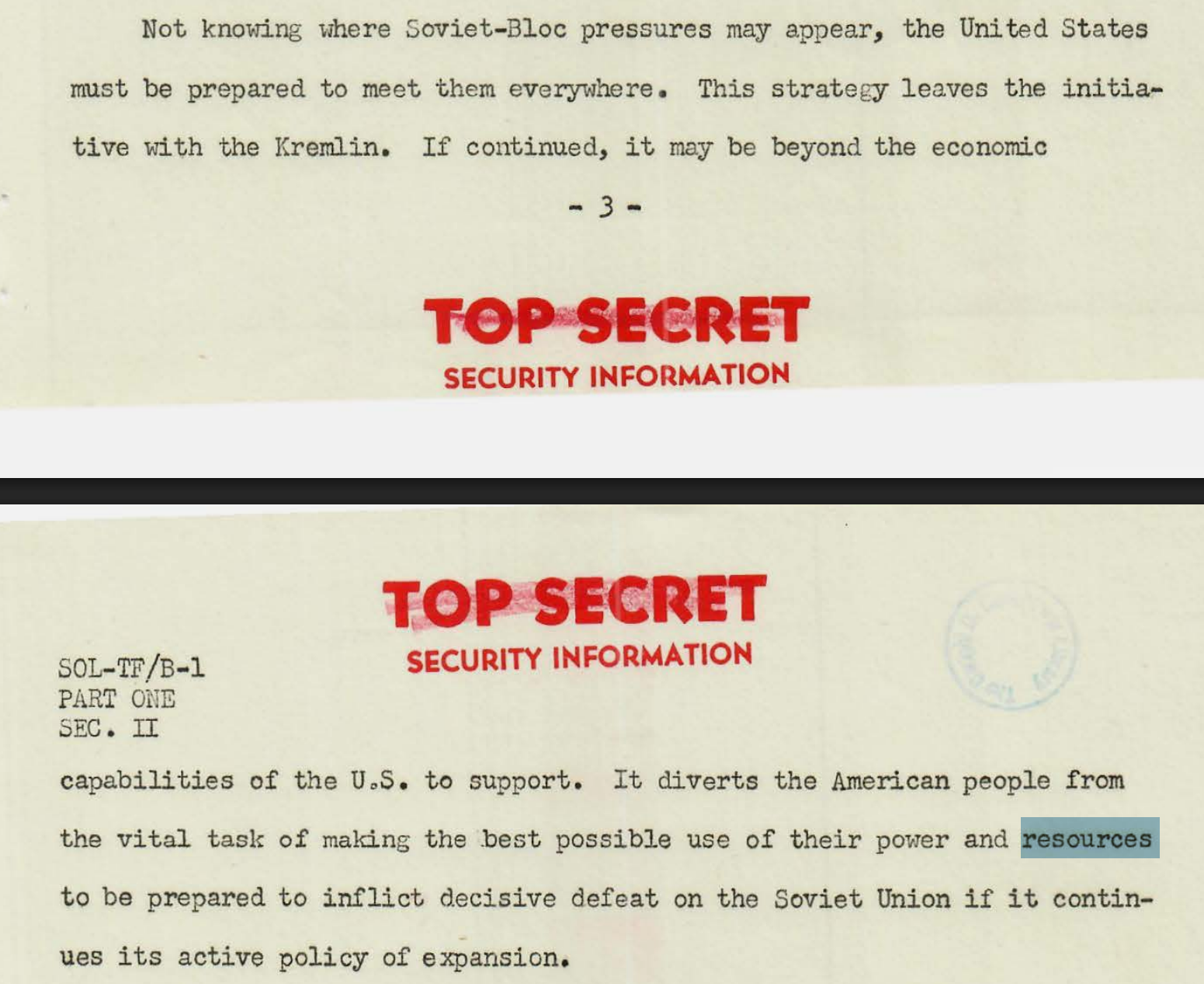
The second approach, Task Force B, abandoned subtlety in favor of clarity. It proposed defining hard global boundaries that could not be crossed without consequence. Under this model, deterrence becomes the central mechanism of control. The United States would maintain overwhelming military readiness and establish clear thresholds where any advance by an adversary would be treated as an act of war.
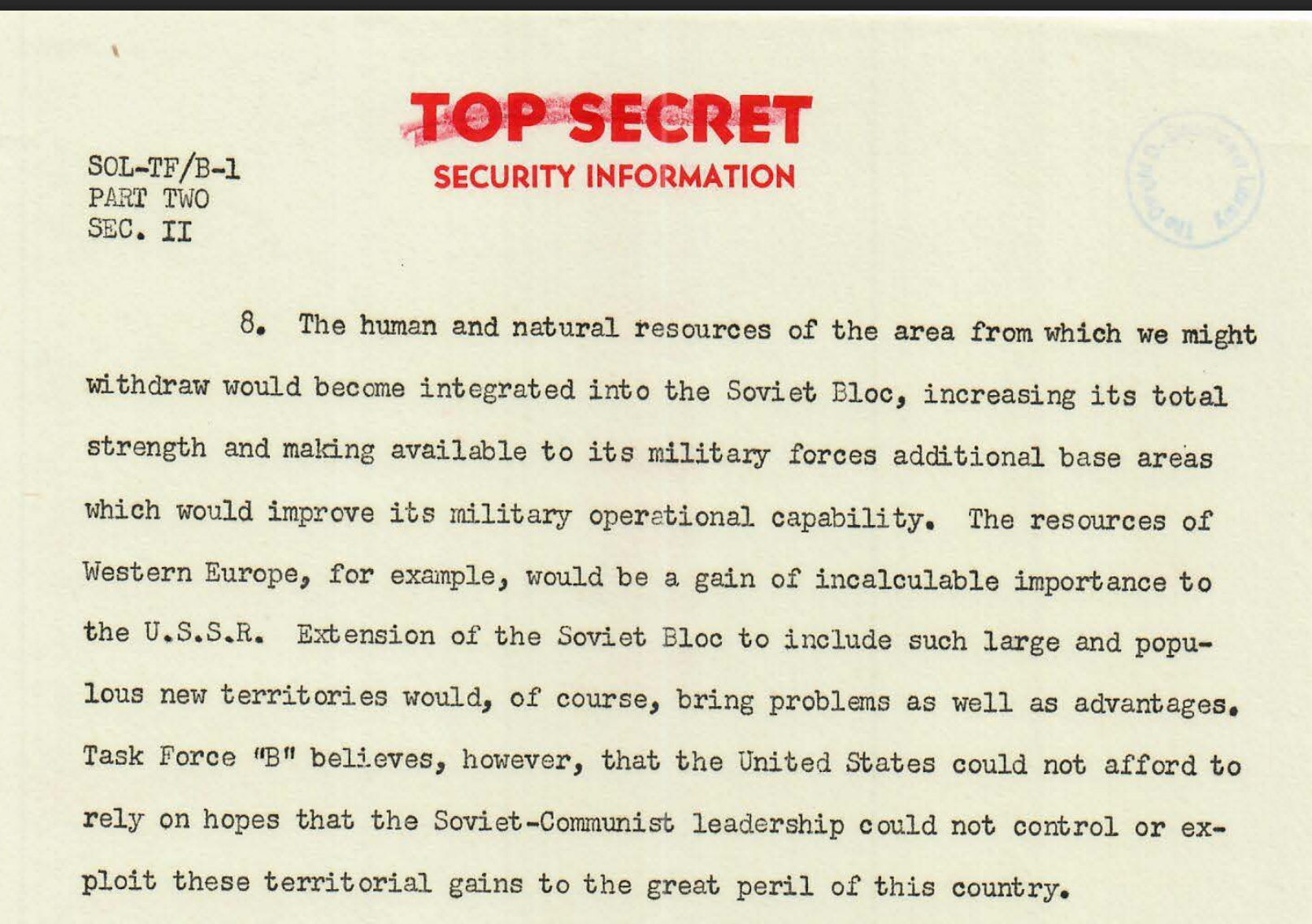
This created a permanent state of tension. Stability, in this framework, is not achieved through cooperation but through the constant threat of escalation. The documents make clear that any breach of these boundaries would carry the risk of general war, requiring the United States to sustain military capabilities at a level capable of immediate response. Peace, therefore, is not the absence of conflict, but the management of it. A system held together by force held in reserve.
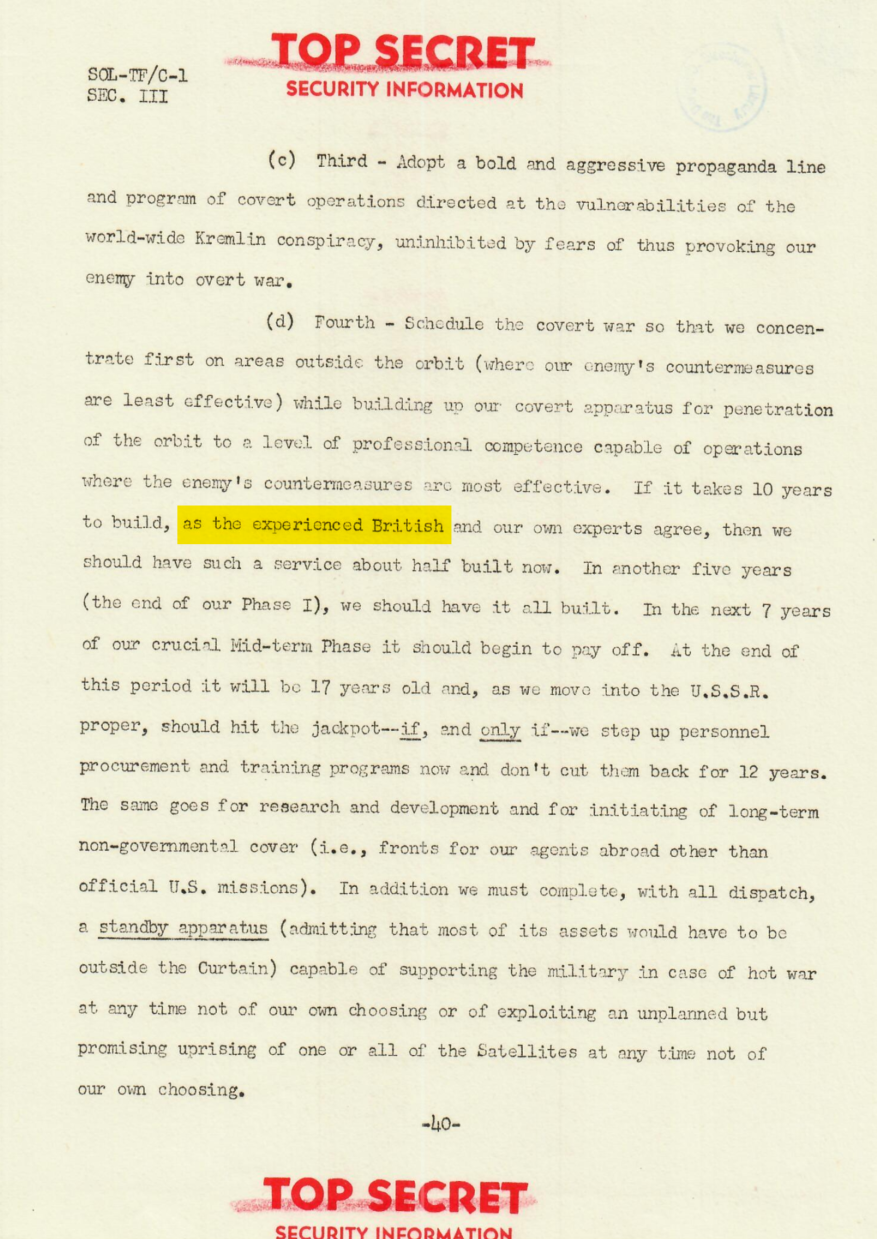
The third approach, Task Force C, rejected both patience and restraint. It argued that time itself was working against the United States and that waiting would only allow adversaries to strengthen. Survival, under this model, required active intervention. Not just containment, and not just deterrence, but continuous disruption.
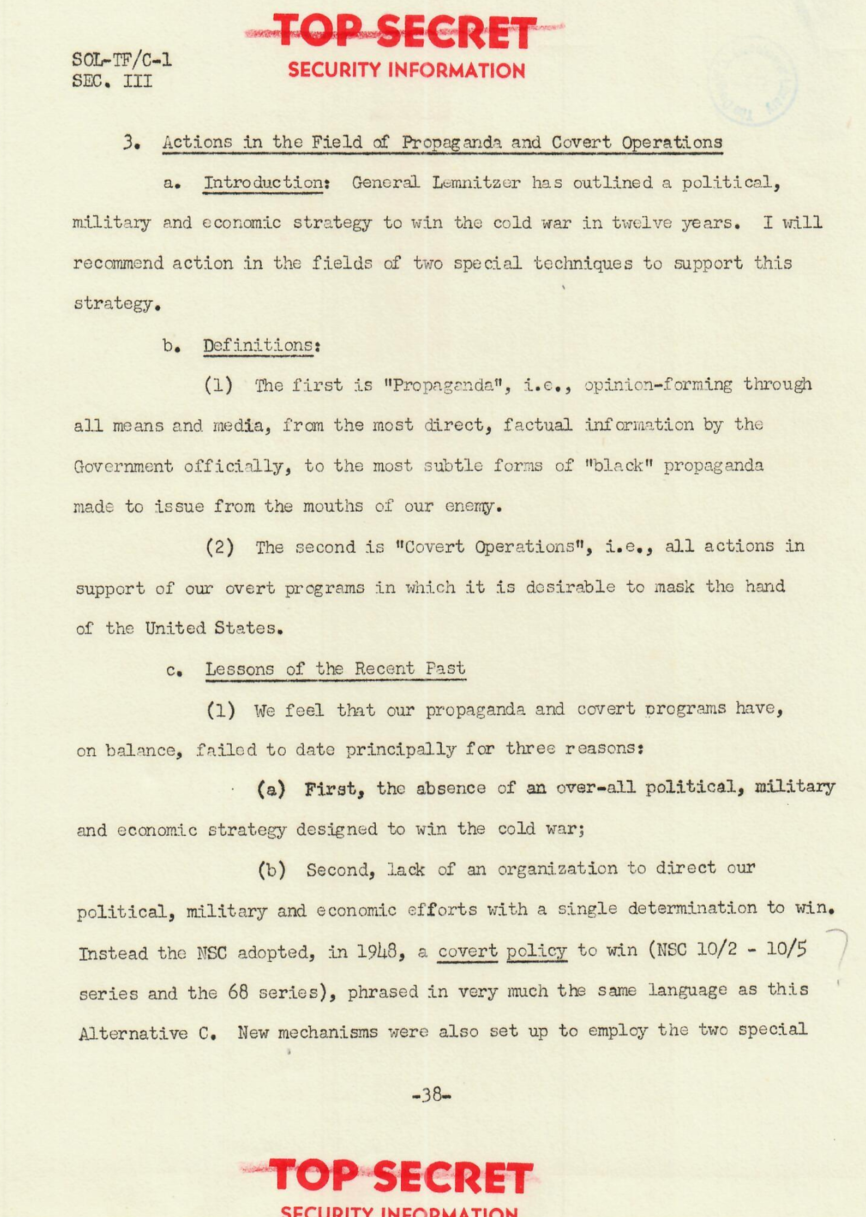
This included direct efforts to destabilize opposing powers, encourage internal dissent, and weaken adversaries from within. The strategy openly acknowledges the risks involved, including the possibility that such actions could significantly increase the likelihood of general war. This is not framed as a failure of the system, but as a cost of maintaining it.
What distinguishes this approach is its explicit recognition that power can be preserved not only by building systems or defending them, but by preventing competing systems from ever stabilizing. The documents go further, incorporating political, economic, and psychological measures as coordinated tools of influence. This is not limited to physical conflict. It extends into perception, narrative, and the shaping of understanding itself.
Presented individually, these three approaches appear as alternatives. In reality, they reveal the full operating range of the system that followed. A system capable of building alliances, enforcing boundaries, and applying pressure simultaneously. A system that does not rely on a single method of control, but on the integration of all three.
And most importantly, a system that requires constant funding to sustain each layer at once.
The public was never asked to choose between these paths. It was never shown how they fit together. Yet it continues to finance the result.
THE REAL DECISION: A System You Fund, Not a Policy You Choose
Although Solarium presented these as alternatives, the United States did not choose one. It did not adopt a single path. It operationalized elements of all three. The result was not a policy but a machine– a system capable of operating across multiple layers at once.
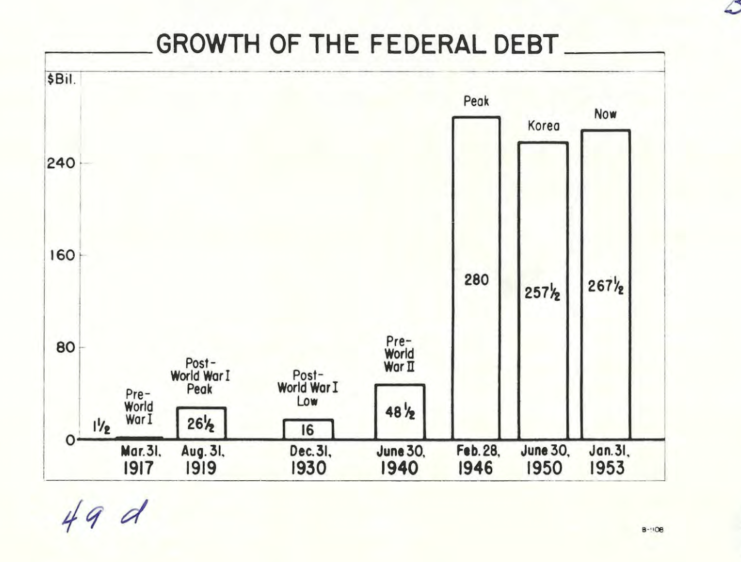
This system builds alliances, enforces boundaries, and disrupts threats simultaneously. It funds foreign governments, maintains global military positioning and conducts operations that never appear in a single line item. It adapts continuously, shifting between economic support, military pressure, and covert action depending on the situation.
This is what your tax dollars fund.
Not just defense. Not just aid. But the integration of both into a multi-layered system of global influence.
THE INFORMATION LAYER: WHY THE PUBLIC DOESN’T SEE IT
A system of this scale cannot function without public support. But it also cannot function if fully explained.
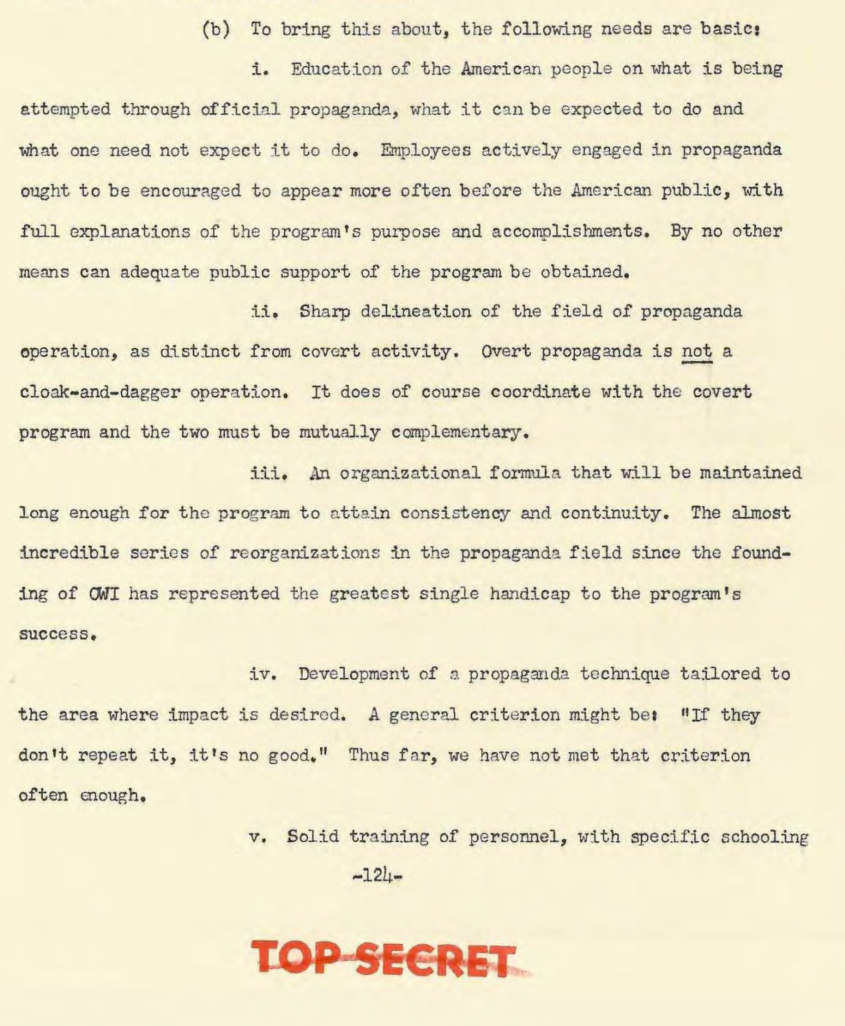
Solarium embeds information as a core instrument of power. The use of “psychological measures” is not limited to foreign adversaries. It reflects the need to maintain alignment, cohesion, and acceptance across the entire system.
This logic does not stop at foreign audiences. It extends wherever alignment, cohesion, and consent must be maintained.
The public must:
- Accept long-term military spending
- Support foreign engagement
- Tolerate economic trade-offs
- Believe in the legitimacy of the system
This is reinforced through narrative framing, selective disclosure, and the structuring of information itself. The system does not rely on secrecy alone. It relies on incomplete understanding. It normalized the use of information as an instrument of power, including in ways the public would not fully see or evaluate.
The result is a population that funds the system without fully seeing it, while the system protects its own continuity by shaping the limits of public understanding.
THE COST: STRUCTURAL, NOT TEMPORARY
Solarium does not describe a system that ends. It describes one that must be sustained indefinitely. That means the costs are not temporary. They are embedded.
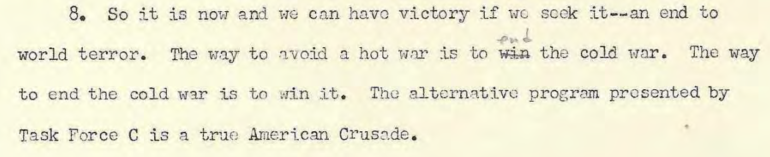
The United States must continuously:
- Fund global commitments
- Maintain military readiness
- Support aligned economies
- Manage ongoing competition
This creates a permanent outflow of resources. Domestic priorities compete with global requirements, and optimization at home is often secondary to stability abroad.
This is not mismanagement.
It is design.
RESOURCE REALITY: POWER REQUIRES ACCESS
Beneath the strategic language and institutional structure, Solarium rests on a constraint that cannot be abstracted away: power is material. Industrial capacity, energy, metals, and critical inputs define the limits of what a nation can produce, project, and sustain. No system of global influence exists independently of the resources that feed it. Strategy can organize power, but it cannot substitute for the physical inputs that make power possible.
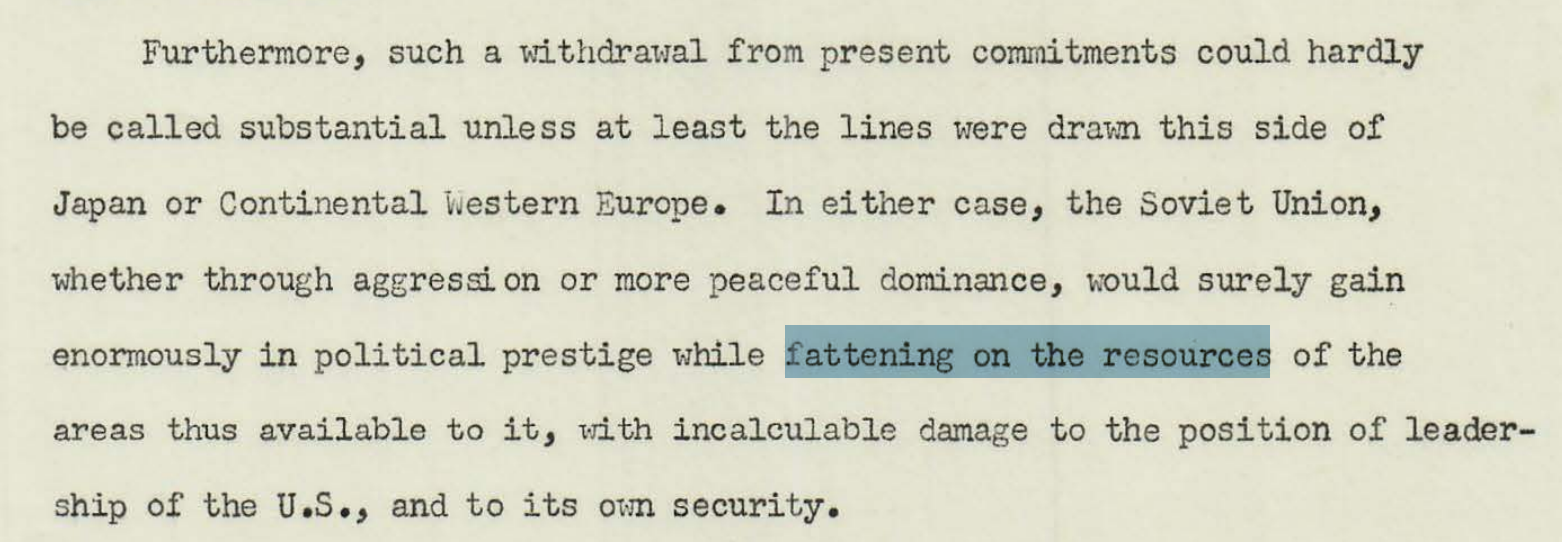
The United States entered the postwar era with unmatched industrial strength, yet not with complete resource independence. Many of the materials required to sustain long-term dominance—strategic minerals, energy inputs, and industrial components—exist beyond its borders. This created a structural reality that Solarium implicitly confronted. Dominance could not be secured through domestic production alone. It required reliable, scalable access to resources distributed across the world.
Over time, this necessity shaped policy in ways that are often misunderstood when viewed purely through an economic lens. Rather than maximizing self-sufficiency, the system prioritized control through integration. Alliances were strengthened, trade routes secured, foreign producers stabilized, and access embedded within a broader global framework. What appears as offshoring or import reliance in one context can be understood, in another, as the extension of influence across supply chains that do not reside within national borders.
This reflects a fundamental shift from ownership of resources to management of access. Ownership is finite and geographically constrained. Access, when structured effectively, can be expansive and adaptive. But access is not passive. It must be maintained through continuous diplomatic, economic, and, at times, military engagement. Stability in resource-producing regions is not incidental to the system. It is a requirement of it.
This logic is not theoretical. It is formalized through mechanisms such as Security of Supply Arrangements, which establish priority access to critical goods and industrial capacity among allied nations. These frameworks allow governments to request preferential fulfillment of contracts across borders during periods of stress, emergency, or conflict. In effect, they codify a simple reality: access is not left entirely to market forces. It is coordinated, prioritized, and, when necessary, redirected to serve national security objectives.
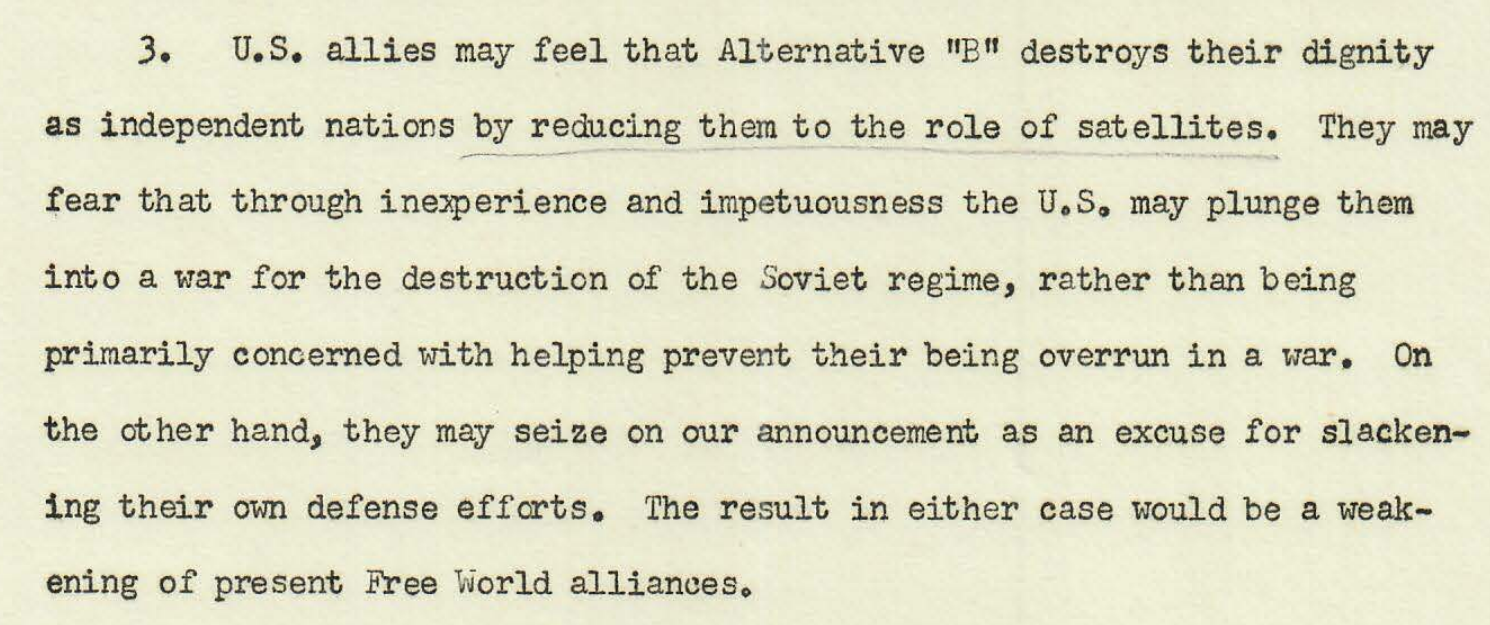
What appears as a global supply chain is, in part, a managed network—one in which availability is shaped not only by price, but by alignment.
These choices introduce trade-offs that are not always visible at the surface level. Reliance on external supply can increase exposure to disruption, while the prioritization of global positioning can come at the expense of domestic optimization. Efficiency, cost, and strategic alignment do not always coincide with resilience at home. What may appear as imbalance or decline in certain sectors is, in part, the byproduct of operating within a system designed for global reach rather than local completeness.
This is not accidental. It is the result of a framework that prioritizes sustained access to the inputs of power over the location of their production. The system does not require that resources originate within its borders. It requires that they remain available, accessible, and aligned with its broader objectives.
MARKETS UNDER PRIORITY: WHEN SECURITY OVERRIDES PRICE OR SCARCITY
At its core, the Solarium framework elevates one principle above all others: continuity of national power. Within that hierarchy, markets are not sovereign. They are instruments.
In theory, markets allocate resources through price discovery. In practice, during periods of stress or strategic importance, that process can be shaped, redirected, or temporarily constrained in the name of stability.
This is not a hidden function. It is embedded in how modern states operate.
Financial systems underpin national security. Currency stability, capital flows, and access to critical resources are not treated as passive outcomes of market activity. They are actively monitored and, when necessary, stabilized through coordinated action across institutions.
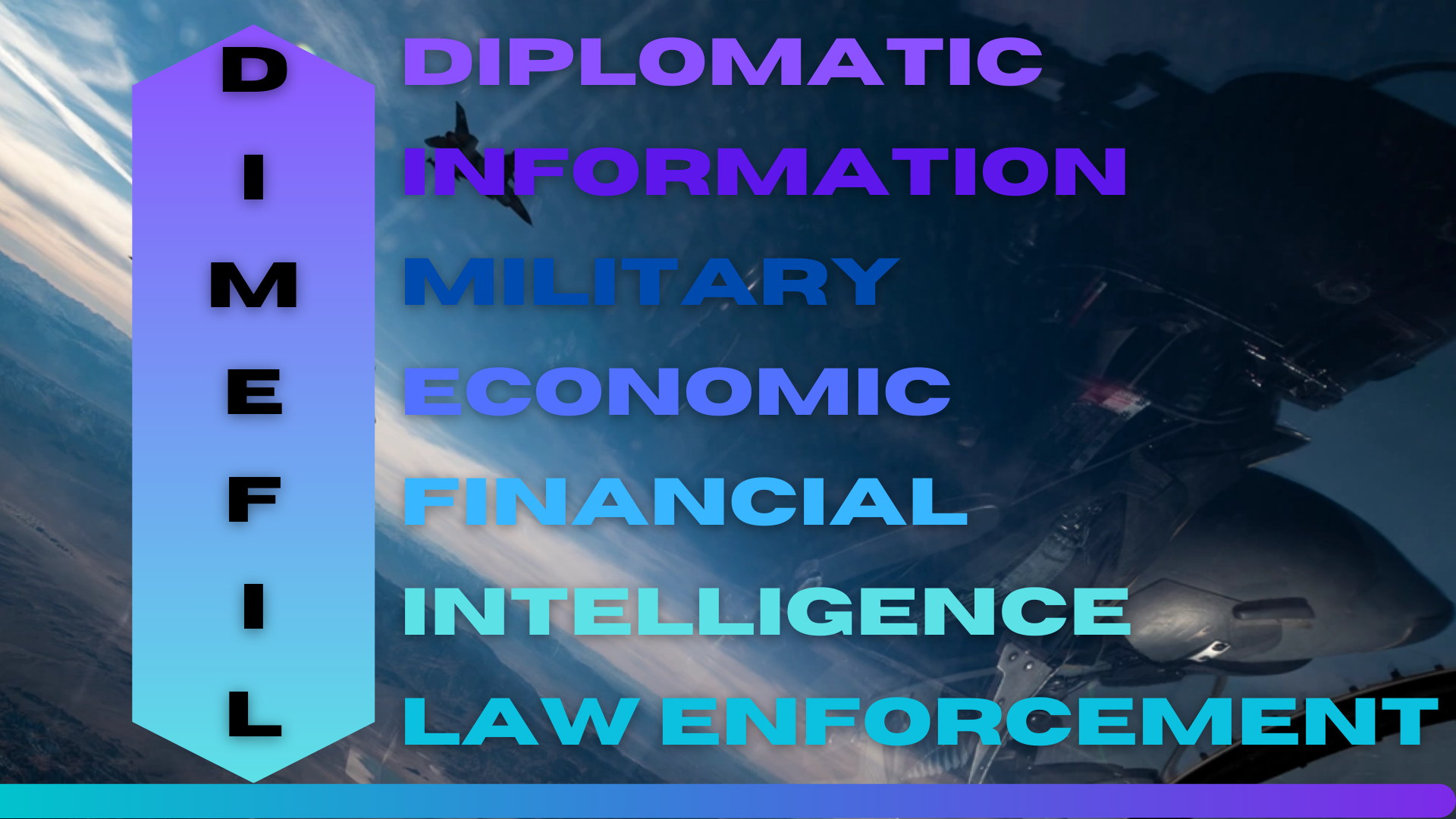
In contemporary terms, this sits within the same multi-domain logic captured by DIMEFIL. Economic and financial instruments are not separate from strategy. They are part of it.
Moments of extreme market dislocation—whether driven by concentrated positioning, supply constraints, or rapid shifts in sentiment—test this boundary. When volatility threatens broader systemic stability, the response is rarely to allow pure market resolution. It is to contain, absorb, or redirect the pressure.
From one perspective, this is risk management. From another, it introduces a structural asymmetry.
Participants operate under the assumption of open competition. But the system retains the capacity to intervene when outcomes begin to conflict with higher-order priorities. Those priorities are not always visible, and they are not always aligned with short-term investor outcomes.
This does not require a conspiracy. It requires a hierarchy. Stability over disruption. Continuity over purity. The result is a market environment that functions freely—until it doesn’t.
CONTINUITY BEYOND NATIONS
What persists over time is not a single nation or administration, but a structure.
The transition from one era to the next—empire to alliance, dominance to coordination—does not erase underlying systems of power. It adapts them. Institutions evolve, alliances shift, and leadership changes, yet the mechanisms that organize capital, resources, and influence often continue with remarkable consistency.
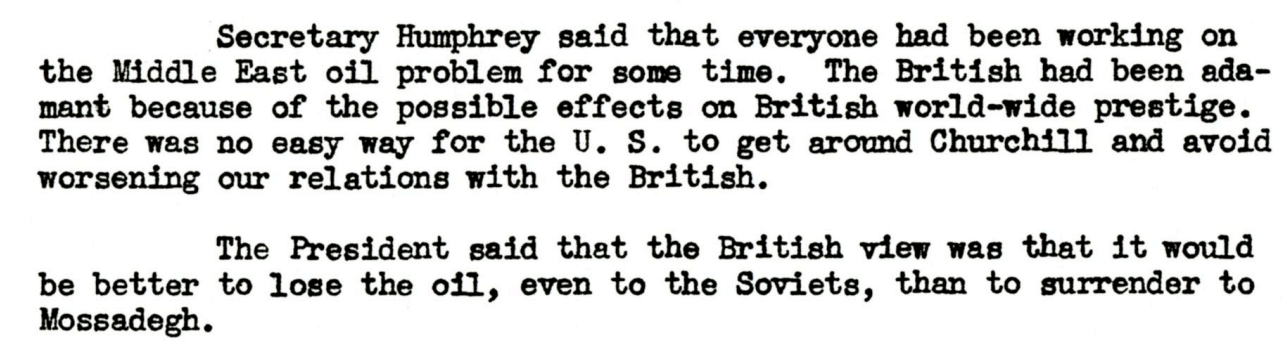
The United States did not inherit a vacuum after World War II. It entered into an existing global framework of finance, trade, and strategic coordination—one that it expanded, reshaped, and ultimately led. What appears as a transfer of power is often better understood as a reconfiguration of it.
Over time, this creates continuity that is not tied to any single government or generation. The system persists because it is distributed across institutions, networks, and interests that outlast individuals and transcend national boundaries.
This raises a more fundamental question.
Not who controls the system.
But whether the system, once established, begins to operate according to its own internal logic—one that prioritizes its continuation above all else.
THE TRADE THAT STILL DEFINES EVERYTHING
In 1953, the United States did not simply choose a strategy. It chose a philosophy of survival.
It chose a way of seeing the world in which stability would not be trusted to chance, where access to resources would not be left to markets alone, and where the future would be shaped deliberately, even if that shaping could not be fully explained to those living inside it.
Project Solarium did not create something new so much as it revealed a truth the architects believed unavoidable: that a nation seeking to remain a superpower must think beyond its borders, beyond its people in isolation, and beyond the visible boundaries of democracy itself.
The system that followed was not hidden in the sense of being absent. It was hidden in plain sight, fragmented across policies, institutions, and decades of decisions that appear disconnected unless viewed as a whole. Each piece, on its own, can be explained. Together, they form something else entirely.
Elections rotate leadership, but they do not rewrite the underlying logic. Administrations change tone, priorities, and pace, yet the structure persists beneath them, steady and largely untouched. It persists because it was never meant to be temporary. It was designed as a continuity mechanism, a framework that could outlive any single moment of political will.
And so the system endures.
It is funded continuously, almost invisibly, by the people it does not fully describe itself to. Tax dollars move outward into a lattice of commitments, conflicts, alliances, and guarantees that stretch far beyond what is commonly understood. The public participates in this system not through informed consent, but through assumption. It is told stories about necessity, about security, about stability, but rarely shown the full architecture those words are meant to justify.
From one perspective, the system succeeded. It secured dominance. It prevented collapse. It shaped the global order in ways that benefited the continuity of American power and the network aligned with it.
But success carries its own shadow.
A system built to operate beyond full transparency inevitably begins to distance itself from the people who sustain it. Not always through malice, but through design. When continuity becomes the priority, accountability becomes secondary. When stability becomes the goal, consent becomes less essential than compliance. And in that quiet shift, something fundamental changes. The public is no longer the driver of the system. It becomes the substrate that supports it.
Not because it chose to be. Because it was never shown the full map.
THE LABYRINTH PROTECTING THE SYSTEM
A system designed for continuity does not naturally return to equilibrium. It deepens. Each cycle reinforces its logic, each disruption justifies further integration, and each layer of coordination makes the next more necessary. Over time, the system no longer appears as a series of decisions. It becomes the environment itself—something operated within rather than consciously directed.
Within that environment, participation is constant. Individuals, institutions, and markets all function inside its boundaries, whether they fully perceive them or not. Understanding remains partial, yet it continues to develop—not because the system is revealed in full, but because it is encountered incrementally, through outcomes rather than explanations.
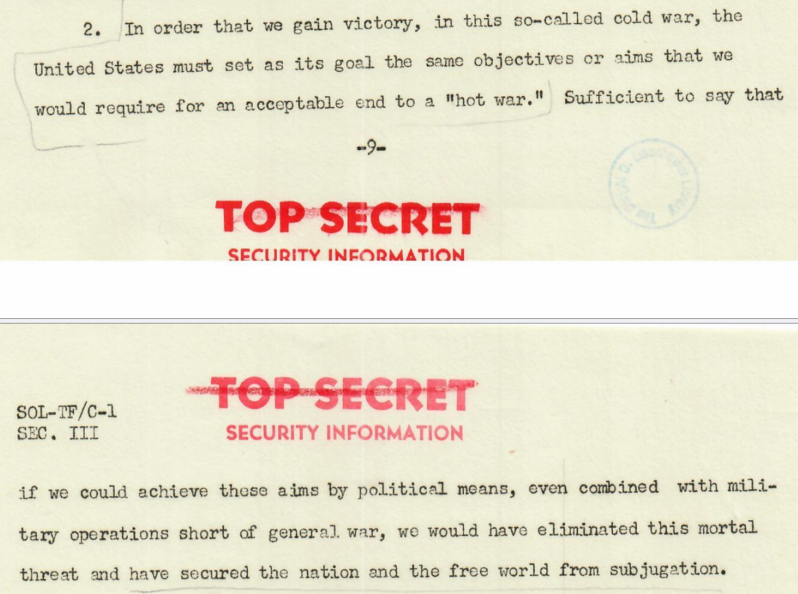
There is no defining moment at which the system can be reset. It does not hinge on a single event, nor does it present a clear point of return. Instead, it is often accelerated by crisis. Moments of national emergency expand the range of what is considered necessary, bringing into play authorities and actions that would otherwise remain constrained. What begins as response becomes precedent, and what is justified by urgency is sustained by continuity.
Over time, this produces an inherent tension. Measures introduced as temporary solutions can become embedded features. Justifications rooted in security extend beyond their original scope, not through sudden change, but through gradual normalization. The balance between protection and constraint does not disappear. It shifts—subtly, persistently, and often without a clearly defined threshold at which that shift can be reversed.
The question, then, is not whether such powers are ever warranted. It is how, and whether, they are ultimately relinquished.
Sourced Declassified Documents:
 SilverWars
“Continuity doesn’t require reinvention. Only transfer of control and its inherited problems.” - IA