


January 14, 2026, the United States took a step that received little public attention but carries long-term strategic consequences: an adjustment of imports of processed critical minerals and their derivative products into the United States. The language was technical, the framing bureaucratic, and the implications profound. This action did not target finished weapon systems, nor did it announce an export restriction or arms-sales freeze. Instead, it addressed something more fundamental: the upstream materials and components that make advanced military systems possible.
This marks a structural shift in how military readiness is defined. Platforms, fleets, and munitions remain visible measure of power, but they are no longer the primary constraint. The constraint has moved upstream, into processing capacity, derivative components, and assured access to performance-critical materials. For the defense sector, this reorders supply-chain priorities. For the mining sector, it reframes mineral production as strategic infrastructure. For capital allocators, it redraws the map of where durable demand and government alignment now sit.
A Supply-Chain Sovereignty Action, Not a Sales Ban
The recent trade adjustment is best understood as a supply-chain sovereignty measure. It focuses on imports, not exports, and on processed inputs rather than finished goods. “Processed critical minerals” and “derivative products” encompass a broad category of materials and components embedded across modern defense systems: electronics assemblies, guidance modules, sensors, power-management hardware, secure communications components, and high-frequency circuitry.
These derivative products are not interchangeable commodities. They are engineered inputs with specific performance tolerances, often designed for extreme environments involving heat, vibration, radiation, and sustained operational stress. By asserting control over how and where these inputs are sourced and processed, the government gains leverage over readiness without announcing rationing or restricting final deliveries.
The result is not fewer weapons sold, but tighter prioritization of inputs. Scarcity, when it emerges, will appear upstream as delayed components, constrained production runs, or longer lead times, not as empty arsenals.
Silver’s Role in Advanced Defense Systems
 Proclamations
 IA
IA
 Stevie Bonifield
Among the materials implicated by this shift, silver occupies a particularly consequential position. Its relevance is not monetary or symbolic. It is functional.
Silver possesses the highest electrical conductivity of any metal and exceptional thermal conductivity. These properties make it indispensable in high-reliability electronics where signal integrity, heat dissipation, and failure resistance are non-negotiable. In advanced weapons systems and supporting platforms, silver is used in contacts, coatings, solders, and conductive pathways that must perform flawlessly under extreme conditions.
Its applications span missile guidance and seekers, phased-array radar, satellite systems, electronic warfare platforms, secure communications infrastructure, avionics, and directed-energy systems. Unlike gold, silver in these contexts is consumed. It is embedded, bonded, worn, and ultimately removed from circulation through use.
From an engineering perspective, silver is not a substitute-friendly input. Alternative materials may exist in laboratory conditions, but they rarely scale with equivalent reliability across temperature extremes, high frequencies, and sustained duty cycles. For defense manufacturers, silver is not a cost optimization variable. It is a performance requirement.
Derivative Products as the New Choke Point
The inclusion of derivative products in trade controls is the most important element of the policy shift. Finished weapons are visible outputs, but derivative components determine production velocity. By influencing the flow of processed materials and intermediate assemblies, governments can indirectly shape who receives systems first, how quickly programs advance, and which projects take priority.
This approach enables a form of industrial triage without overt intervention. Domestic and allied supply chains gain preference. Strategic programs receive inputs first. Non-essential or lower-priority exports face friction without being formally restricted. The control point is subtle, but effective.
For defense contractors, this elevates supply assurance above marginal cost savings. For allied nations, it introduces incentives to realign processing and manufacturing closer to trusted supply networks. For adversaries, it raises barriers that cannot be bypassed by simply purchasing finished goods on the open market.
Implications for the Defense Sector
Defense primes and subcontractors are now operating in an environment where platform design excellence is necessary but insufficient. Competitive advantage increasingly derives from supply-chain resilience.
This means:
- Long-term contracts that emphasize traceability and origin of inputs
- Greater scrutiny of processing locations for critical materials
- Redundancy in sourcing, even at higher nominal cost
- Vertical alignment with upstream suppliers to reduce exposure to trade friction
The defense sector is being pushed, quietly but firmly, toward deeper engagement with material producers and processors. In this framework, assured access outranks lowest-price sourcing. Reliability becomes a strategic differentiator.
Implications for the Mining Sector
For mining companies, particularly those involved in silver and other defense-relevant minerals, this policy shift reframes their role. These are no longer extractive operations competing solely on price. They are potential contributors to national and allied security.
Many critical-mineral projects are constrained not by geology, but by capital access, permitting timelines, and infrastructure build-out. Defense relevance alters that equation. Projects aligned with national-security supply chains gain access to new funding pathways, including government loan guarantees, strategic offtake agreements, and defense-aligned private capital.
When minerals are treated as infrastructure, volatility becomes less punitive. Long-term demand certainty replaces spot-market exposure. For miners, alignment with defense needs can transform risk profiles and financing terms.
Capital Alignment and Strategic Investment
This environment creates space for new forms of capital alignment. Defense contractors have incentives to invest upstream. Mining firms benefit from anchor customers with long planning horizons. Governments act less as price managers and more as demand backstops.
Capital that understands this shift moves earlier and with greater confidence. The opportunity is not speculative. It is structural. As supply-chain sovereignty becomes embedded in policy, capital flows will follow compliance, traceability, and resilience.
Readiness Is Now Measured in Materials
Military readiness is no longer defined solely by the number of platforms deployed or weapons produced. It is increasingly measured by assured access to the materials that make those systems possible. The adjustment of imports of processed critical minerals and their derivative products reflects this reality.
For the defense sector, the message is clear: supply chains are now part of force posture. For the mining sector, minerals are no longer peripheral commodities, but strategic inputs. For investors and policymakers, the upstream layer has become the decisive terrain.
Those who recognize materials as the foundation of power will shape the next decade of industrial and military resilience.
Historic Reminder:
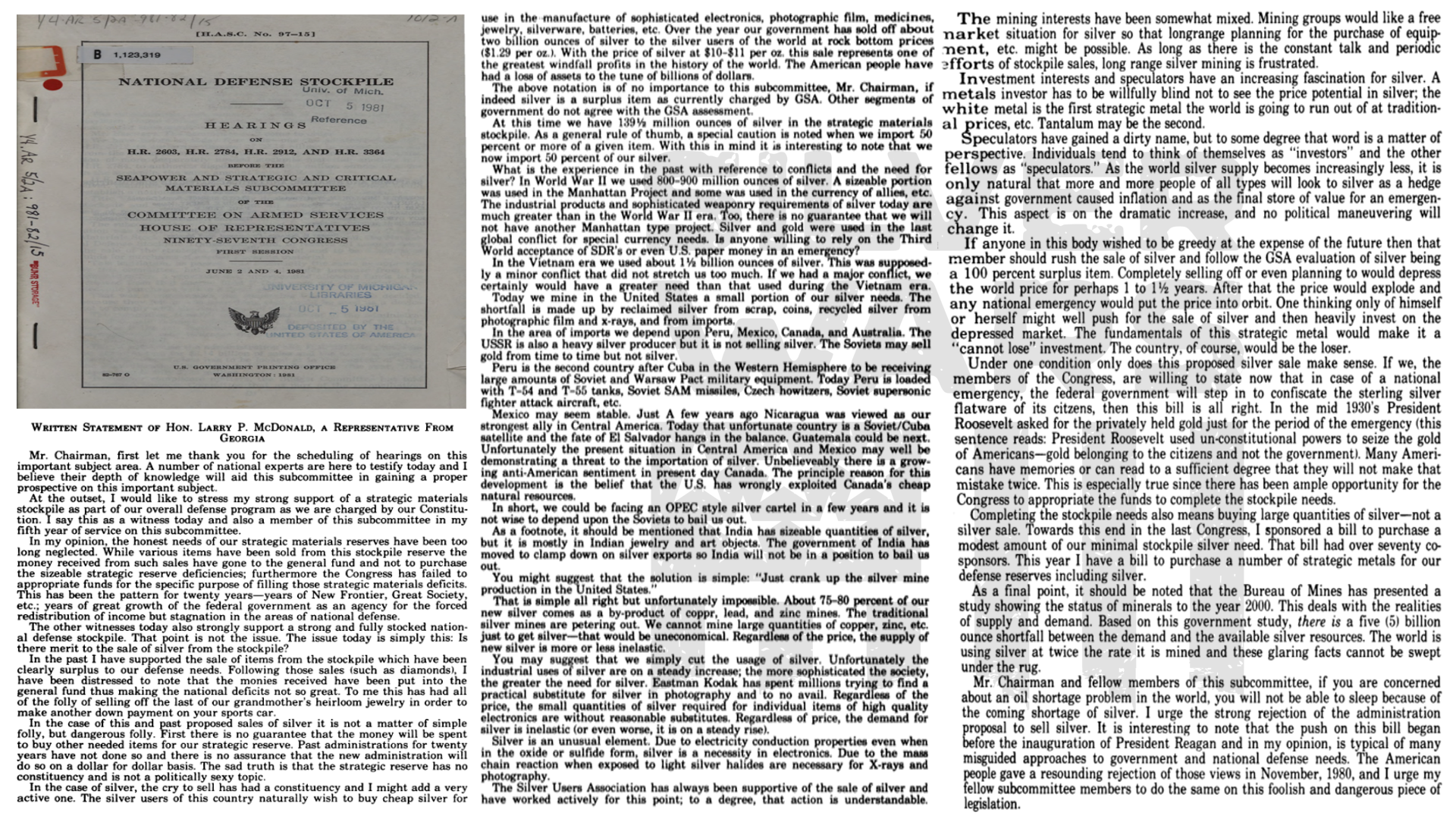
"What is the experience in the past with reference to conflicts and the need for silver? In World War II we used 800-900 million ounces of silver."
"In the Vietnam era we used about 1 1/2 billion ounces of silver. This was supposedly a minor conflict that did not stretch us too much."
"If anyone in this body wished to be greedy at the expense of the future then that member should rush the sale of silver and follow the GSA evaluation of silver being a 100 percent surplus item. Completely selling off or even planning to would depress the world price for perhaps 1 to 1 1/2 years. After that the price would explode and any national emergency would put the price into orbit..."
"Under one condition only does this proposed silver sale make sense. If we, the members of the Congress, are willing to state now that in case of a national emergency, the federal government will step in to confiscate the sterling silver flatware of its citizens..."
No Silver = No WW3