 Strategic Resource Intelligence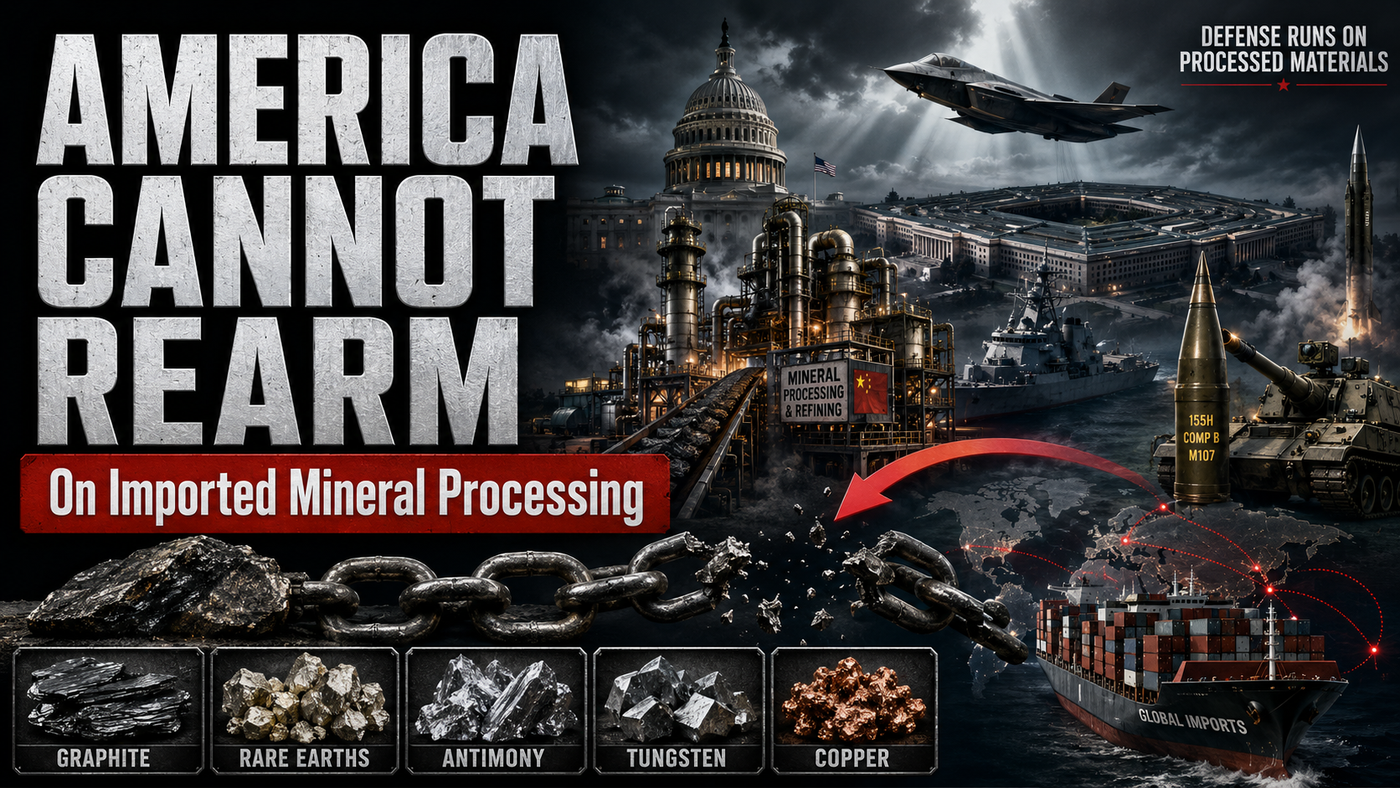
America Cannot Rearm on Imported Mineral Processing
America is trying to rebuild its defense industrial base at the exact moment the mineral supply chain is still wired backward. We talk about mines. We talk about deposits. We talk about lithium, graphite, rare earths, tungsten, antimony, copper, and silver. But the chokepoint is not just what comes out of the ground. The chokepoint is what happens after that material is mined.
That is the uncomfortable part of the rearmament story. A country can have mineral deposits and still depend on foreign processing. A country can announce new mines and still lack the refineries, separators, chemical converters, magnet plants, metal-making capacity, and specialty manufacturing needed to turn ore into defense-ready inputs.
The Pentagon already understands this. The Department of Defense has said its National Defense Industrial Strategy is built around resilient supply chains, stockpiles, supplier diversification, and expanded production capacity. That is the right frame. Rearmament is not just buying more weapons. It is rebuilding the industrial chain that makes weapons possible.
That chain starts long before the prime contractor. It starts with minerals, chemicals, metals, powders, alloys, magnets, wafers, explosives, batteries, and specialty components. If too much of that processing is offshore, especially in strategic chokepoints controlled or influenced by adversarial states, the United States is not fully rearming. It is assembling a larger weapons program on top of someone else’s mineral-processing base.
The Mine Is Only the First Step
Mining matters. But mining alone does not solve the defense supply chain problem.
A rare earth deposit does not become a guidance system by itself. Graphite ore does not become battery-grade anode material by itself. Antimony ore does not become flame retardants, ammunition inputs, or metal products by itself. Tungsten in the ground does not become carbide, specialty steel, or high-performance military manufacturing input without processing.
This is where investors, policymakers, and even some company presentations get sloppy. They use the phrase “domestic supply” like it means the same thing at every stage. It does not.
- A mine is not the same thing as a processor.
- A concentrate is not the same thing as a refined material.
- A separated oxide is not the same thing as a metal.
- A metal is not the same thing as a magnet.
- A mined mineral is not automatically a defense-ready input.
That is why the phrase “mine-to-magnet” matters. DoD has said it is working to establish a domestic rare earth supply chain that includes mining, separation, refining, metallization, and magnet production, not just digging up material. The Department has also said rare earth permanent magnets are used in systems including the F-35, Virginia and Columbia class submarines, Tomahawk missiles, radar systems, Predator unmanned aerial vehicles, and the Joint Direct Attack Munition series of smart bombs.
That is the real lesson. The United States does not need minerals in theory. It needs processed materials that can actually enter the defense production system.
The Processing Gap Is the Real Strategic Weakness
The United States has spent decades letting processing move offshore. That was sold as efficiency. In a peacetime spreadsheet, maybe it looked smart. In a defense crisis, it looks like a supply-chain trap.
USGS data shows why this matters. In 2025, the United States had no domestic natural graphite mine production, while natural graphite was still used in batteries, brake linings, lubricants, powdered metals, refractory applications, steelmaking, and some defense-related materials and components. USGS also estimated U.S. net import reliance for natural graphite at 100 percent of apparent consumption.
Antimony is another warning sign. USGS reported that recycling supplied only 12 percent of estimated domestic apparent consumption in 2025, with the rest coming from imports. It also listed antimonial lead and ammunition as 40 percent of leading U.S. antimony uses. That is not an abstract green-energy story. That is a defense and munitions story.
Rare earths show the same problem in a more famous form. USGS reported that rare earths were mined and processed domestically in 2025, including mineral concentrates at Mountain Pass, California. That is progress. But USGS still showed net import reliance for rare-earth compounds and metals at 67 percent of apparent consumption in 2025, and import-source data for 2021 through 2024 showed China at 71 percent for rare-earth compounds and metals.
Tungsten is no cleaner. USGS reported no U.S. mine production in 2025 and net import reliance above 50 percent of apparent consumption. It also noted that China continued to be the world’s leading producer, importer, and consumer of tungsten concentrates, while China implemented new export controls on selected tungsten items in 2025.
That is the pattern. The United States can talk about rearmament all it wants, but if the processing chain sits offshore, the bottleneck sits offshore too.
The Defense Supply Chain Is Not Just Final Assembly
The modern defense industry likes to talk about platforms: aircraft, submarines, drones, missiles, ships, satellites, radars, interceptors, and artillery shells. That is what the public sees. But the platform is the end of the chain, not the beginning.
Before the weapon exists, the supply chain has to deliver the materials that make it possible. That includes magnets, alloys, specialty steels, semiconductors, energetic materials, battery materials, graphite products, tungsten products, antimony products, copper systems, and advanced manufacturing inputs.
That is why mineral processing belongs inside the defense conversation. Not as a side topic. Not as a green-energy footnote. As the front end of military production.
The Army Science Board’s report on surge capacity in the defense munitions industrial base warned that Ukraine-related surge requirements exposed brittle supply chains, long lead times, single points of failure, and fragile foreign sources of supply. The same logic applies to processed minerals. If the United States cannot control or reliably access the materials behind the munitions, the bottleneck shows up before the assembly line ever starts moving.
The Critical Minerals List Is Getting More Defense-Heavy
The federal government is also widening the official list of what counts as strategically important. The final 2025 U.S. Critical Minerals List now includes 60 minerals. The list added materials such as copper, silver, uranium, silicon, metallurgical coal, boron, lead, phosphate, potash, and rhenium.
That matters because the list is no longer just a narrow battery-metals document. It is starting to look more like an industrial-power document. Copper matters for electrification, grid expansion, ships, wiring, motors, and defense electronics. Silver matters for electronics, solar, sensors, and high-performance industrial uses. Uranium matters for nuclear energy and strategic power security. Tungsten, antimony, graphite, rare earths, and gallium already sit closer to the obvious defense chokepoints.
This is the key shift: critical minerals are not just “energy transition” inputs anymore. They are defense, grid, AI, manufacturing, and national-security inputs.
Where the Processing Bottleneck Hits Defense
| Material | Defense Relevance | Processing Problem | Investor Read |
|---|---|---|---|
| Rare Earths | Permanent magnets for aircraft, submarines, missiles, radar, drones, and precision weapons | Mining is not enough. Separation, refining, metallization, and magnet production are the real chain. | Mine-to-magnet projects deserve more attention than simple resource stories. |
| Graphite | Batteries, steelmaking, refractories, powdered metals, and some defense-related components | USGS reported no U.S. natural graphite mine production in 2025 and 100 percent net import reliance. | Domestic anode and purification capacity may matter more than raw deposit size. |
| Antimony | Antimonial lead, ammunition, flame retardants, metal products, and batteries | USGS reported 91 percent net import reliance in 2025 and major price pressure after Chinese export restrictions. | Projects with credible domestic antimony production and processing can carry a defense premium. |
| Tungsten | Cemented carbides, specialty steels, electronics, filaments, electrodes, and hard-metal industrial uses | USGS reported no U.S. mine production in 2025 and net import reliance above 50 percent. | The market should separate tungsten resource stories from actual APT, powder, carbide, and alloy pathways. |
| Copper and Silver | Electrical systems, defense electronics, grid hardening, sensors, communications, and industrial hardware | The issue is not only mine supply, it is refining, fabrication, component manufacturing, and strategic demand growth. | Copper and silver now belong in the national-security minerals conversation, not just the commodity-cycle conversation. |
DOE Is Now Funding the Processing Layer
The Department of Energy is also pointing directly at processing. In March 2026, DOE announced a $500 million funding opportunity to expand U.S. critical mineral and materials processing, derivative battery manufacturing, and recycling.
That announcement matters because it shows the government is not only thinking about mines. It is thinking about the middle of the chain. That middle layer is where the United States has allowed too much capacity to disappear.
DOE’s Battery Materials Processing Grants Program is even more direct. DOE says the program is designed to provide grants for battery materials processing so the United States has a viable battery materials processing industry. It lists a $3 billion funding amount, grant funding type, and eligible uses that include demonstration projects, construction of commercial-scale facilities, and retrofit or retooling of existing battery material processing facilities.
That is exactly the right target. If America wants to rearm, electrify, automate, and harden its industrial base at the same time, it cannot only chase rocks. It needs plants. It needs qualified output. It needs domestic and allied processing capacity that can scale.
Why Imported Processing Breaks the Rearmament Thesis
The rearmament thesis sounds simple: spend more money, buy more weapons, expand production, rebuild stockpiles. But the real chain is more fragile than that.
If the United States depends on imported processing, several problems show up immediately:
- Adversaries can restrict exports or slow-walk supply.
- Prices can spike before the Pentagon can ramp procurement.
- Private companies may hesitate to build capacity without long-term demand signals.
- Defense contractors may not see the full upstream exposure until a disruption hits.
- Mining projects may advance while processing capacity remains missing.
- Allied supply may help, but only if it includes processing, not just ore.
This is why the United States cannot solve the problem by only permitting more mines. It needs the industrial steps that convert mined material into usable defense inputs. Otherwise, the U.S. can have domestic deposits and still be forced to rely on foreign processors at the worst possible moment.
What Investors Should Actually Watch
For mining investors, the processing gap creates a different kind of filter. The strongest companies are not always the ones with the biggest resource headline. The stronger setups may be the companies that can answer the harder questions.
- Does the project include processing, refining, conversion, or separation?
- Can the company produce a form that U.S. industry can actually use?
- Is there a U.S. or allied offtake partner?
- Does the material have an obvious defense, grid, AI, battery, or munitions use?
- Is the project eligible for DoD, DOE, EXIM, DFC, or tax-credit support?
- Is the company talking about real capacity, or just using national-security language?
- Does the supply chain stop at concentrate, or does it move into finished input territory?
This is where the market is still underpricing nuance. A junior miner with a deposit is one thing. A company with mine supply, processing plans, permits, offtake, and a defense-relevant material is a different story. A project that can plug into domestic manufacturing may deserve more attention than a project that only exports raw material into the same foreign bottleneck.
The Misconception Investors Need to Kill
The worst phrase in this whole sector is “domestic supply” when nobody defines the stage of supply.
Domestic mine supply is good. Domestic processing is better. Domestic refining, metal-making, magnet production, battery-material conversion, and qualified defense inputs are where the strategic value gets real.
That does not mean every mine needs to own every step. It does mean investors should stop treating every critical-minerals project as if it solves the same problem.
A raw-material story is not the same as a processed-material story. A mining story is not the same as a defense-industrial story. A resource estimate is not the same as a supply-chain solution.
Rearmament Runs Through Processing
America can spend more on defense. It can order more ships, submarines, drones, missiles, artillery shells, interceptors, sensors, and vehicles. It can talk about deterrence, stockpiles, reshoring, and allied supply chains.
But if the mineral-processing layer is still offshore, the rearmament strategy is incomplete.
The official record is already pointing in that direction. DoD is talking about resilient supply chains and mine-to-magnet capability. DOE is funding processing, manufacturing, and recycling. USGS data keeps showing import reliance across materials that matter for defense and industrial power.
The message is obvious: America does not just need more minerals. It needs the ability to process those minerals into the materials that modern weapons, grids, batteries, electronics, and machines actually use.
That is where the next phase of the critical-minerals trade will be fought. Not just at the mine mouth, but at the processing plant.
Official Sources
- DoD, National Defense Industrial Strategy release
- DoD, Mine-to-Magnet rare earth supply chain
- DOE, $500 million critical materials processing funding opportunity
- DOE, Battery Materials Processing Grants Program
- Federal Register, Final 2025 List of Critical Minerals
- USGS, Mineral Commodity Summaries 2026, Graphite
- USGS, Mineral Commodity Summaries 2026, Antimony
- USGS, Mineral Commodity Summaries 2026, Rare Earths
- USGS, Mineral Commodity Summaries 2026, Tungsten
- Army Science Board, Surge Capacity in the Defense Munitions Industrial Base